 English
 Arabic
 French
 Spanish
 Portuguese
 Deutsch
 Turkish
 Dutch
Dutch
 Italiano
 Russian
 Romaian
 Portuguese (Brazil)
 Greek
Greek
Digital Marketing Courses
Networking |
2026-06-04 10:48:52
 Social Networth OS
 Creator Commerce
 Launch Startup
 Global News
 Creator Award
 Talkfever App
Ver todos
Talkfever App
Ver todos

Atualizar para Plus
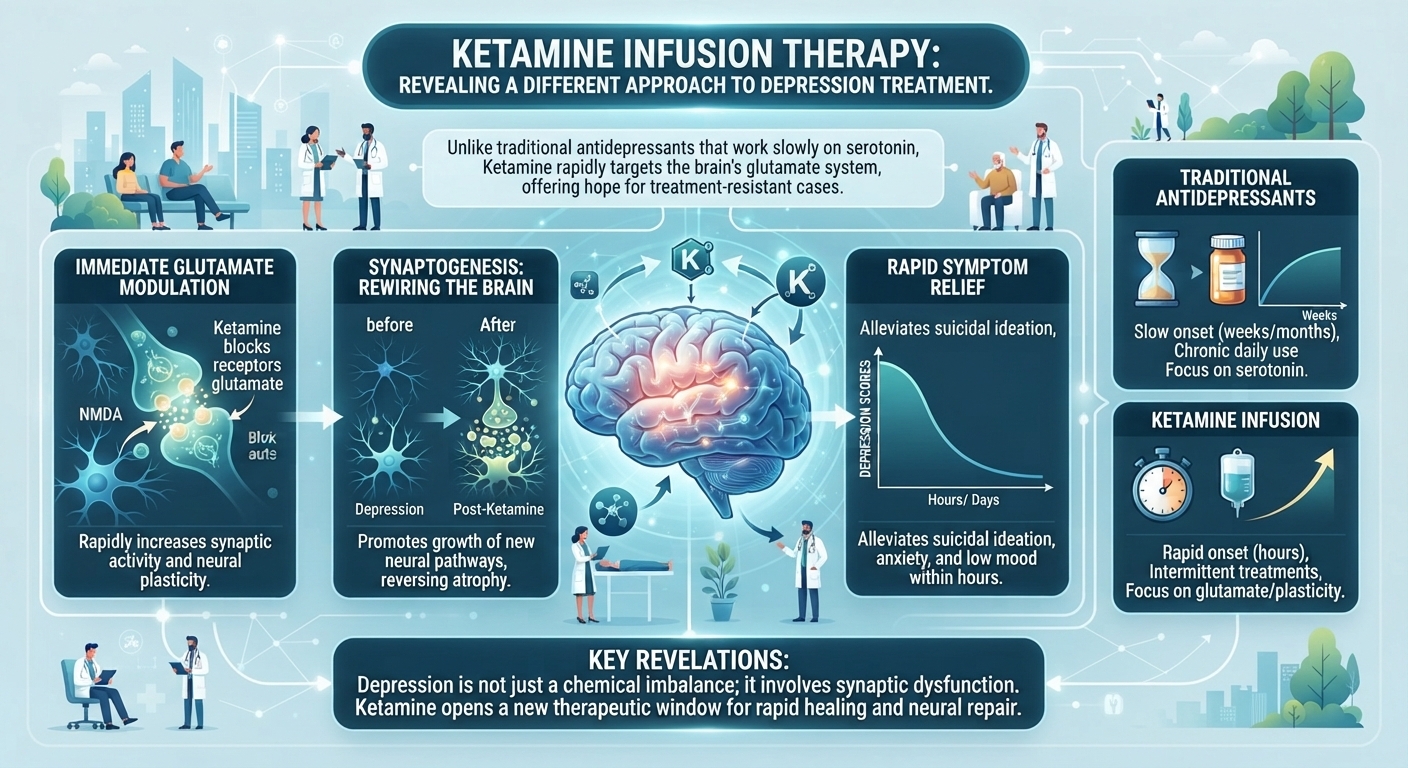
For decades, treating depression has often meant working through a sequence of familiar options. A patient starts an antidepressant, waits to see how symptoms change, adjusts the dose, switches medications, or adds another treatment when improvement is limited. This approach remains valuable and works well for many people. But when depression persists despite multiple appropriate treatments, repeating the same strategy can start to raise a different question: what if the next treatment needs to work through a different biological pathway? Ketamine Infusion Therapy has become part of that discussion because research into intravenous ketamine has challenged some long-standing assumptions about how quickly antidepressant effects can occur and which brain systems may be involved in depression.l
The significance of ketamine is therefore bigger than the infusion itself. Its study has helped researchers look beyond the mechanisms emphasized by many traditional antidepressants and investigate glutamate signaling, neural communication, and other processes involved in mood regulation. That does not make ketamine a replacement for conventional treatment, nor does it mean every person with depression should receive it. It does show that depression treatment can follow more than one biological route.
Traditional antidepressants remain central to modern psychiatric care. Many commonly used medications influence serotonin, norepinephrine, dopamine, or combinations of these neurotransmitter systems. For some patients, the first medication provides substantial relief. Others need several adjustments before finding an effective treatment, and some continue experiencing significant symptoms despite multiple medication trials.
This last group presents one of psychiatry's more difficult challenges. Persistent symptoms can affect far more than mood. Depression may interfere with sleep, concentration, motivation, relationships, work, self-care, and the ability to participate meaningfully in therapy. When several appropriate treatments have produced limited improvement, clinicians may begin considering whether the patient has treatment-resistant depression and whether another therapeutic strategy deserves attention.
Calling depression treatment resistant should involve more than counting unsuccessful prescriptions. Clinicians may examine whether previous medications were taken at adequate doses and for sufficient periods, whether side effects prevented full treatment trials, and whether other psychiatric or medical conditions could be affecting the response.
Anxiety disorders, bipolar-spectrum illness, trauma-related conditions, sleep problems, substance use, chronic medical conditions, and medication interactions can complicate the clinical picture. A thorough assessment matters because the goal is not simply to move toward a more advanced treatment. It is to understand why previous treatment has not produced the expected improvement and determine what type of intervention now makes the most sense.
The scientific interest surrounding Ketamine Infusion Therapy comes partly from ketamine's interaction with the glutamate system. Ketamine is an NMDA receptor antagonist, and NMDA receptors are involved in signaling by glutamate, the brain's major excitatory neurotransmitter. Research continues to investigate exactly how ketamine produces antidepressant effects, and the complete mechanism should not be reduced to one simple explanation.
This differs from the simplified story often associated with conventional antidepressants, where attention historically centered heavily on monoamine neurotransmitters such as serotonin and norepinephrine. Ketamine research helped broaden the discussion toward neural signaling, synaptic function, and the way networks of brain cells communicate and adapt.
The interest in glutamate does not mean that older theories of depression suddenly became irrelevant. Depression is too biologically complex to explain through a single neurotransmitter. Instead, ketamine provided evidence that researchers needed to investigate additional pathways when trying to understand why some people respond poorly to traditional treatments.
Experimental and clinical research has examined how ketamine may influence processes involved in synaptic communication and plasticity. Early NIMH-supported research also explored changes in neural connections associated with ketamine's rapid antidepressant effects. These findings helped open a broader scientific conversation about what an antidepressant mechanism can look like.
Another reason intravenous ketamine drew substantial attention was the speed of improvement observed in some clinical studies. Traditional antidepressants often require repeated daily dosing and several weeks before their effects can be properly evaluated. Research involving subanesthetic intravenous ketamine has shown that depressive symptoms can improve much sooner in some patients, including within hours or within a day following treatment.
That difference has major scientific importance, but it also requires careful interpretation. Faster potential improvement does not mean every patient responds quickly, and it certainly does not mean ketamine should be described as an instant cure. Some people experience a substantial response, some experience partial improvement, and others do not receive enough benefit to continue treatment.
One of the central challenges with ketamine is that a rapid antidepressant effect does not automatically mean the improvement will persist indefinitely. Research has explored repeated and maintenance infusions partly because the benefits following a single infusion can be temporary for some patients. (
This distinction changes how treatment should be discussed. A dramatic improvement shortly after an infusion can be clinically meaningful, but clinicians still need to consider durability. They may monitor whether symptoms return, how long benefits persist, how repeated treatment affects the patient, and whether the overall treatment plan remains appropriate over time.
Ketamine infusion treatment for depression typically involves administering ketamine intravenously at doses below those traditionally used for anesthesia. The intravenous route allows clinicians to deliver the medication in a controlled medical setting while monitoring the patient throughout the treatment process.
It is important to understand the regulatory distinction surrounding this treatment. Ketamine itself is FDA-approved as an anesthetic, but it is not FDA-approved specifically for treating depression or other psychiatric disorders. When clinicians use intravenous ketamine for depression, they are using the medication off-label. Off-label prescribing is a recognized part of medical practice, but patients should understand what it means and why clinical oversight matters.
Ketamine infusion therapy should also not be confused with Spravato simply because the treatments are chemically related. Spravato contains esketamine and is administered as a nasal spray under a specific FDA-approved treatment framework for certain depressive conditions. Intravenous ketamine uses ketamine itself and follows a different regulatory pathway.
The differences affect administration, dosing, clinical protocols, insurance considerations, and regulatory status. Patients comparing the two should therefore discuss the actual treatment options with a qualified clinician rather than assuming that all ketamine-based treatments are interchangeable.
Ketamine can temporarily alter perception and awareness. During an infusion, some patients may experience dizziness, changes in visual or sensory perception, unusual awareness of time or surroundings, nausea, or a feeling of detachment from themselves or their environment. This feeling of detachment is commonly described as dissociation.
The intensity of these effects varies. One person may notice only mild perceptual changes, while another may experience a more pronounced shift in awareness. Appropriate clinical monitoring matters because ketamine can also affect physiological measures such as blood pressure, and clinicians need to consider a patient's medical status before and during treatment.
It is tempting to assume that a powerful or unusual infusion experience means the treatment is working more effectively. That conclusion is too simplistic.
The clinically meaningful question is what happens to depression after treatment. Does hopelessness become less intense? Does motivation improve? Can the person concentrate more effectively? Are normal responsibilities becoming manageable again? Is the patient becoming more engaged in therapy, relationships, or everyday life?
An unusual experience during an infusion may be memorable, but it is not the same thing as a sustained antidepressant response.
Depression does not always disappear in one dramatic moment. Even when a treatment helps, improvement may first become noticeable through changes in everyday functioning. A person might start answering messages they had ignored for weeks, preparing meals more consistently, completing work, leaving the house more often, or reconnecting with people they had withdrawn from.
For someone living with persistent depression, these apparently small changes can be significant. Severe depression often erodes normal life gradually. Motivation declines, activities become harder, relationships require more effort, and even routine decisions can feel overwhelming. Meaningful treatment should therefore be evaluated not only by how a person reports their mood but also by whether life is becoming more manageable.
Ketamine infusion therapy should not be presented as a treatment that works simply because traditional antidepressants did not. Clinical trials have demonstrated rapid antidepressant effects in some people with treatment-resistant depression, but individual outcomes vary.
Some patients may experience substantial improvement. Others may receive partial benefits that still leave significant symptoms. Some may not respond sufficiently, while others may respond initially but find that symptoms begin returning later. These possibilities need to be part of an informed discussion before treatment begins.
A different mechanism does not eliminate the need for careful medical decision-making. Before Ketamine Infusion Therapy, a clinician may evaluate psychiatric history, previous treatments, current medications, cardiovascular health, blood pressure, substance-use history, and other medical factors that could influence safety.
Ketamine also has abuse and misuse potential and is classified as a Schedule III controlled substance in the United States. This does not mean appropriately supervised medical treatment should be equated with recreational ketamine use. It does mean clinicians and patients need to treat the medication with appropriate seriousness.
The growing interest in ketamine has also created considerable variation in how treatment is marketed and delivered. Patients should look beyond promises about rapid results and examine the quality of clinical care surrounding the medication.
A responsible treatment model should include appropriate screening, medical supervision, monitoring, realistic expectations, and follow-up. Ketamine should not be marketed as a guaranteed transformation, and treatment decisions should not be based primarily on dramatic testimonials or social media descriptions of the infusion experience.
One of the biggest mistakes in discussing newer depression treatments is treating them as replacements for everything that came before. Ketamine Infusion Therapy may provide another treatment pathway, but depression remains a complex condition that often requires multiple forms of care.
Psychotherapy can remain important. Existing psychiatric medications may still have a role. Sleep, physical health, relationships, substance use, chronic stress, trauma, and coexisting psychiatric conditions may all need attention. A successful infusion does not automatically resolve these areas.
Where ketamine treatment becomes particularly interesting is what may happen if symptoms improve enough for a person to engage more effectively with the rest of treatment. Someone who previously lacked the energy to participate in therapy may become more involved. A person who has withdrawn from friends and family may begin reconnecting. Basic routines that once felt impossible may become manageable again.
In that sense, symptom reduction is not necessarily the final destination. It can create an opportunity to rebuild functioning, relationships, habits, and other parts of life affected by depression.
Perhaps the most important thing Ketamine Infusion Therapy has revealed is that depression treatment does not have to follow one pharmacological blueprint. Ketamine research demonstrated that investigating systems beyond the traditional monoamine pathways could produce clinically meaningful discoveries.
That insight has influenced depression research beyond ketamine itself. NIMH research describes ketamine as having helped launch the development of a newer generation of rapid-acting antidepressant approaches and contributed to investigation of additional glutamate-related mechanisms.
The lesson is therefore broader than whether one medication should be used. Ketamine showed that when an established treatment model does not work for everyone, exploring a genuinely different biological approach can expand what clinicians and researchers consider possible.
Traditional antidepressants remain essential treatments for depression, and their value should not be minimized simply because newer approaches exist. But persistent depression has repeatedly shown that one therapeutic model cannot meet every patient's needs. When appropriate antidepressants, psychotherapy, and other conventional strategies have provided insufficient relief, clinicians may need to consider whether a different treatment pathway is justified.
Ketamine Infusion Therapy represents one of the clearest examples of that shift. Its effects on glutamate-related signaling, its different treatment format, and the rapid antidepressant responses observed in some clinical research have challenged assumptions about how depression medications must work and how long meaningful changes must take. At the same time, ketamine is not FDA-approved specifically for depression, response is not guaranteed, benefits may not always be durable, and treatment requires careful medical evaluation and monitoring.
What ketamine ultimately reveals is not that traditional antidepressant treatment was wrong. It reveals that the biology of depression is more complicated than any single treatment framework can capture. For appropriately selected patients, medically supervised Ketamine Infusion Therapy may offer a different route when familiar approaches have not been enough. More broadly, it reminds us that progress in depression care often begins when researchers and clinicians become willing to ask a different question rather than simply repeat the same answer.


