English
 Arabic
 French
 Spanish
 Portuguese
 Deutsch
 Turkish
 Dutch
Dutch
 Italiano
 Russian
 Romaian
 Portuguese (Brazil)
 Greek
Greek
Major Depressive Disorder Drugs Market: Breakthrough Therapies Set to Transform Treatment Outlook
Health |
2025-07-08 13:52:01
 Social Networth OS
 Creator Commerce
 Launch Startup
 Global News
 Creator Award
 Talkfever App
Mostra tutti i risultati
Talkfever App
Mostra tutti i risultati

Passa a Pro
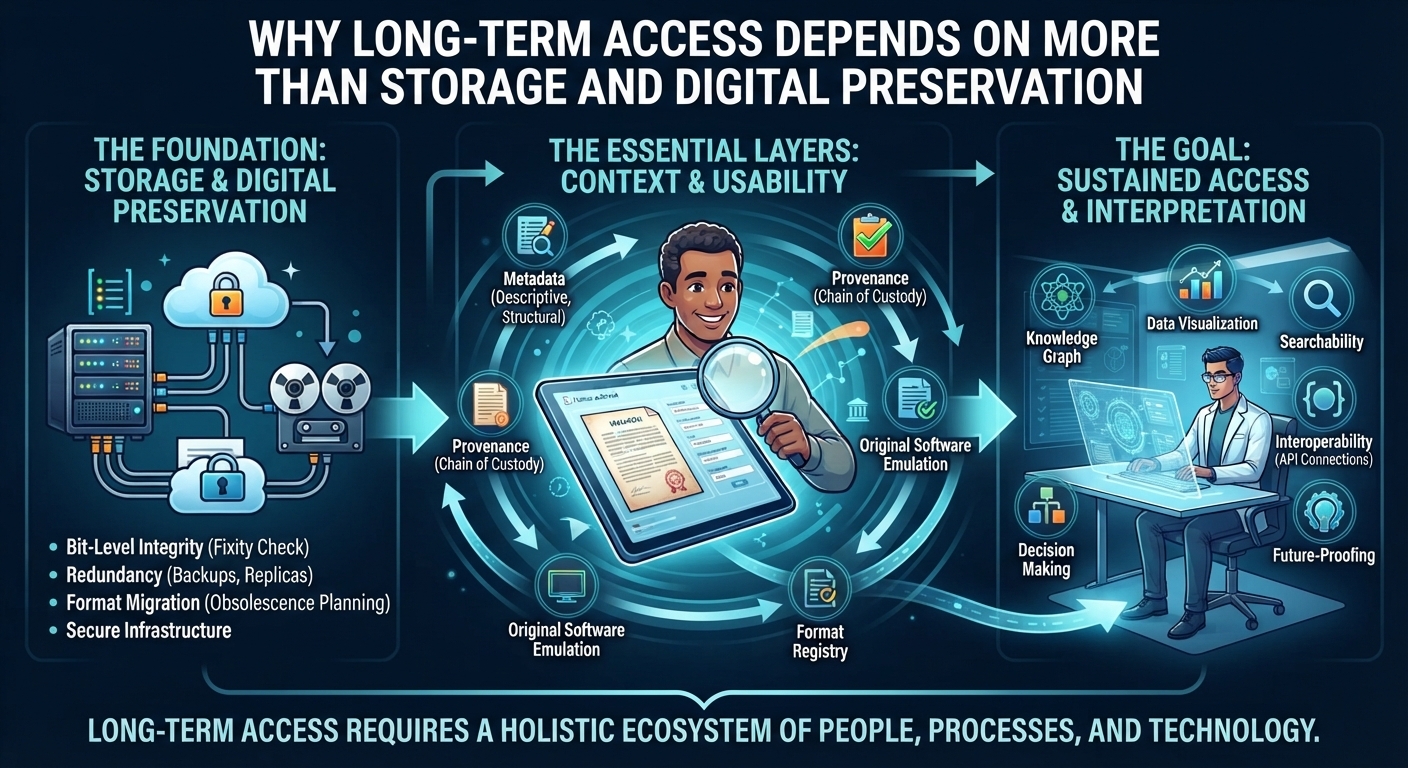
Keeping a digital file is easy. Keeping it usable, understandable, trustworthy, and accessible for ten, twenty, or thirty years is much harder. Organizations often assume that once information has been moved into secure storage, the preservation problem is solved. In reality, storage only protects the physical existence of the data. Long-term access depends on whether that information can still be opened, interpreted, verified, governed, and connected to its original context years after the technology that created it has changed. This is why digital preservation has become a broader information management discipline rather than a simple backup or storage function. The real objective is not merely to keep data from disappearing. It is to make sure important records continue to serve their legal, operational, historical, and compliance purposes throughout their required lifetime.
A storage system can preserve the binary data that makes up a file, but that does not guarantee that future users will understand what the file represents. A document may survive perfectly while the surrounding information needed to interpret it disappears. A contract, for example, may still be available as a PDF years later, but employees may no longer know which customer it belongs to, whether it is the final version, when it became effective, or which retention rule applies. This is one of the central challenges of long-term preservation. Organizations need to protect not only the file itself but also the metadata, relationships, classification, ownership, and business context that make the record meaningful. Without that context, information can technically survive while becoming operationally useless.
Digital information exists inside constantly changing technology environments. File formats evolve, operating systems are replaced, applications are discontinued, vendors disappear, storage technologies change, and encryption methods eventually become outdated. A document created in a proprietary format today may become difficult to open years later if the original software is no longer supported. The same problem can affect databases, multimedia files, engineering records, system exports, email archives, and digitally signed documents. Effective preservation therefore requires organizations to think beyond the current technology stack. They need to consider whether records can be migrated, converted, or represented in formats that remain accessible over time. The challenge is not predicting every future technology change. It is building preservation processes that can respond when those changes happen.
One of the clearest examples of the difference between storage and preservation is file format obsolescence. A business may retain millions of old documents without corruption, yet still struggle to open them because the applications required to interpret those formats are no longer available. Proprietary file types create particular risk when organizations depend on one vendor or application to read historical records. Long-term preservation strategies therefore need to consider format sustainability from the beginning. In some cases, organizations may convert records into more durable formats. In others, they may maintain the original file while also preserving a standardized representation. The right approach depends on the type of record, its evidentiary value, the retention period, and the importance of preserving specific features. The critical point is that storage alone does not solve future readability.
A document without metadata can quickly become difficult to manage. Metadata provides information about the record, including who created it, when it was created, what business process it belongs to, which version is authoritative, who can access it, and how long it should be retained. Over time, this information becomes even more valuable because the people who originally understood the record may no longer be available. In a strong digital preservation environment, metadata helps maintain continuity between the record's original business context and its future use. It can also support discovery, retention, auditability, access control, and migration. When organizations preserve files but lose metadata during system transitions, they often discover that they have retained documents without retaining enough information to use them effectively.
Long-term access is not useful if users cannot trust the information they retrieve. Organizations therefore need mechanisms that help demonstrate whether a record has changed since it was preserved. Integrity controls may include checksums, cryptographic hashes, controlled ingestion processes, audit trails, timestamps, and validation procedures. These mechanisms allow an organization to identify accidental corruption or unauthorized modification. This becomes increasingly important as records move through storage migrations, application changes, cloud transitions, and archive platforms. The longer the retention period, the more opportunities exist for information to be altered or damaged. Preservation therefore requires an ongoing ability to verify the state of a record rather than simply assuming that a stored copy remains unchanged.
Digitally signed records introduce another important challenge. A document may remain accessible long after the certificates, validation services, or cryptographic technologies used during signing have changed. The visible signature itself may not provide enough evidence to establish why the record was considered trustworthy when it was signed. Organizations may need to preserve related validation information, timestamps, certificate data, and other evidence that supports future verification. This is especially important for agreements, regulated records, approvals, and transactions that may later be reviewed during audits, disputes, or legal proceedings. Preserving the document without preserving the evidence surrounding its signature can weaken the long-term reliability of the record.
Legacy systems often contain information that businesses must retain long after the application itself has become obsolete. Organizations sometimes keep old systems running simply because employees still need access to historical records. This creates unnecessary infrastructure costs, cybersecurity exposure, licensing expenses, and dependence on outdated technical expertise. Moving records out of a legacy application can solve part of that problem, but only when the migration preserves enough structure and context. Exporting files into a basic storage location may separate documents from customer records, transaction histories, audit data, retention rules, or case relationships. A preservation-focused retirement process should retain the information needed to understand and retrieve those records without depending indefinitely on the original application.
Long-term access does not mean unrestricted access. Archived records may contain personal information, financial data, contracts, employee records, intellectual property, or other sensitive content. Preservation systems therefore need to maintain appropriate access controls throughout the retention period. This becomes challenging when organizational structures change. Employees leave, departments merge, roles are renamed, and identity platforms are replaced. A record preserved for fifteen years may pass through several generations of access management systems. Preservation planning should account for this reality by ensuring that permissions and governance rules can be maintained or translated as systems change. The objective is to keep records accessible to the right people without allowing historical information to become broadly exposed.
A common misconception is that preservation means moving information somewhere secure and leaving it untouched. Long-term preservation is actually an active process. Organizations may need to monitor storage health, verify file integrity, review format risks, update metadata, migrate content, refresh access controls, and respond to changes in legal or regulatory requirements. Records that remain untouched for decades may be more vulnerable than records managed through a controlled preservation lifecycle. The preservation environment should therefore be designed to evolve. The objective is continuity, not immobility.
Preserving every piece of information forever is neither practical nor responsible. Organizations need to distinguish between records that must remain available and data that should eventually be deleted. Retention schedules define how long different categories of information should be kept, while preservation ensures that records remain usable during that period. When these disciplines are disconnected, businesses can create two opposite problems. They may delete information before its obligations expire, or they may retain unnecessary data indefinitely. Both can create legal, privacy, security, and operational risks. A mature preservation strategy therefore connects long-term accessibility with controlled disposition.
Backups are essential for disaster recovery, but they serve a different purpose. A backup helps restore systems or files after accidental deletion, corruption, ransomware, or infrastructure failure. It is generally designed to recover a previous operational state. Preservation focuses on maintaining selected records over extended periods while protecting their usability, context, integrity, and governance. A backup copy may contain the file, but it may not contain the metadata, retention controls, audit evidence, migration strategy, or format planning required for long-term access. Treating backups as archives can create false confidence because recovery and preservation solve different problems.
The best way to understand long-term preservation is to think about the future user. That person may not know the systems, employees, vendors, or business processes that exist today. They may be investigating a transaction from twenty years earlier, responding to an audit, reviewing an old contract, verifying a signed document, or retrieving historical evidence after a system has been retired. The preservation strategy should make it possible for that future user to find the correct record, understand what it represents, trust that it has not been improperly altered, and access it without reconstructing obsolete technology. That is a much higher standard than simply proving that the file still exists.
Long-term access requires more than durable storage because digital information depends on context, technology, integrity, metadata, governance, and continued usability. A file can remain perfectly intact while becoming impossible to interpret, verify, or retrieve effectively. Digital preservation addresses that broader challenge by protecting the information and the evidence needed to keep it meaningful over time. Organizations that plan for format change, system retirement, metadata continuity, access control, integrity verification and appropriate retention are better positioned to maintain reliable records for as long as those records matter. The goal is not to keep data forever. It is to make sure important information remains useful and trustworthy throughout the entire period in which the organization is expected to rely on it.