English
 Arabic
 French
 Spanish
 Portuguese
 Deutsch
 Turkish
 Dutch
Dutch
 Italiano
 Russian
 Romaian
 Portuguese (Brazil)
 Greek
Greek
 IMS for Investors
 Global News
 Vdo Junction
 Talkfever App
 Upcoming
Portable Grinders Market Opportunity Analysis Report 2025: Regional Markets and Segments
Other |
2025-04-21 07:27:54
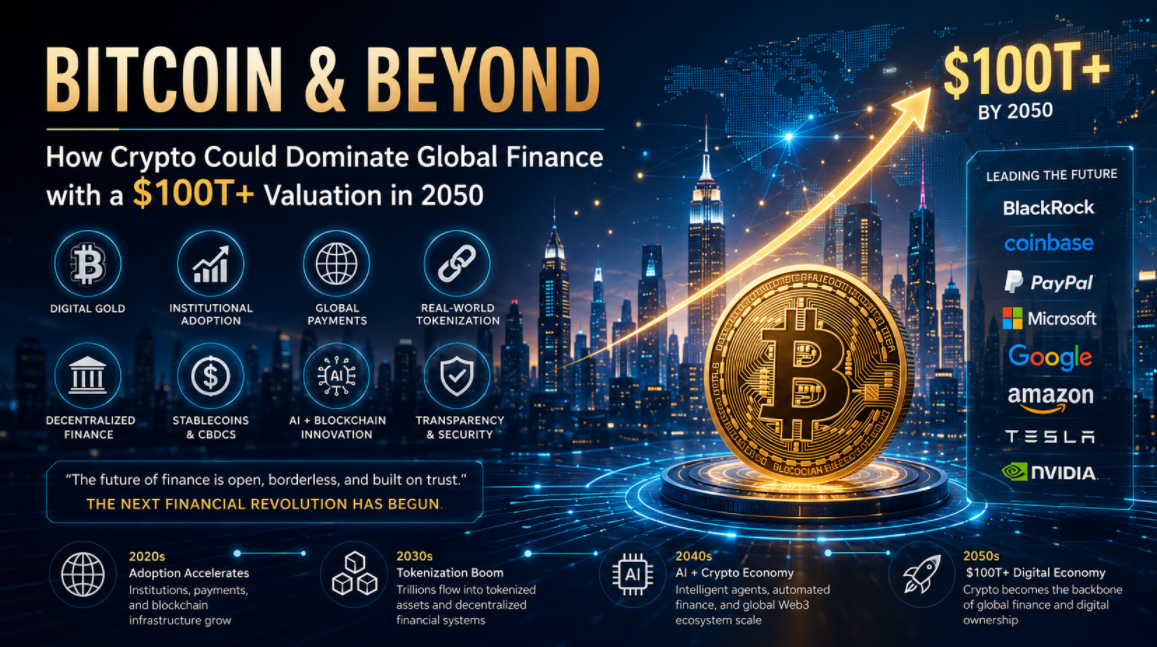
For more than a decade, cryptocurrencies have evolved from an experimental digital payment system into one of the world's fastest-growing financial innovations. What began with Bitcoin in 2009 has now expanded into an ecosystem of digital assets, decentralized finance (DeFi), tokenized real-world assets, stablecoins, and blockchain-powered applications.
Today, the global cryptocurrency market is valued at several trillion dollars. Yet many institutional analysts, venture capital firms, and technology leaders believe this is only the beginning. If blockchain technology achieves widespread adoption across banking, investing, commerce, and government infrastructure, the total crypto economy could surpass $100 trillion by 2050, making it one of the largest financial asset classes in history.
But how realistic is this projection? What forces could drive such extraordinary growth? Let's explore the practical roadmap.
Every major technological revolution reshapes finance.
Blockchain represents the next stage of financial evolution.
Instead of relying solely on centralized institutions, blockchain allows secure, transparent, peer-to-peer financial transactions without requiring traditional intermediaries.
Bitcoin introduced digital scarcity.
Ethereum introduced programmable money.
Now thousands of blockchain projects are building the infrastructure for tomorrow's financial system.
Several powerful trends support the long-term growth thesis.
Bitcoin has increasingly become recognized as a scarce digital asset.
With only 21 million BTC ever to exist, many investors compare Bitcoin to digital gold.
As inflation concerns continue and governments expand money supply, institutions increasingly seek scarce assets for long-term wealth preservation.
If Bitcoin captures even a significant portion of gold's global wealth storage market, its valuation could increase dramatically.
One of blockchain's biggest opportunities lies in tokenizing traditional assets.
Imagine owning fractions of:
Instead of complicated paperwork and intermediaries, ownership could exist directly on blockchain.
Industry experts estimate tokenized assets alone may represent tens of trillions of dollars over the coming decades.
Traditional banking involves multiple intermediaries.
Blockchain removes many of these layers.
Users can:
—all without visiting a bank.
As regulations mature, DeFi could become an alternative financial infrastructure serving billions worldwide.
Stablecoins have rapidly become one of crypto's largest real-world use cases.
Businesses increasingly use them for:
Compared to traditional wire transfers, stablecoins offer near-instant settlement with significantly lower costs.
Many analysts believe stablecoins will eventually process trillions of dollars annually.
The convergence of AI and blockchain could unlock entirely new industries.
AI systems require:
Blockchain provides these capabilities.
Future AI agents may autonomously:
without human intervention.
This machine-to-machine economy could become one of blockchain's largest growth drivers.
Perhaps the strongest bullish indicator is institutional participation.
Major asset managers, investment firms, pension funds, hedge funds, and multinational corporations are increasingly allocating capital to digital assets.
Large financial institutions now offer:
As institutional confidence grows, liquidity, regulation, and market maturity improve simultaneously.
Rather than banning crypto entirely, many governments are building regulatory frameworks.
Central Bank Digital Currencies (CBDCs) are being researched globally.
Although CBDCs differ from decentralized cryptocurrencies, they familiarize billions of people with blockchain-based financial systems.
Clear regulation may become one of crypto's strongest catalysts.
Imagine an average individual in 2050.
Their financial life could look like this:
Most users may never even realize blockchain is operating behind the scenes—just as many people use the internet today without understanding TCP/IP.
Several global technology and financial giants are investing heavily in blockchain innovation.
Leading players include:
These companies illustrate that blockchain is no longer a niche technology—it is becoming part of mainstream digital infrastructure.
Despite its enormous potential, crypto faces significant challenges.
Key risks include:
Long-term success depends on responsible innovation, stronger security, and balanced regulation.
A $100 trillion crypto economy may sound ambitious today, but transformative technologies often appear unrealistic in their early stages.
If blockchain captures meaningful portions of:
then a multi-decade expansion toward a $100 trillion valuation becomes a plausible long-term scenario rather than pure speculation.
The journey is unlikely to be linear. Volatility, regulation, and technological shifts will shape the path. However, history suggests that technologies solving real-world problems tend to compound in value over time.
Bitcoin sparked the digital asset revolution, but the future of crypto extends far beyond a single cryptocurrency. Blockchain technology is steadily transforming payments, investing, ownership, and financial infrastructure. As institutions, governments, and technology leaders continue embracing decentralized systems, the crypto economy could evolve into one of the defining pillars of global finance by 2050.
Whether or not the market ultimately surpasses $100 trillion, the broader trend is clear: digital assets are moving from the fringe toward the financial mainstream. Investors, businesses, and policymakers who understand this transition early may be better positioned to navigate—and benefit from—the next era of economic innovation.
Yes, it is possible if blockchain becomes deeply integrated into global payments, finance, asset tokenization, and AI-driven digital economies. However, this remains a long-term projection rather than a certainty.
Bitcoin has a fixed supply of 21 million coins, making it scarce. Many investors view it as a hedge against inflation and a long-term store of value, similar to physical gold.
AI could use blockchain for secure data sharing, automated payments, smart contracts, and machine-to-machine transactions, creating entirely new economic models.
Finance, real estate, healthcare, supply chain management, insurance, gaming, digital identity, government services, and artificial intelligence are among the leading sectors expected to benefit.
Regulatory changes, cybersecurity threats, technological challenges, market volatility, and competition from government-backed digital currencies remain the primary obstacles to widespread adoption.