English
 Arabic
 French
 Spanish
 Portuguese
 Deutsch
 Turkish
 Dutch
Dutch
 Italiano
 Russian
 Romaian
 Portuguese (Brazil)
 Greek
Greek
Digital Remittance market was valued at USD 78.3 billion in 2025 and is projected to reach USD 147.9 billion by 2034,
Other |
2026-08-22 09:05:15
 Social Networth OS
 Creator Commerce
 Launch Startup
 Global News
 Creator Award
 Talkfever App
Alle anzeigen
Talkfever App
Alle anzeigen

Upgrade auf Pro
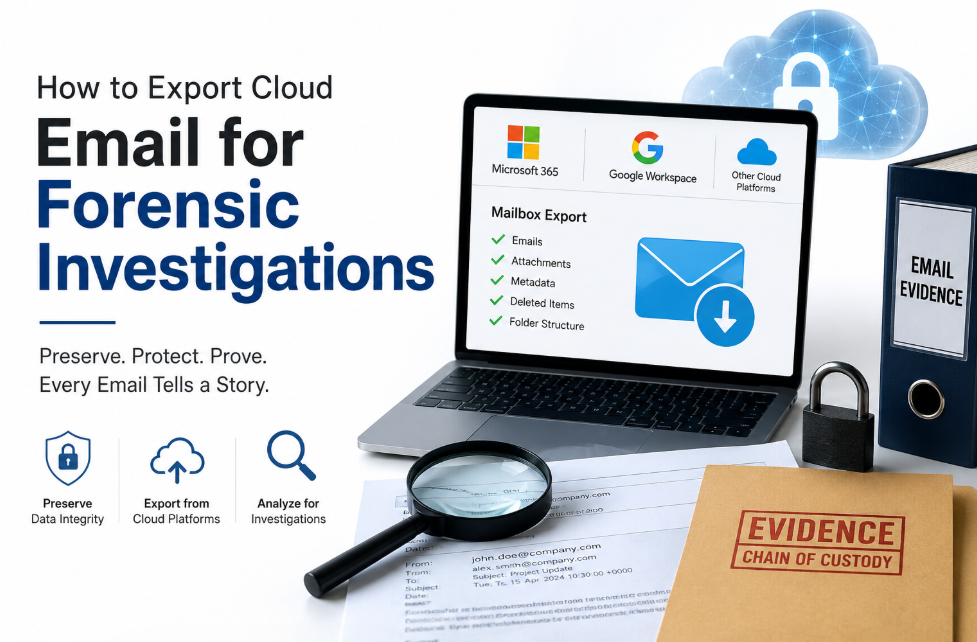
Every day, organizations generate millions of emails across cloud platforms like Microsoft 365, Google Workspace, and other hosted services. Buried within this constant stream of communication are timestamps, attachments, sender-receiver relationships, and conversation threads that often become the single most important piece of evidence in a corporate investigation, litigation matter, or cybercrime case. As businesses move further away from on-premises servers and deeper into the cloud, digital forensic investigators are being forced to rethink how they collect, preserve, and analyze this data.
Unlike physical evidence, cloud-based email is dynamic. It can be altered, deleted, or rendered inaccessible the moment an account is suspended, a license expires, or an administrator makes a configuration change. This volatility is exactly why forensic professionals treat email preservation as one of the earliest and most critical steps in any investigation — long before deeper analysis or reporting begins.
Email remains the primary communication channel inside most organizations, which makes it a goldmine for investigators trying to reconstruct a sequence of events. Whether the case involves internal fraud, intellectual property theft, harassment claims, regulatory audits, or a full-scale data breach, the email trail frequently tells the story that no other data source can.
A few scenarios illustrate why this matters so much:
Litigation and regulatory compliance. Courts and regulators increasingly expect organizations to produce complete, defensible email records on demand. Incomplete or improperly preserved data can weaken a legal position or even result in sanctions.
Insider threat and fraud investigations. Employees planning to leave an organization, or those engaged in wrongdoing, often leave behind digital footprints in their sent items, drafts, and deleted folders that reveal intent.
Compromised accounts. When an admin or executive account is breached, attackers can quietly delete or modify messages to cover their tracks. Having a preserved, hash-verified copy of the mailbox allows investigators to compare what existed before and after the incident.
Vendor and third-party disputes. Email often serves as the only written record of agreements, approvals, or instructions exchanged between organizations, making it central to contractual disputes.
In each of these situations, the integrity of the underlying data is just as important as its content. If an investigator cannot prove that an email record hasn't been tampered with, its evidentiary value collapses.
Traditional, on-premises mail servers gave IT administrators direct access to mailbox stores, making export and preservation relatively straightforward. Cloud-hosted platforms operate very differently. Data lives across distributed infrastructure, access is governed by strict permission models, and native export tools are often limited, slow, or missing altogether.
Microsoft 365, for example, does not provide a simple one-click way to export a mailbox for offline preservation. Investigators typically have to rely on a combination of compliance tools, scripting, and administrative permissions just to pull a single custodian's mailbox into a portable, reviewable format. This is precisely the gap that guides like Export Office 365 Mailbox to PST are designed to address — walking investigators and IT teams through the available options, from built-in compliance search tools to scripting workarounds, so that mailbox data can be captured accurately and preserved in a format suitable for offline review.
The challenge isn't just technical access, though. Cloud exports also raise questions around scale, deduplication, metadata preservation, and chain of custody — all of which matter enormously once that data is presented as evidence.
Simply getting a copy of a mailbox isn't enough. For the data to hold up under scrutiny, the export process needs to preserve several things:
Complete metadata. Timestamps, header information, read/unread status, and folder structure all carry investigative value. A poorly executed export can strip away context that later proves critical.
Attachments and embedded content. Investigators frequently need to trace files that were shared via email, which means attachments must be captured intact and linked back to their original messages.
Deleted and archived items. Wrongdoing is rarely documented in the inbox alone. Sent items, drafts, and even recoverable deleted items often contain the most revealing communications.
Verifiable integrity. Once a mailbox has been exported, generating a cryptographic hash of the resulting file allows investigators to prove, at any later point, that the evidence has not been altered since collection.
Scalability across custodians. Corporate investigations rarely involve a single mailbox. Being able to process multiple custodians consistently, without manual repetition for each account, saves time and reduces the risk of human error.
Most organizations start with the tools they already have — admin portals, compliance search features, or desktop email clients. These methods can work for small, one-off exports, but they tend to break down as case complexity grows. Manual processes are time-consuming, require a fair amount of technical know-how, and often fall short when it comes to preserving full metadata or handling multiple mailboxes at once. Desktop client exports, in particular, are limited to whatever is currently cached locally and cannot easily capture organization-wide data.
This is where purpose-built Email Forensics Software becomes valuable. Rather than stitching together several manual steps and hoping nothing gets missed, dedicated forensic platforms are built specifically to handle mailbox acquisition, preservation, and analysis in a single, auditable workflow. These tools typically allow investigators to connect directly to cloud accounts, apply date or keyword filters, pull data from multiple custodians simultaneously, and generate verification reports that document the entire chain of custody — all while keeping the process defensible enough to stand up in legal or regulatory proceedings.
For investigators working under time pressure, especially in cases involving compromised accounts or active litigation holds, this kind of consistency and reliability isn't a luxury — it's a requirement.
Regardless of which method or tool an organization chooses, a few best practices consistently separate defensible investigations from problematic ones:
Act quickly. Cloud data can be altered or lost through routine retention policies, account changes, or malicious activity. The sooner preservation begins, the less risk there is of data loss.
Document every step. From the moment collection begins, investigators should log who accessed what data, when, and how. This documentation becomes essential if the evidence is ever challenged.
Preserve before you analyze. Always create a verified, unaltered copy of the original data before running any analysis, filtering, or review work on it.
Validate integrity at each stage. Hash values should be generated immediately after export and checked again before any evidence is presented or shared.
Plan for scale. Even investigations that start small can expand to include additional custodians or date ranges, so choosing a workflow that scales smoothly saves significant time later.
Does exporting a mailbox change the original data on the server? When done correctly, no. A proper export creates a separate, static copy of the mailbox while leaving the source account untouched. This is why verification hashes matter so much — they prove that the copy accurately reflects the original state of the data at the moment of collection, and that nothing has changed since.
Can deleted emails still be recovered from a cloud mailbox? In many cases, yes, depending on how much time has passed and what retention policies are in place. Items sitting in a "Recoverable Items" or similar folder may still be accessible for a limited window after deletion, which is another reason speed matters once an investigation begins.
Is a PST file itself considered forensically sound? A PST file is simply a container format. Its forensic value comes from how it was generated and verified, not the format alone. An export paired with proper documentation, hash verification, and a clear chain of custody carries far more weight than an identical file created without any of that process behind it.
What happens if multiple custodians need to be processed at once? This is usually where manual methods start to show their limits. Repeating a multi-step export process for dozens of mailboxes individually is slow and increases the chance of inconsistency. Purpose-built platforms are generally designed to handle bulk custodian processing with consistent settings applied across every account, which keeps the resulting dataset uniform and easier to defend.
As more organizations shift their communication entirely into the cloud, the way digital forensic investigations are conducted has to evolve alongside it. Preserving cloud-based email isn't just a technical task — it's a foundational step that determines whether the evidence gathered will hold up to scrutiny weeks, months, or even years down the line. Whether a team relies on native compliance tools, scripting, or dedicated forensic software, the priority should always be the same: capture the data completely, preserve it verifiably, and document the process every step of the way. Getting this stage right sets the foundation for every conclusion an investigation ultimately reaches.