English
 Arabic
 French
 Spanish
 Portuguese
 Deutsch
 Turkish
 Dutch
Dutch
 Italiano
 Russian
 Romaian
 Portuguese (Brazil)
 Greek
Greek
How Effective Is Stem Cell Therapy for Long-Term Hair Recovery?
Fitness |
2026-05-07 05:54:12
 Social Networth OS
 Creator Commerce
 Launch Startup
 Global News
 Creator Award
 Talkfever App
عرض كل النتائج
Talkfever App
عرض كل النتائج

ترقية الحساب
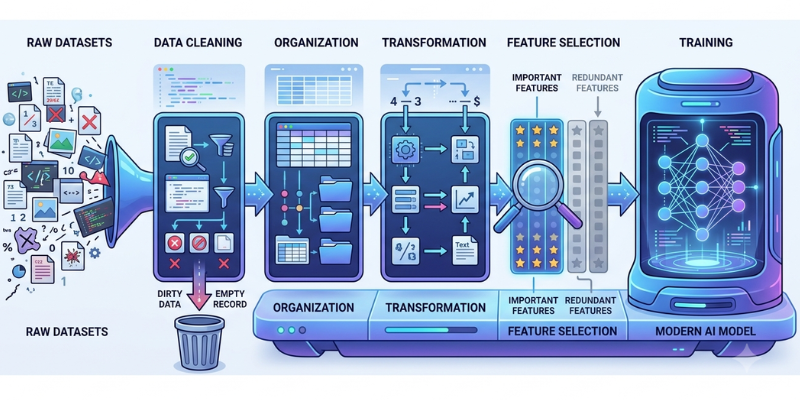
Artificial intelligence depends on data to learn patterns, identify relationships, and produce useful results. However, raw data is rarely ready for direct use in an AI system. It may contain missing values, duplicate records, errors, or inconsistent formats. Proper data preparation helps turn this raw information into a reliable dataset that an AI model can understand. If you want to build a strong foundation in this field, you can enroll in an Artificial Intelligence Course in Trivandrum at FITA Academy to develop practical AI skills.
Data preparation is the process of collecting, organizing, cleaning, and transforming data before using it to train an AI model. The quality of this process can have a major effect on how well the model performs.
For beginners, it is useful to think of data preparation as getting ingredients ready before cooking. Even the best recipe cannot produce a good meal if the ingredients are damaged or poorly prepared. Similarly, an advanced AI algorithm may produce unreliable results when it receives poor-quality data.
AI models learn from the examples provided during training. When those examples contain errors or unnecessary information, the model may learn incorrect patterns. This can reduce accuracy and make predictions less dependable.
Good data preparation can improve the consistency, usefulness, and reliability of a dataset. It can also help reduce unnecessary complexity and make the training process more efficient. For this reason, data preparation is one of the most important steps in an artificial intelligence workflow.
The first step is to collect data that is relevant to the problem being solved. The type of data needed depends on the AI application. A recommendation system may require information about user preferences, while an image recognition system may need a large collection of labeled images.
Data should come from reliable sources and represent the situations the AI system will encounter. A dataset that does not reflect real-world conditions can lead to weak or misleading results.
Raw datasets often contain missing information, duplicate entries, incorrect values, and inconsistent formats. Data cleaning focuses on identifying and addressing these problems.
Missing values may need to be filled, removed, or handled using an appropriate strategy. Duplicate records should be identified so that the same information does not influence the model more than necessary. Inconsistent formats should also be standardized to make the dataset easier for an AI model to process.
Different AI models work better when data is represented in suitable formats. Data transformation may involve converting categories into numerical representations, adjusting numerical values, or organizing information into a consistent structure.
This stage helps the model process different types of information more effectively. It also makes the dataset more suitable for the mathematical operations used during machine learning.
A prepared dataset is commonly divided into separate portions for different purposes. Training data helps the model learn patterns, while testing data helps evaluate how well the trained model performs on information it has not previously seen.
Keeping these datasets separate provides a more realistic understanding of model performance. It can also help identify situations where a model performs very well on training examples but struggles with new data.
Data preparation also involves checking whether the dataset contains unwanted bias. If certain groups, situations, or outcomes are poorly represented, an AI model may learn patterns that do not work fairly across different cases. Reviewing the dataset carefully can help identify gaps and improve representation. If you want to strengthen your understanding through structured learning, consider taking an Artificial Intelligence Course in Kochi to explore AI concepts and practical data preparation skills.
Not every piece of available information is equally useful for an AI model. Feature selection involves identifying the data elements that are most relevant to the problem.
Removing unnecessary information can make a dataset easier to manage and may help the model focus on meaningful patterns. At the same time, important features should not be removed simply because they appear complex. Data preparation requires a balance between simplicity, relevance, and completeness.
Effective data preparation should be systematic and carefully reviewed. Teams should understand where their data comes from, check its quality, document important transformations, and regularly review datasets as new information becomes available.
It is also important to consider privacy and security when working with sensitive information. Responsible data handling helps create AI systems that are not only effective but also trustworthy.
Data preparation for artificial intelligence is much more than cleaning a spreadsheet. It is a fundamental process that helps AI models learn from useful, accurate, consistent, and representative information. From data collection and cleaning to transformation, splitting, and quality checks, each stage contributes to better AI development. A strong understanding of data preparation can help beginners approach machine learning and artificial intelligence with greater confidence. If you are ready to build deeper knowledge and practical skills, explore an Artificial Intelligence Course in Pune to learn AI fundamentals and develop your understanding of real-world AI workflows.