English
 Arabic
 French
 Spanish
 Portuguese
 Deutsch
 Turkish
 Dutch
Dutch
 Italiano
 Russian
 Romaian
 Portuguese (Brazil)
 Greek
Greek
Global Visa Outsourcing Services market was valued at USD 3.25 billion in 2025
Other |
2026-08-13 09:43:42
 Social Networth OS
 Creator Commerce
 Launch Startup
 Global News
 Creator Award
 Talkfever App
عرض كل النتائج
Talkfever App
عرض كل النتائج

ترقية الحساب
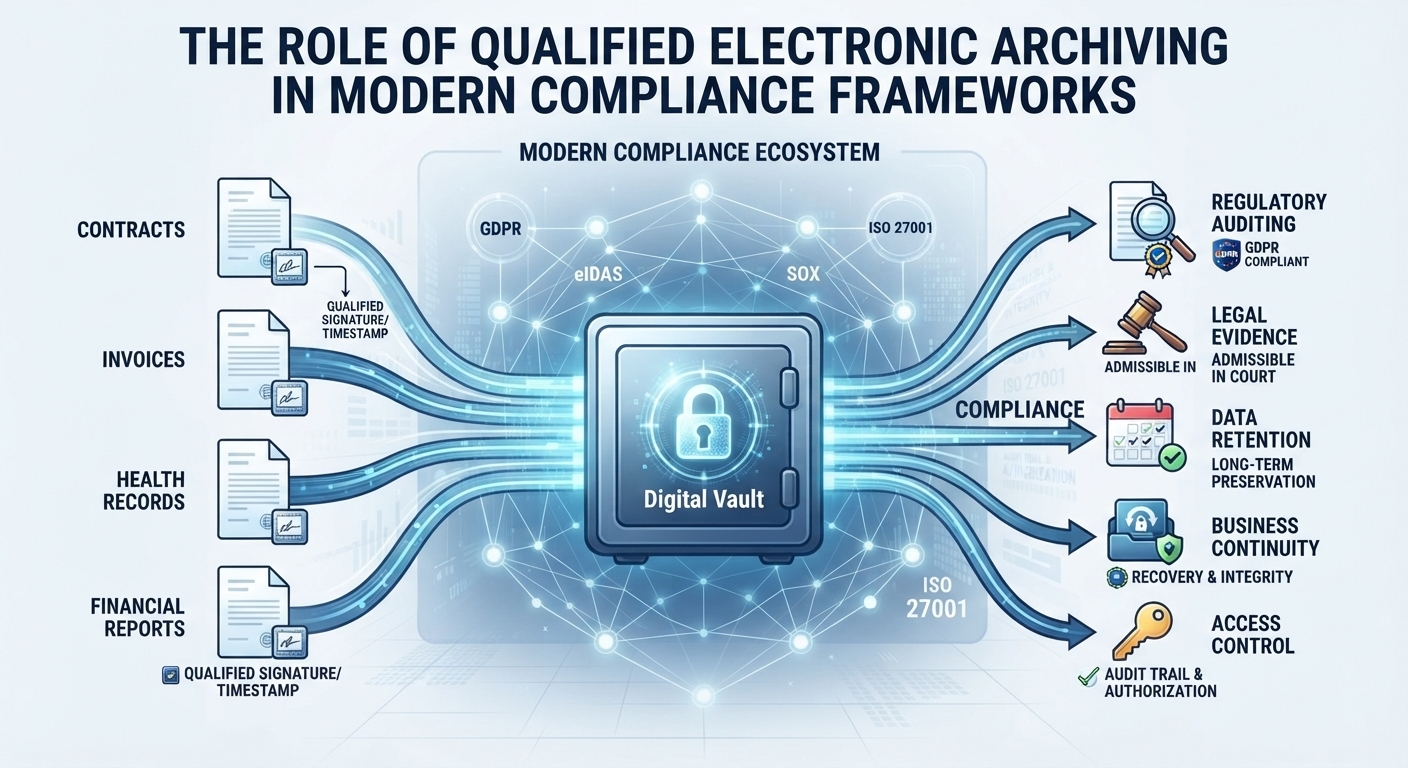
Organizations today operate in an environment where digital records have become central to almost every business process. Contracts are signed electronically, financial transactions happen through digital platforms, customer interactions are recorded online, and regulatory documents are created and exchanged without physical copies.
While this shift has improved efficiency, it has also created a new compliance challenge: ensuring that digital records remain trustworthy, accessible, and legally reliable over long periods. Qualified Electronic Archiving plays an important role in modern compliance frameworks by helping organizations preserve digital records with the controls needed to maintain authenticity, integrity, confidentiality, and long-term accessibility. Instead of treating archives as simple storage locations, qualified electronic archiving focuses on protecting records as reliable evidence throughout their entire lifecycle.
Many organizations assume compliance simply means retaining required documents for a specific period. However, modern compliance requirements are much broader.
A company may need to prove:
that a record existed at a specific time
that the information has not been improperly altered
that the correct version is being presented
that access was properly controlled
that retention rules were followed
that the record can still be understood years later
A document stored in a folder may technically exist, but that does not automatically make it a trustworthy compliance record.
Compliance depends on confidence in the information, not just its availability.
Qualified Electronic Archiving provides a structured approach for maintaining that confidence.
Organizations now create records across many different systems, including:
enterprise applications
customer platforms
electronic signature solutions
financial systems
collaboration tools
cloud services
document management platforms
This creates fragmented information environments.
A single business process may involve multiple records stored across different systems. A contract may begin in a collaboration platform, move through approval workflows, receive a digital signature, and later become subject to long-term retention requirements.
Without a controlled archival strategy, important information can become disconnected.
Qualified Electronic Archiving helps bring structure to this complexity by preserving records together with the context and evidence required for future use.
Authenticity is one of the most important requirements in compliance-driven environments.
Organizations often need to demonstrate that a record is:
the original or authoritative version
created by a known source
preserved without unauthorized changes
connected to the correct business process
This becomes more difficult as time passes.
Employees leave. Systems change. Applications are replaced. Historical context can disappear.
Qualified Electronic Archiving helps maintain authenticity by preserving records with important supporting information, including metadata, provenance details, integrity evidence, and lifecycle history.
This allows future users to understand not only what the record contains but also why it should be trusted.
A compliance record must remain reliable throughout its retention period.
Digital records often move through different environments during their lifecycle. Organizations migrate systems, upgrade platforms, consolidate repositories, and retire applications.
Each transition creates potential risks.
Information can be:
accidentally modified
incorrectly migrated
separated from metadata
duplicated without clear ownership
Qualified Electronic Archiving uses preservation-focused controls to help maintain record integrity over time.
These controls may include:
integrity verification
controlled migration processes
preservation evidence
audit records
validation mechanisms
The objective is ensuring organizations can demonstrate continuity between the original record and the preserved version.
Electronic signatures have become common in contracts, approvals, agreements, and regulated workflows.
However, maintaining a signed document over many years involves more than storing the final file.
Digital signatures depend on technical elements such as:
certificates
timestamps
validation information
cryptographic mechanisms
signing history
These elements may change over time.
Certificates expire. Signing platforms are replaced. Trust technologies evolve.
Qualified Electronic Archiving helps preserve the evidence surrounding digital signatures so organizations can continue proving the reliability of electronic transactions long after the original signing event.
Retention is a fundamental part of compliance.
Organizations must often keep certain records for specific periods while avoiding unnecessary storage of information that no longer serves a legitimate purpose.
Without proper controls, businesses may face two risks:
Deleting records before required retention periods end.
Keeping records indefinitely without justification.
Qualified Electronic Archiving supports structured retention management by connecting records with lifecycle information.
This allows organizations to understand:
why information is retained
which retention rules apply
when retention periods begin
whether legal holds exist
when controlled disposal is appropriate
Effective compliance requires both preservation and responsible removal.
Many compliance situations involve proving historical events.
Examples include:
regulatory inspections
financial audits
legal disputes
contractual reviews
internal investigations
In these situations, organizations may need to demonstrate more than the content of a document.
They may need to show:
where the record came from
who created or approved it
whether it remained unchanged
how it was managed over time
A qualified archive provides stronger evidence because it maintains the record's lifecycle information rather than only preserving the final document.
Metadata is often the difference between a stored file and a managed record.
Without metadata, a document may lose important business meaning.
For compliance purposes, useful metadata can include:
creation date
source system
document classification
business owner
customer or transaction reference
retention category
approval information
access history
This information allows organizations to explain the purpose and history of records years after they were created.
Qualified Electronic Archiving preserves this context so records remain understandable even when original systems no longer exist.
Legacy applications often contain records that organizations are legally required to preserve.
However, retiring these systems can create challenges.
Important information may exist across:
databases
document repositories
workflow histories
audit logs
user permissions
linked records
A simple export may move files while losing the evidence needed for compliance.
Qualified Electronic Archiving provides a way to separate records from obsolete applications while maintaining the controls required for long-term governance.
The application can be retired while the records continue to meet compliance expectations.
Compliance requires organizations to balance availability with security.
Records must be accessible to authorized users but protected from unauthorized access or modification.
This is especially important for information such as:
financial records
personal information
legal agreements
healthcare documents
intellectual property
A qualified archive supports controlled access by applying governance rules around who can retrieve or manage records.
This reduces information risk while maintaining operational availability.
Compliance is often about proving that the right processes were followed.
Audit trails help organizations demonstrate:
when records entered the archive
who accessed information
whether changes occurred
how preservation actions were performed
whether retention rules were applied
Without audit history, organizations may struggle to explain how records were managed.
Qualified Electronic Archiving supports stronger accountability by maintaining evidence of important lifecycle events.
Compliance obligations often last longer than technology platforms.
A document created today may still be required decades later, even though the application used to create it no longer exists.
Technology changes create risks:
file formats become outdated
applications are retired
storage systems change
security standards evolve
Qualified Electronic Archiving works alongside digital preservation strategies to help ensure records remain accessible and meaningful despite these changes.
The goal is long-term usability without losing authenticity.
Modern compliance frameworks increasingly rely on structured approaches and recognized standards for managing digital information.
Standards help organizations create consistent practices around:
record preservation
metadata management
integrity protection
information security
long-term accessibility
A standards-based approach reduces dependence on individual technologies and helps organizations maintain confidence as systems evolve.
The purpose is creating archives that remain reliable beyond the lifespan of any single platform.
Compliance and business continuity are closely connected.
Organizations depend on historical records to continue operations, resolve disputes, support customers, and make decisions.
If critical records become inaccessible, the impact can extend beyond compliance issues.
A qualified archive ensures that important information remains available even during:
system replacements
organizational changes
mergers
technology migrations
application retirement
This creates resilience by separating valuable records from temporary operational systems.
The difference between ordinary storage and Qualified Electronic Archiving is the level of control applied to information.
Storage focuses on keeping data available.
Qualified Electronic Archiving focuses on maintaining trustworthy records.
A compliant archive considers:
authenticity
integrity
provenance
retention
accessibility
auditability
security
lifecycle management
This distinction becomes increasingly important as organizations rely more heavily on digital records as evidence.
Digital transformation will continue increasing the importance of electronic records.
Organizations will create more contracts, approvals, transactions, and regulatory documents digitally.
The challenge will not be creating digital records.
The challenge will be proving that those records remain reliable years later.
Qualified Electronic Archiving provides the foundation for this future by helping organizations maintain digital information as trusted evidence throughout its lifecycle.
Modern compliance frameworks require organizations to do more than store digital documents. They must ensure records remain authentic, secure, accessible, and defensible throughout their required retention periods.
Qualified Electronic Archiving helps organizations achieve this by preserving digital records with the context, integrity controls, metadata, audit history, and lifecycle management needed for long-term trust.
As businesses continue moving away from paper-based processes and relying more on electronic transactions, qualified electronic archiving becomes an essential capability for protecting information, supporting compliance obligations, and maintaining confidence in digital records years after they are created.