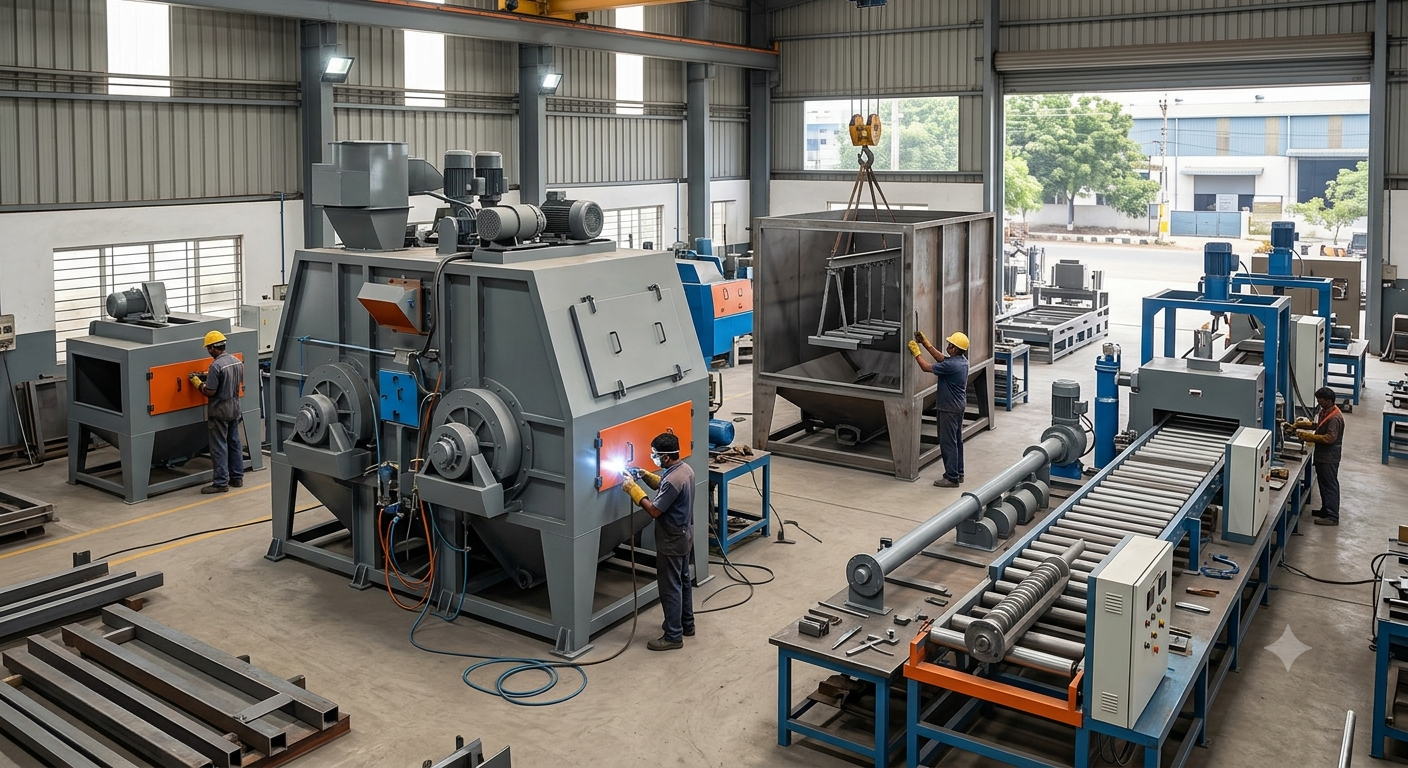
Why Choosing the Right Equipment Partner Matters
Surface preparation has a direct impact on the quality and durability of many industrial finishing processes. Components may require cleaning, descaling, removal of corrosion, or preparation before painting and protective coating.
Shot blasting offers a controlled mechanical method for preparing metal surfaces by propelling abrasive media against the workpiece. However, achieving consistent results depends on selecting equipment that matches the application.
Working with an experienced shot blasting equipment supplier can help manufacturers evaluate their production requirements and select a suitable machine configuration rather than relying on a generic solution.
Understanding Your Surface Preparation Requirements
The first step in equipment selection is identifying what the blasting process needs to achieve. Different industries process different materials, component shapes, and surface conditions.
Before approaching a supplier, manufacturers should assess:
• Type of material being processed
• Component dimensions
• Component weight
• Surface contaminants
• Required surface finish
• Production volume
• Processing frequency
• Available installation space
These details provide a foundation for determining the appropriate machine capacity and configuration.
How Shot Blasting Supports Industrial Production
Manual surface cleaning can become inefficient when manufacturers process large quantities of components. Automated blasting systems can improve consistency while reducing repetitive labor.
A suitable blasting system can support:
• Faster surface preparation
• Consistent cleaning quality
• Improved coating adhesion
• Reduced manual intervention
• Better production repeatability
• Efficient batch processing
For manufacturers operating continuous or high-volume production lines, equipment selection can have a significant influence on overall workflow efficiency.
Selecting the Appropriate Machine Configuration
Different blasting applications require different equipment designs. Machine selection should therefore be based on component characteristics and production methods.
Tumble systems may be appropriate for batches of smaller components that can be processed together. Hanger systems can accommodate larger or irregularly shaped workpieces. Table systems may provide controlled positioning for specific components.
For continuous production, conveyor-based systems can move components through the blasting process as part of an integrated manufacturing line.
A knowledgeable shot blasting equipment supplier should be able to explain the advantages and limitations of different configurations based on the customer's application.
Evaluate Abrasive Handling Efficiency
Abrasive media management is an important part of operating a blasting system. Used abrasive should be collected, separated from contaminants, and returned to the process where appropriate.
An effective recovery system can help reduce unnecessary media consumption and maintain consistent blasting conditions.
When evaluating equipment, consider:
• Abrasive recovery method
• Media separation efficiency
• Dust removal
• Storage capacity
• Media circulation
• Ease of cleaning
Efficient abrasive management can contribute to lower operating costs and more stable surface treatment results.
Consider Dust Collection Performance
The blasting process generates dust as surface contaminants are removed. Effective dust extraction is therefore essential for maintaining suitable working conditions and protecting equipment components.
A dust collection system should be selected according to the machine size, operating cycle, material being blasted, and expected dust generation.
Important factors include airflow capacity, filtration arrangements, maintenance access, and collection efficiency.
Proper dust management can also help keep the surrounding production area cleaner and reduce the accumulation of airborne particles.
Examine Machine Construction and Durability
Blasting equipment is exposed to continuous abrasive impact. Internal components therefore need appropriate protection against wear.
When comparing machines, examine the construction of:
• Blasting chambers
• Protective liners
• Blasting wheels
• Abrasive handling systems
• Recovery components
• Access doors and inspection areas
Durable construction can reduce unexpected interruptions and help maintain consistent equipment performance.
Manufacturers should also understand which components are considered wear parts and how frequently they may need inspection or replacement.
Automation and Process Control
Automation can improve efficiency when manufacturers process components repeatedly. Depending on the machine design, automated systems may manage loading, component movement, blasting cycles, abrasive circulation, and unloading.
The benefits can include:
• Consistent processing times
• Reduced manual handling
• Improved production flow
• Greater repeatability
• Better process control
However, automation should be selected according to actual production requirements. A smaller operation may need a simpler system, while high-volume manufacturing may benefit from greater automation.
Maintenance and Spare Part Availability
The reliability of blasting equipment depends heavily on regular maintenance. Abrasive wear, dust accumulation, and continuous mechanical operation can affect components over time.
Before purchasing a machine, manufacturers should ask about:
• Preventive maintenance schedules
• Wear component replacement
• Spare part availability
• Cleaning procedures
• Technical support
• Installation assistance
• Operator training
A dependable shot blasting equipment supplier should provide clear guidance about machine maintenance and operational requirements.
Safety Should Be Built Into the Process
Industrial blasting equipment should incorporate suitable safety measures. Enclosed blasting chambers, controlled access, emergency controls, dust extraction, and appropriate operating procedures are important considerations.
Operators should receive proper training covering machine operation, abrasive handling, cleaning, inspection, and maintenance.
Safety should be evaluated before equipment installation so that the production process can be planned around appropriate safeguards.
Look Beyond the Initial Purchase Price
The lowest equipment price does not necessarily represent the best long-term investment. Operating expenses can include abrasive consumption, energy use, maintenance, replacement parts, downtime, and technical support.
Manufacturers should therefore compare equipment based on total ownership considerations.
A system with efficient abrasive recovery, durable components, manageable maintenance, and reliable technical support may provide stronger long-term value than equipment selected only on initial cost.
Questions to Ask Before Finalizing a Supplier
A detailed discussion with potential suppliers can help manufacturers make a better decision. Consider asking:
• Is the equipment suitable for the specific component?
• What production capacity can it support?
• What abrasive media is recommended?
• How is abrasive recovered?
• What dust collection system is included?
• Which components require regular replacement?
• What maintenance is required?
• Is installation support available?
• What technical assistance is provided?
Clear answers to these questions can help identify a supplier capable of supporting the complete equipment lifecycle.
Conclusion
Choosing the right blasting equipment requires more than comparing machine specifications or purchase prices. Manufacturers should evaluate application suitability, machine configuration, abrasive recovery, dust collection, automation, durability, maintenance, safety, and technical support.
Wewin Finishing Equipments Pvt. Ltd provides industrial finishing equipment solutions for different manufacturing requirements. Businesses looking for a shot blasting equipment supplier should prioritize technical suitability, operational efficiency, long-term reliability, and service support to make a practical and informed investment.
 English
 Arabic
 French
 Spanish
 Portuguese
 Deutsch
 Turkish
 Dutch
Dutch
 Italiano
 Russian
 Romaian
 Portuguese (Brazil)
 Greek
Greek
 Social Networth OS
 Creator Commerce
 Launch Startup
 Global News
 Creator Award
 Talkfever App
Смотреть все
Talkfever App
Смотреть все