English
 Arabic
 French
 Spanish
 Portuguese
 Deutsch
 Turkish
 Dutch
Dutch
 Italiano
 Russian
 Romaian
 Portuguese (Brazil)
 Greek
Greek
Badminton Net Height: A Key Element for Fair Play
Sports |
2025-02-27 20:48:47
 Social Networth OS
 Creator Commerce
 Launch Startup
 Global News
 Creator Award
 Talkfever App
Ver todos
Talkfever App
Ver todos

Atualizar para Plus
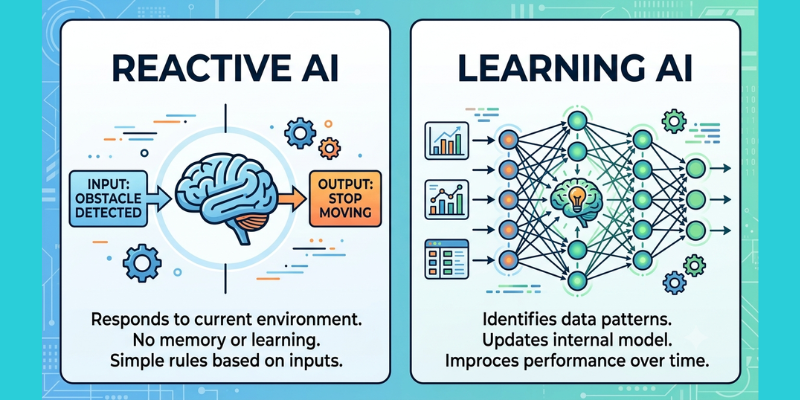
Artificial Intelligence has become part of many everyday technologies, from virtual assistants to recommendation systems. However, not every AI system learns from experience. Some systems simply respond to the information they receive based on predefined rules or their current input. These are known as reactive AI systems. If you want to build a strong foundation in AI, enroll in an Artificial Intelligence Course in Mumbai at FITA Academy to explore these concepts in a structured way for beginners.
Reactive AI is one of the simplest forms of Artificial Intelligence. It responds to a specific situation without storing memories of previous experiences. The system examines the current input and produces an appropriate response based on its programming.
A simple example is a chess-playing AI that evaluates the current position of the pieces and selects a move based on its programmed strategy. It does not need to remember every previous game to make its next move. The key feature of reactive AI is that it focuses on the present situation rather than learning from past events.
Reactive systems can be useful when the task is predictable, and the required response can be clearly defined. They are often easier to design and control because their behavior follows established rules. However, they have limited flexibility because they cannot improve their decisions through experience.
Learning AI systems work differently because they can use data and experience to improve their performance. Instead of relying only on fixed instructions, these systems identify patterns in information and adjust their behavior based on what they learn.
Machine Learning is a major approach used to create learning AI systems. During training, a model receives data and searches for patterns that can help it make predictions or decisions. For example, a learning system can analyze thousands of emails to identify patterns associated with spam.
The more useful and relevant data a learning system receives, the better it can become at certain tasks. However, learning does not mean that an AI system understands information in the same way humans do. Its performance depends on its training data, model design, and evaluation process.
The main difference between reactive AI and learning AI is how they handle information and experience. Reactive AI responds to current inputs using predefined logic, while learning AI uses patterns learned from data to produce responses or predictions.
Reactive systems can be effective when consistency and predictable behavior are important. Learning systems are more suitable for complex situations where manually defining every possible response would be difficult.
For example, a basic automated system might respond to a specific customer question with a fixed answer. A learning-based system could analyze customer language and identify the likely intent behind a question. This enables it to manage a wider variety of circumstances. If you want to strengthen your understanding of machine learning and related AI concepts, you can take an AI Course in Kolkata to explore how learning systems are designed and trained effectively.
Understanding reactive and learning AI provides an important foundation for studying modern Artificial Intelligence. It helps beginners recognize that AI systems can work in very different ways depending on their architecture, purpose, and ability to learn.
Reactive AI is useful for clearly defined tasks, while learning AI can handle patterns and situations that are harder to describe with fixed rules. Modern AI applications often combine several techniques to achieve better performance.
As AI continues to develop, understanding these fundamental concepts makes it easier to learn advanced areas such as Deep Learning, Natural Language Processing, Computer Vision, and Generative AI. A strong understanding of the basics can also help you evaluate how different AI technologies work in real-world applications.
Reactive AI and learning AI represent two important approaches to Artificial Intelligence. Reactive systems focus on responding to present inputs, while learning systems use data and experience to improve their performance. Knowing this difference helps beginners understand the foundations behind many AI applications. If you want to continue developing your AI knowledge and explore more advanced concepts, join AI Courses in Delhi to develop hands-on abilities and enhance your comprehension of Artificial Intelligence.
Also check: Tokenization and Text Processing Basics