 English
 Arabic
 French
 Spanish
 Portuguese
 Deutsch
 Turkish
 Dutch
Dutch
 Italiano
 Russian
 Romaian
 Portuguese (Brazil)
 Greek
Greek
At Qatar (Doha) +971521553488^| Abortion medecine pills in qatar
Food |
2025-04-22 15:45:32
 Social Networth OS
 Creator Commerce
 Launch Startup
 Global News
 Creator Award
 Talkfever App
عرض كل النتائج
Talkfever App
عرض كل النتائج

ترقية الحساب
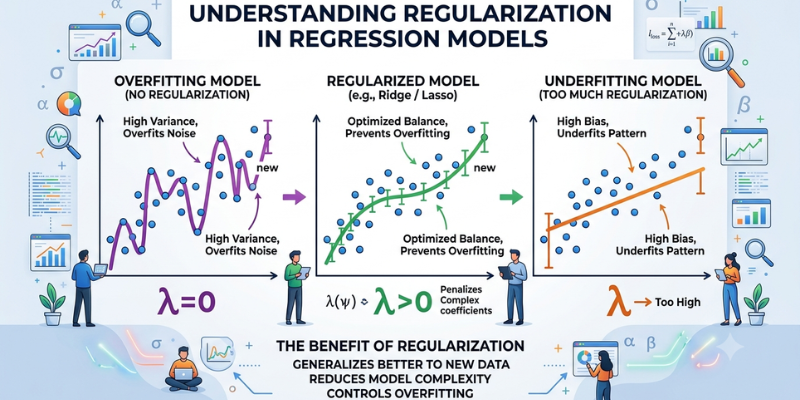
Regression models are commonly utilized in data science to forecast continuous outcomes like sales, prices, demand, or revenue. However, a model can become too complex when it tries to fit every small pattern in the training data. This problem can lead to overfitting and poor performance on new data. Regularization is a useful technique that helps control model complexity and encourages better generalization. If you want to strengthen your practical skills, you can enroll in Data Science Courses in Bangalore at FITA Academy and build a stronger foundation in regression and machine learning concepts.
Regularization is a method employed to minimize overfitting by introducing a penalty to a regression model when its coefficients grow too large. Instead of focusing only on minimizing prediction errors, the model also considers its complexity.
This method promotes the model to adopt more straightforward connections between the input features and the target variable. A simpler model may perform slightly worse on training data but often performs better when it encounters new and unseen data.
Regularization is especially useful when a dataset contains many features or when some features have strong relationships with each other. In such situations, an ordinary regression model can become unstable or overly dependent on individual variables.
A regression model should not simply memorize patterns found in its training dataset. Its main goal is to learn useful relationships that can also work on new data. Regularization supports this goal by discouraging unnecessarily large coefficients.
Without regularization, a model with many features may assign very high importance to certain variables. This can make predictions sensitive to small changes in the data. Regularization reduces this sensitivity and can produce a more stable model.
The amount of regularization is controlled by a parameter that determines how strongly model complexity should be penalized. Choosing an appropriate value is important because too little regularization may not prevent overfitting, while too much can make the model too simple.
Ridge regression is one of the most common regularization techniques. It adds a penalty based on the squared values of the model coefficients.
This penalty encourages coefficients to become smaller without usually forcing them completely to zero. As a result, Ridge regression can be useful when many features contribute to the prediction, and you want to retain them while reducing their influence.
Ridge regression is also helpful when input features are highly correlated. Instead of allowing one feature to receive an extremely large coefficient, the regularization process can distribute the influence more smoothly across related features.
Lasso regression uses a different type of penalty. Instead of penalizing squared coefficient values, it penalizes the absolute values of the coefficients.
One important advantage of Lasso is that it can reduce some coefficients completely to zero. This means it can effectively perform feature selection while training the regression model.
Lasso can therefore be useful when a dataset contains many features, but only some of them are genuinely helpful for prediction. By removing the contribution of less useful features, it can create a simpler and easier-to-understand model.
The main difference between Ridge and Lasso is how they treat model coefficients. Ridge generally shrinks coefficients toward zero, while Lasso can set some coefficients exactly to zero.
Ridge can be a strong choice when most features contain useful information, especially when features are correlated. Lasso can be valuable when you want automatic feature selection and a more compact model.
There is also Elastic Net, which combines the ideas behind Ridge and Lasso. It can provide a useful balance when a dataset contains many features and correlated variables. If you want to develop your understanding through structured learning, consider taking a Data Science Course in Hyderabad to explore regression, regularization, and other core machine learning concepts.
The strength of regularization should not be selected randomly. Data scientists commonly test different values and evaluate how well the resulting models perform on validation data.
Cross-validation is a useful approach for comparing different regularization settings. It helps estimate how a model may perform on unseen data rather than relying only on its training performance.
Feature scaling is also important for many regularized regression models. When features have very different numerical ranges, larger-scale variables can have an unintended influence on the penalty. Standardizing numerical features can help make the regularization process more balanced.
One common mistake is applying strong regularization without checking its effect on model performance. Excessive regularization can cause underfitting, where the model becomes too simple to capture important relationships.
Another mistake is evaluating the model only on training data. A regularized model should be assessed using appropriate validation or test data to determine whether it generalizes effectively.
It is also important to avoid data leakage when preparing features and applying scaling. Preprocessing steps should be handled carefully so that information from the test data does not influence the training process.
Regularization is a fundamental concept for building reliable regression models. It helps control complexity, reduce overfitting, improve stability, and support better performance on unseen data. Ridge, Lasso, and Elastic Net offer different approaches for controlling model coefficients and managing feature influence. Understanding when and how to use these techniques can make your regression workflow more effective. If you want to deepen your data science knowledge with practical training, you can join the Data Science Course in Ahmedabad and continue developing your skills in regression and machine learning.


