English
 Arabic
 French
 Spanish
 Portuguese
 Deutsch
 Turkish
 Dutch
Dutch
 Italiano
 Russian
 Romaian
 Portuguese (Brazil)
 Greek
Greek
Cricplus: Your Ultimate Platform for Sports Betting and Casino Game
Sports |
2025-03-24 10:05:21
 Social Networth OS
 Creator Commerce
 Launch Startup
 Global News
 Creator Award
 Talkfever App
عرض كل النتائج
Talkfever App
عرض كل النتائج

ترقية الحساب
If you’re an Indian student staring at the prospect of a law degree from the UK, you’ve probably already been buried under brochures that all sound the same. Every university claims to be "world-class." Every prospectus promises "life-changing opportunities." So let’s step away from the marketing speak and talk about the University of Essex in UK the way we’d talk to a student sitting across our desk.
Essex isn't Oxford or Cambridge. It doesn't pretend to be. What it is, however, is a place that takes law seriously—but not in a stuffy, oak-panelled-library kind of way. The law school here has a personality. It leans hard into human rights, social justice, and the kind of law that actually affects people's lives. If that sounds like your sort of thing, keep reading.
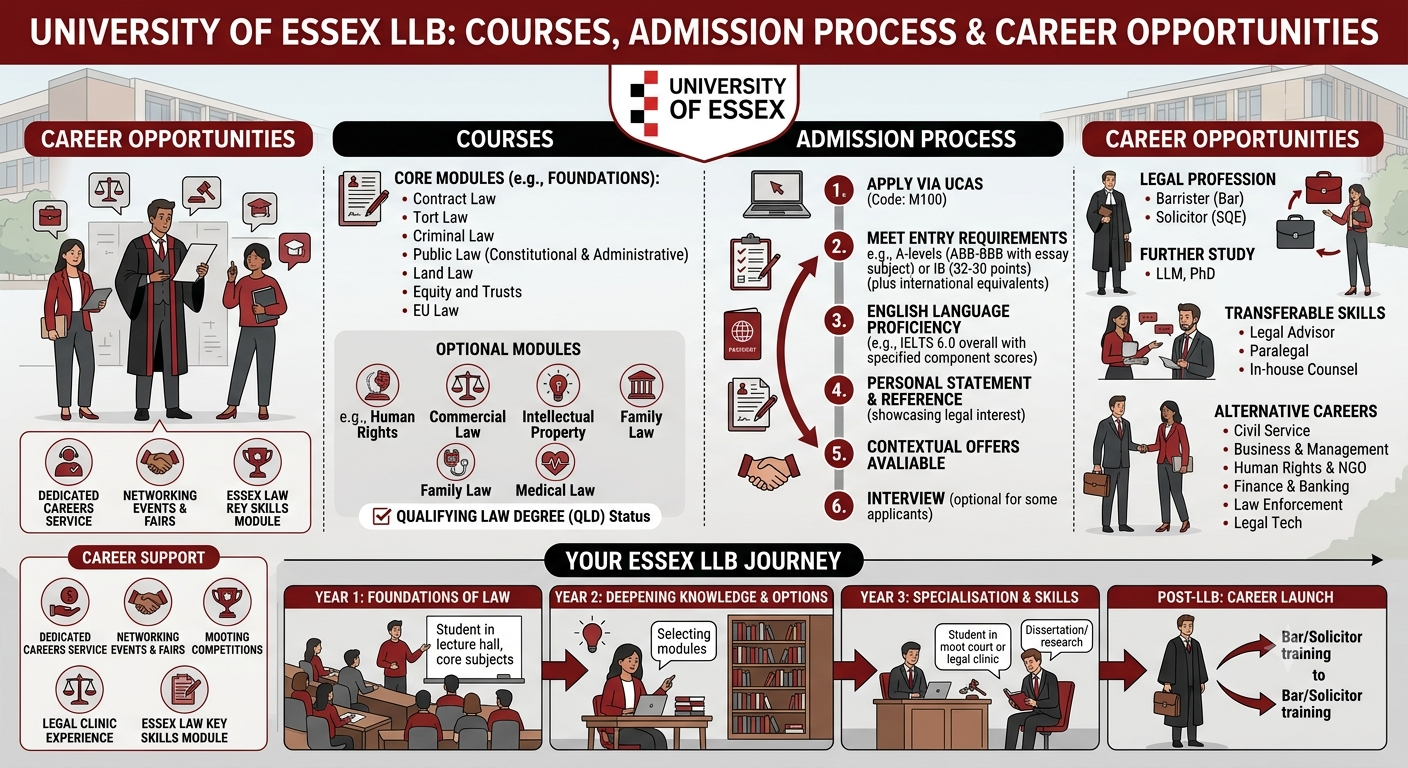
The LLB at Essex runs for three years, though there's a four-year option with a placement year—and honestly, we usually recommend the placement route to Indian students who can afford the extra year. Why? Because UK firms hire heavily from their internship pools, and that year in practice often makes the difference between a training contract and a frustrating job hunt.
Year one is your foundation diet: Contract, Criminal, Public Law, and Tort. It's the same menu you'd get at most UK law schools. The difference shows up in year two, when you start picking from options like International Human Rights Law, Environmental Law, and even Maritime Law—yes, that one attracts a fair few students from coastal Indian cities. The intellectual property modules have also become quietly popular among students eyeing the tech and pharma sectors back home.
One thing that genuinely sets Essex apart is the legal advice clinic. You work on actual client cases under supervision. It's not simulated. It's not a role-play. Real people walk in with real problems, and you help untangle them. That experience lands differently on a CV than another high-scoring exam paper.
Let's talk about what nobody puts in the glossy prospectus. The University of Essex in UK has a sizeable Indian student community—not overwhelming, but present enough that you won't feel like a complete outsider. The Indian Society runs regular events, and the university calendar quietly accommodates Diwali and Holi in ways that feel genuine rather than performative.
The academic shift, however, is real. Back home, you're used to lectures where the professor speaks and you take notes. Here, you're expected to have read the material before the seminar, come with arguments prepared, and defend your position against peers who will not hesitate to poke holes in your logic. That's not a flaw—that's the point. Essex teaches you to think on your feet. We've seen students from CBSE and ISC backgrounds struggle in the first semester, then absolutely dominate by the second. It's a steep curve, but the climb is worth it.
Cost-wise, Colchester is cheaper than London by a noticeable margin. Rent, groceries, transport—you'll feel the difference. The tuition is also more competitive than Russell Group heavyweights. Scholarships exist, and Indian applicants should actively chase them rather than waiting for the university to offer.
The admission process for the University of Essex LLB isn't unnecessarily complicated, but it does have its quirks. For Indian school leavers, the standard offer hovers around 85% in your best four subjects from CBSE or ISC. If you're on A-levels, they want AAA; IB students need 32 points. That's the headline number—but we've seen students with slightly lower grades get in if their personal statement showed genuine fire.
You apply through UCAS if you're coming straight from school, with the January 29th deadline for equal consideration. Mature students or those with prior degrees can apply directly via the university portal—a route we often suggest for graduates who want a career pivot.
English language is non-negotiable. IELTS 6.0 overall with no band below 5.5 is the baseline. The good news? Essex also accepts Pearson PTE and Duolingo, which many Indian students find easier to crack.
Now, the personal statement—this is where most applicants trip. We've read hundreds of them over the years. The ones that work aren't the ones that say "I want to help people." They're the ones that show you've actually engaged with law—maybe through a debate, a volunteer stint at a legal aid cell, or even just reading a judgment and explaining why it bothered you. Essex admissions tutors can smell generic statements from a mile away. Don't be generic.
Let's be practical. You finish your University of Essex LLB. Now what?
If you're planning to practise in India, the Bar Council recognises UK law degrees, but you'll need to clear the mandatory conversion exams. Many Essex graduates knock these off during their final year through distance learning—it's doable, but you need to plan ahead.
If you're aiming for the UK, Essex graduates have secured training contracts with Magic Circle firms, though we'll be honest—it's competitive. Where Essex alumni truly shine is in international arbitration, human rights law, and in-house roles with multinational corporations. The careers team at Essex runs an annual law fair that attracts serious employers, and the alumni network in India is now substantial enough that new graduates often find mentors through informal channels.
The Essex degree carries weight not because of its age, but because employers know the calibre of thinking it produces. The human rights emphasis, the clinical training, the Socratic seminars—they produce lawyers who can argue, yes, but more importantly, lawyers who can think. And in a crowded legal market, that's what ultimately separates the memorable from the forgettable.
We're not here to sell you Essex. We're here to tell you that if you're the kind of student who gets restless with rote learning, who wants to argue the why behind the what, and who believes law can actually change things—then this university deserves a serious look.
The LLB in UK for Indian students is a major investment—of money, time, and emotional energy. Essex gives you a decent return on that investment, provided you show up ready to work, ready to question, and ready to be uncomfortable in the best possible way.
That's the real value of a legal education here. It's not the certificate. It's the way you learn to see the world.