English
 Arabic
 French
 Spanish
 Portuguese
 Deutsch
 Turkish
 Dutch
Dutch
 Italiano
 Russian
 Romaian
 Portuguese (Brazil)
 Greek
Greek
Rsorder Cave Slimes Slayer Guide–Old School RuneScape
Sports |
2026-04-08 00:37:27
 Social Networth OS
 Creator Commerce
 Launch Startup
 Global News
 Creator Award
 Talkfever App
Hepsini Gör
Talkfever App
Hepsini Gör

Upgrade to Pro
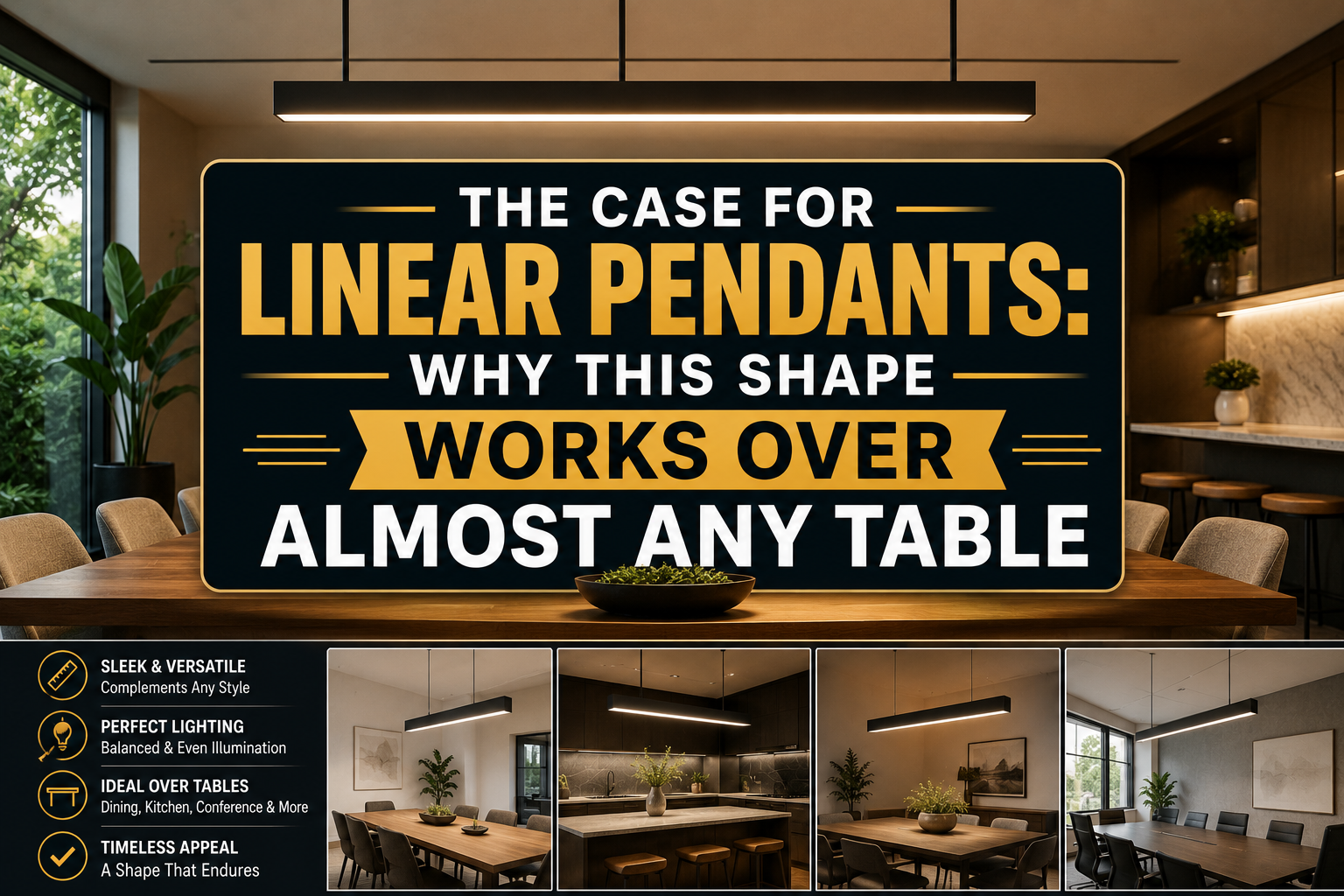
Walk into any recently renovated dining room or kitchen and there's a good chance you'll spot the same silhouette hanging above the table: a long, low, two-light pendant running parallel to the surface below it. That shape isn't a trend so much as a solution. Rectangular tables and long kitchen islands have never been well served by a single round pendant or a single chandelier centered overhead the light pools in the middle and leaves the ends of the table dim. Linear pendants fix that problem by spreading illumination along the full length of the surface instead of concentrating it in one spot.
A round chandelier or single-drop pendant is designed to throw light in a circle. Hang it over an eight-foot table and you get a bright center and two shadowy ends. It looks fine in photos taken from directly underneath, but it doesn't actually light the space the way people use it.
A two-light linear pendant, spaced properly, puts a light source over each half of the table rather than one source over the middle. The result is more even coverage, softer shadows on faces during dinner, and a fixture silhouette that echoes the shape of the table or island underneath it instead of fighting against it.
Most linear pendants in this style use a slim steel or iron frame, which keeps the fixture visually light even though it spans a long horizontal distance. A thinner frame reads as more refined and lets the shape of the shades do the visual work, rather than the hardware.
Conical or drum-shaped shades often in linen or a similar soft fabric diffuse the light rather than exposing the bulb directly. This matters more over a dining table than almost anywhere else in the house, since it's where people sit at eye level with the fixture for extended periods.
Where the horizontal bar meets the drop rods and shade arms, small wood or metal hub details often appear. These are easy to overlook in a listing photo, but they're usually the difference between a pendant that reads as generic and one that reads as designed.
Rectangular and oval dining tables, where a round fixture leaves the ends of the table underlit
Kitchen islands, especially longer ones where a single pendant looks lost in the middle
Entry consoles and long hallway tables, where a horizontal fixture matches the proportions of the furniture below it
Open-concept dining areas, where the pendant also functions as a visual boundary between the kitchen and living space
A general starting point is choosing a fixture that spans roughly one-third to one-half the length of the table beneath it, so the light reads as intentional rather than either too small or overwhelming.
For most dining rooms, the bottom of the fixture should sit around 30 to 34 inches above the tabletop, adjusted up or down depending on ceiling height and how tall the household members are.
Rooms with unusually high or low ceilings often need a non-standard drop length. Fixtures that offer custom height options are worth prioritizing if your ceiling doesn't match a standard 8- or 9-foot plan.
A linear pendant isn't just a stylistic choice, it's a practical response to the shape of the furniture most of us actually eat and gather around. Once you've lived with even light across the full length of a table, going back to a single centered fixture feels like a step backward.
If you're weighing options for a dining table or kitchen island, Circ Lighting's Piaf 2-Light Linear Pendant is a solid example of the style done well, with a slim frame, softly diffused shades, and proportions built specifically for horizontal spaces like these.