English
 Arabic
 French
 Spanish
 Portuguese
 Deutsch
 Turkish
 Dutch
Dutch
 Italiano
 Russian
 Romaian
 Portuguese (Brazil)
 Greek
Greek
Oral Care Market Growth, Market Size and Forecast Outlook 2026-2036
Other |
2026-08-13 09:28:29
 Social Networth OS
 Creator Commerce
 Launch Startup
 Global News
 Creator Award
 Talkfever App
Mostra tutti i risultati
Talkfever App
Mostra tutti i risultati

Passa a Pro
A supplier sample can pass every initial check and still leave formulation teams adjusting the process after the first commercial delivery. With Organic Peppermint Leaf Powder, the difference often appears in subtle ways: a stronger or weaker aroma, changes in color, different powder flow, or a shift in particle size. These differences are not always signs of poor quality. They often reflect the agricultural and processing variables behind the ingredient.
For procurement managers sourcing Organic Peppermint Leaf Powder Bulk, understanding those variables before approving a long-term supply can prevent unnecessary reformulation and production adjustments.
The Supply Chain Starts With the Crop
Organic peppermint leaf powder is produced by drying and milling peppermint leaves, commonly Mentha × piperita. Unlike highly standardized manufactured ingredients, peppermint begins as an agricultural crop. Growing region, cultivar, climate, harvest timing, and post-harvest handling can influence the final powder.
This makes traceability particularly useful. Rather than relying only on a country-of-origin statement, sourcing teams should establish the botanical identity, agricultural region where available, harvest period, drying method, and processing location.
Organic certification should be verified as part of the overall documentation package. Buyers should ensure the certificate applies to the ingredient being purchased and that supporting records provide a clear connection between the agricultural source and finished material.
A supplier changing its growing region or harvest source is not necessarily a quality concern, but the change can create lot-to-lot differences worth evaluating.
Drying and Milling Affect Manufacturing Behavior
Peppermint contains naturally occurring volatile oils, including menthol and menthone, as well as polyphenols, chlorophyll, fiber, and other plant constituents. Processing conditions can influence the sensory and physical characteristics of the powder.
Drying is particularly important. Temperature, airflow, and drying duration can affect moisture and aromatic characteristics. Once dried, milling determines particle-size distribution, which in turn can influence bulk density, flowability, blending, and filling.
For R&D teams, these variables matter during scale-up. A powder that disperses adequately in a small laboratory vessel may behave differently in an industrial mixer. Changes in particle size or bulk density can affect blend uniformity and dosing.
Moisture is another practical consideration. Excess moisture can contribute to caking, while unsuitable storage conditions may affect powder handling over time.
Choose the Format According to the Formulation
Organic Peppermint Leaf Powder can be used in food, functional beverage, nutraceutical, and botanical formulations. Food manufacturers may use it in herbal blends, dry mixes, confectionery products, seasonings, and other applications where powdered leaf material is appropriate.
Nutraceutical producers may incorporate it into capsules, tablets, sachets, and botanical blends. Functional beverage manufacturers can use peppermint powder in powdered drink systems where its sensory and physical properties are compatible with the formulation.
However, leaf powder should not automatically be treated as equivalent to peppermint extract. Whole-leaf powder provides the broader characteristics of the dried botanical, while an extract may be selected when a concentrated or more specifically defined constituent profile is required.
This distinction should be established before procurement begins because the two formats can have very different specifications and formulation behavior.
What Bulk Buyers Should Verify
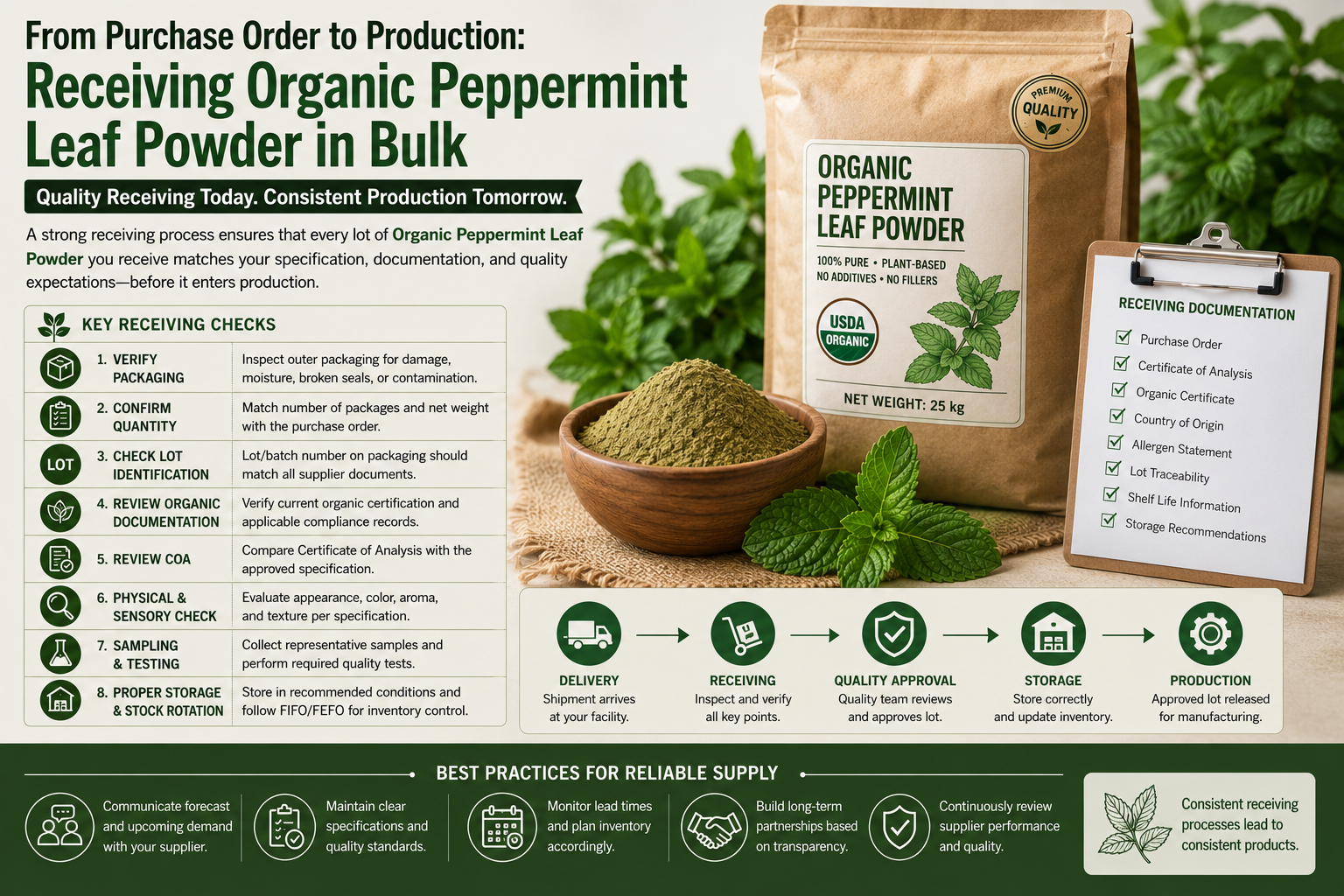
When purchasing Organic Peppermint Leaf Powder Bulk, the COA is only one component of the technical review. Depending on the application, buyers may request organic certification, botanical identity testing, microbiological analysis, pesticide-residue results, heavy-metal testing, allergen documentation, country-of-origin information, and applicable food-safety certifications.
Beyond paperwork, multiple-lot testing is one of the more useful sourcing exercises. Compare samples for color, aroma, moisture, particle size, bulk density, flowability, and dispersion.
For beverage or powdered formulations, the ingredient should ideally be tested within the intended product matrix. A raw-material sample may look acceptable while behaving differently once combined with other powders, acids, flavors, or processing aids.
Packaging should also be part of the conversation. Peppermint's aromatic nature makes protection during storage important. Moisture exposure can affect flow and increase caking, while prolonged exposure to unsuitable conditions may influence the sensory profile.
Making Bulk Supply More Predictable
For recurring Organic Peppermint Leaf Powder Bulk purchases, specifications should reflect actual production requirements. Establishing acceptable ranges for moisture, particle size, bulk density, microbiological parameters, and other relevant quality attributes can make supplier comparisons more meaningful.
Retaining a reference sample from an approved lot provides another practical control. Future deliveries can be compared against that reference rather than evaluated only against a generic product description.
Procurement teams should also clarify how suppliers manage changes in crop source, harvest season, drying conditions, milling equipment, and manufacturing location. These changes may not invalidate the ingredient, but they can affect formulation performance.
Ultimately, dependable sourcing of Organic Peppermint Leaf Powder comes from understanding the entire path from crop to finished powder. When procurement, quality, and R&D teams evaluate agricultural origin, processing, physical behavior, documentation, and storage together, bulk purchasing becomes less about reacting to lot variation and more about managing it proactively.