English
 Arabic
 French
 Spanish
 Portuguese
 Deutsch
 Turkish
 Dutch
Dutch
 Italiano
 Russian
 Romaian
 Portuguese (Brazil)
 Greek
Greek
Waterless Cream Blush Sticks Market Growth, Trends and Forecast 2026 to 2036
Other |
2026-08-10 10:11:19
 Social Networth OS
 Creator Commerce
 Launch Startup
 Global News
 Creator Award
 Talkfever App
See All
Talkfever App
See All

Upgrade to Pro
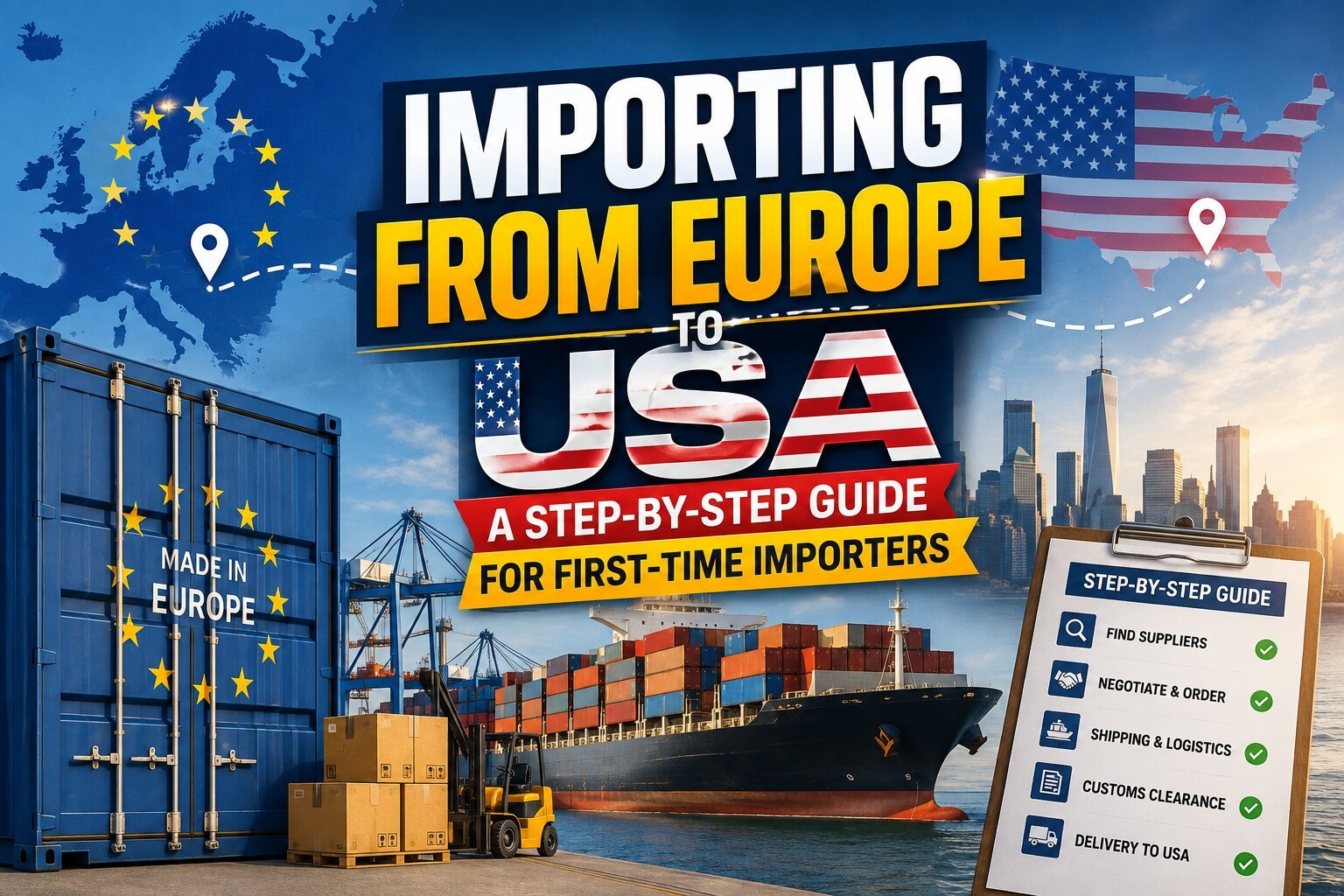
Europe has long been an important source of products for American businesses. From German machinery and Italian furniture to French cosmetics, Swiss products, specialty foods, automotive components, pharmaceuticals, industrial equipment, and luxury goods, European manufacturers serve almost every major sector of the US economy.
The scale of this relationship is enormous. The United States imported approximately $633.2 billion in goods from the European Union in 2025, according to the Office of the U.S. Trade Representative. Major sources included Germany, Ireland, Italy, and France.
For a first-time importer, however, buying from a European supplier is only the beginning.
You also need to understand product requirements, supplier verification, transportation, customs classification, tariffs, documentation, insurance, and the final cost of getting the merchandise into your US warehouse.
That may sound complicated at first.
The good news is that you can break the process into manageable steps.
This guide walks through importing from Europe to the USA, from finding the right supplier to clearing customs and receiving your products.
European countries have strong reputations in many manufacturing and specialty-product categories.
Depending on the country and industry, businesses may source:
The US market already has substantial demand for European merchandise.
In 2024, leading US imports from the European Union included pharmaceuticals, road vehicles, industrial machinery, electrical machinery and parts, and specialized machinery.
But popularity should not be confused with profitability.
A product that sells well in the United States can still be a poor import opportunity if transportation, tariffs, compliance costs, and other expenses eliminate your margin.
So the first rule is simple:
Research the business opportunity before placing the order.
Before contacting European suppliers, define your product as precisely as possible.
Avoid starting with a broad description such as "European furniture" or "industrial equipment."
Instead, document:
A detailed specification sheet makes supplier comparisons much easier.
It also reduces the chance of receiving something different from what you expected.
For example, two manufacturers might both sell stainless-steel equipment, but the thickness, grade, electrical specifications, dimensions, and operating capacity could differ significantly.
The more specific your requirements are, the easier it becomes to compare products fairly.
Before committing money to imports from Europe, determine whether customers in your target market actually want the product.
Research:
Look at what successful competitors are doing.
If several companies already sell an identical product at a price close to your expected landed cost, entering that market may be difficult.
On the other hand, you may find an opportunity if customers want better quality, faster delivery, different specifications, or a product that is currently difficult to source.
Your goal is not simply to find something European that you can buy.
Your goal is to find something you can buy, import, sell, and profit from.
"Europe" is not one manufacturing market.
Each country has its own industrial strengths, business culture, logistics infrastructure, and supplier base.
For example:
Often associated with machinery, automotive products, engineering, industrial equipment, and precision manufacturing.
Known for furniture, fashion, footwear, food products, specialty manufacturing, and luxury goods.
Important in areas such as cosmetics, food and beverages, aerospace, fashion, and luxury products.
A major logistics and distribution hub with an important role in European trade.
Strong in food, agriculture, automotive components, textiles, ceramics, and other manufacturing sectors.
Important manufacturing bases for machinery, automotive components, furniture, electronics, and industrial products.
These are broad examples, not guarantees.
The best country depends on the product you are sourcing.
Once you know what you want, start building a supplier list.
Don't immediately select the first manufacturer that gives you a quotation.
Compare several businesses.
Ask potential suppliers about:
You want to know whether the supplier can consistently produce the product you need.
A supplier may be excellent at small orders but struggle with larger quantities.
Another may offer a low price but have long production lead times.
Look beyond the quotation.
Supplier verification is one of the most important stages of importing from Europe.
Before making a substantial payment, confirm that the company actually exists and can fulfill your order.
Check:
If possible, arrange a factory visit or independent factory audit for a significant purchase.
Ask the supplier for photographs or video of the actual production facility rather than relying exclusively on catalog images.
A professional supplier should be comfortable discussing production, quality control, packaging, and shipping arrangements.
Never assume that a product will meet your expectations simply because the supplier's website looks impressive.
Request a sample whenever practical.
Evaluate:
For machinery or technical products, request detailed specifications and test information.
For food, cosmetics, medical products, children's products, electronics, and other regulated categories, additional testing or certification may be necessary.
A sample gives you a chance to discover problems while your financial exposure is still relatively small.
This is where many first-time importers make mistakes.
A product legally sold in Europe is not automatically compliant with US requirements.
The United States has its own rules concerning safety, labeling, composition, environmental standards, electrical requirements, food, pharmaceuticals, chemicals, vehicles, and many other products.
Depending on your merchandise, agencies that may be relevant include:
CBP specifically notes that importers must ensure their merchandise complies with requirements imposed by other federal agencies when applicable.
So don't ask only:
"Can this product be exported from Europe?"
Ask:
"Can this exact product legally enter and be sold in the United States?"
That is the more important question.
Every commercial import needs appropriate customs classification.
The Harmonized Tariff Schedule of the United States, commonly called the HTSUS, provides the tariff classification system used for US imports.
Classification can depend on:
The classification can affect the duty rate and other customs requirements.
Do not automatically use an HTS code supplied by your European supplier.
The supplier may be using the European Union's classification system, while the US uses its own tariff schedule.
If you are uncertain, work with a qualified customs professional or consider seeking a binding ruling from CBP for an appropriate product.
Getting classification right before your shipment leaves Europe is much better than discovering a problem after arrival.
Tariffs are one of the most important financial considerations when planning imports from Europe.
The applicable rate depends on the exact product classification and the trade measures in effect when the goods enter the United States.
Do not assume that every European product has the same duty rate.
Two products purchased from the same country can have completely different tariff treatment.
There can also be additional measures affecting particular products.
US-EU trade policy has also been evolving. In 2026, the transatlantic trade relationship continues to receive significant policy attention, making it especially important to verify current tariff treatment rather than relying on an old rate or a general internet estimate.
For a commercial shipment, confirm the current treatment for the specific HTS classification before finalizing your purchase.
This is arguably the most important financial calculation in the entire process.
Your supplier's price is not your true import cost.
Your landed cost may include:
Product cost + inland transportation + export charges + international freight + insurance + customs duties + tariffs + port charges + customs fees + domestic transportation + warehousing
You may also have:
Suppose a European supplier quotes:
Product cost: $50,000
You then spend:
Your actual landed cost is approximately:
$68,000
If you calculate your profit using only the $50,000 supplier invoice, your numbers will be misleading.
Always calculate the complete cost before deciding whether the transaction is profitable.
Your European supplier may quote an Incoterm such as:
These terms define responsibilities and risk allocation between the buyer and seller.
Don't choose an Incoterm simply because the quoted price looks attractive.
Ask:
Two suppliers can quote the same product at similar prices but leave you with very different total costs depending on their delivery terms.
Compare quotations on an equivalent basis.
Your shipping method should match the product and business requirements.
Ocean freight is often suitable for:
It generally provides lower transportation costs per unit, although transit times are longer.
Air freight may be appropriate for:
The cost is usually higher, but speed can justify the expense.
The cheapest shipping option isn't always the most economical option.
A delayed shipment can result in lost sales, stockouts, or production interruptions.
Good documentation makes international shipping much easier.
Commercial shipments may require documents such as:
Make sure information is consistent across documents.
Pay particular attention to:
Avoid vague descriptions such as "parts," "equipment," or "goods."
The description should clearly identify what is being imported.
A supplier being located in Germany, Italy, France, or another European country does not necessarily answer every country-of-origin question.
Products may contain:
The applicable origin rules determine how the country of origin is established.
Ask your supplier where the merchandise was manufactured and where substantial processing occurred.
Keep supporting documentation.
Accurate origin information is important for customs declarations and tariff treatment.
US businesses importing commercially need appropriate importer identification information.
For many US businesses, the importer number is tied to the company's IRS Employer Identification Number.
CBP explains that an Importer of Record Number is generally the company's EIN for US businesses, while other identification methods can apply in certain situations.
Make sure your business information is ready before the first shipment.
Don't wait until cargo is sitting at the port to discover that your customs paperwork is incomplete.
A customs broker can make the import process easier, particularly for businesses handling their first commercial shipment.
A broker may assist with:
However, using a broker doesn't transfer all responsibility away from the importer.
CBP makes clear that the importer remains responsible for compliance even when a broker is involved.
Think of a broker as a professional partner, not a replacement for your own due diligence.
Provide accurate information and review important customs details.
International shipping involves risks.
Cargo can be:
Do not assume that the carrier's liability automatically provides complete protection for your shipment.
Consider cargo insurance based on:
Ask exactly what the policy covers and what exclusions apply.
Your shipment doesn't finish its journey when the vessel reaches the United States.
You still need to move the goods to:
Compare the complete route.
Consider:
A slightly cheaper ocean freight quotation can become more expensive if it creates substantially higher inland transportation costs.
Think in terms of door-to-door cost, not just port-to-port freight.
When possible, arrange an inspection before the merchandise leaves Europe.
For larger purchases, an independent inspection can help identify:
It is much easier to address an issue while the goods are still at the supplier's facility.
Once the cargo has crossed the Atlantic, correcting problems can become much more expensive.
If this is your first transaction with a European supplier, don't automatically place the largest order possible.
Start with a manageable shipment.
Use the first transaction to evaluate:
Once the process works, increase your order volume.
This approach gives you valuable experience while limiting your financial exposure.
The lowest quotation doesn't always provide the lowest total cost.
A product that looks excellent in photographs may disappoint when you receive it.
European compliance does not automatically equal US compliance.
Incorrect classification can cause customs and financial problems.
Your landed cost is what matters.
You could unexpectedly become responsible for transportation, insurance, or other expenses.
Preparation should happen before departure.
Large orders increase your exposure to supplier and market risk.
Origin can affect customs treatment and documentation.
The importer remains responsible for compliance.
Before placing your first order, make sure you can answer these questions.
If you cannot answer several of these questions, you're probably not ready to place the order.
Successful importing isn't about eliminating every possible problem.
That isn't realistic.
Instead, the goal is to reduce surprises.
Create a repeatable process.
For every shipment, maintain records of:
After the shipment arrives, compare your original estimate with your actual cost.
Ask:
Did the supplier deliver what was promised?
Was the freight cost accurate?
Were there unexpected customs expenses?
Did the goods arrive on schedule?
Was the packaging sufficient?
Did the final landed cost match the business plan?
The answers will help you improve the next shipment.
Over time, the import process becomes less of a guessing game and more of a repeatable business operation.
Importing from Europe can give US businesses access to established manufacturers, specialized products, advanced machinery, premium consumer goods, and unique products that may be difficult to source domestically.
The scale of US-European trade demonstrates how important the relationship already is. US goods imports from the European Union reached approximately $633.2 billion in 2025.
But a strong trade relationship doesn't guarantee that every individual import will be profitable.
Your results depend on preparation.
Research the market before buying.
Verify the supplier before paying.
Test the product before scaling.
Confirm US regulatory requirements.
Classify the merchandise correctly.
Calculate the complete landed cost.
Choose an appropriate shipping method.
Prepare customs documentation early.
And monitor tariff and trade-policy changes before every major shipment.
For first-time importers, the smartest approach is usually to start small, learn the process, document what works, and then scale.
The objective isn't simply to bring European products into the United States.
The objective is to build a supply chain that is legal, predictable, financially sustainable, and capable of growing with your business.
US businesses import a wide variety of European products, including pharmaceuticals, vehicles, machinery, electrical equipment, furniture, food, apparel, cosmetics, specialty products, and industrial components. The best opportunity depends on market demand, regulations, costs, and supplier capabilities.
The cost varies considerably. Your total expense can include product price, European inland transportation, international freight, insurance, tariffs, customs duties, port fees, domestic transportation, warehousing, and compliance expenses.
Not necessarily. Businesses can sometimes handle their own customs entries, but many first-time commercial importers use a customs broker to assist with entry procedures and documentation. The importer remains responsible for compliance.
No. Tariff treatment depends on the specific merchandise classification and applicable trade measures. Products from different industries can have very different rates and additional requirements.
There is no universal timeline. It depends on the supplier's production time, origin location, transportation method, shipping route, customs processing, port conditions, and final US delivery.
Neither is automatically better. Ocean freight can be more economical for large shipments, while air freight can make sense for smaller, urgent, or high-value merchandise.
Understand the complete transaction before placing the order. That means knowing the product requirements, supplier, HTS classification, tariff treatment, shipping terms, documentation, landed cost, and US regulatory obligations.
Start with supplier verification and product samples. Confirm US requirements before purchasing, calculate landed cost accurately, choose appropriate shipping terms, prepare customs documentation early, and begin with a manageable shipment before scaling.