E-Waste Recycling Business Setup in India

E-Waste Recycling Business Setup in India is a growing opportunity for entrepreneurs, waste management companies, manufacturers, investors, and recycling businesses. With the increasing use of mobiles, laptops, computers, televisions, LED lights, printers, refrigerators, air conditioners, and other electronic products, India is generating a large quantity of electronic waste every year.

E-waste contains valuable materials such as copper, aluminium, iron, plastic, glass, gold, silver, palladium, rare earth elements, circuit boards, wires, and reusable components. At the same time, it may also contain hazardous substances such as lead, mercury, cadmium, brominated flame retardants, and other harmful materials. This makes proper recycling essential for environmental protection and resource recovery.

An e-waste recycling business is not just a scrap trading business. It requires proper land, machinery, pollution control systems, trained manpower, safe dismantling process, CPCB registration, State Pollution Control Board consent, EPR portal compliance, and proper recordkeeping.

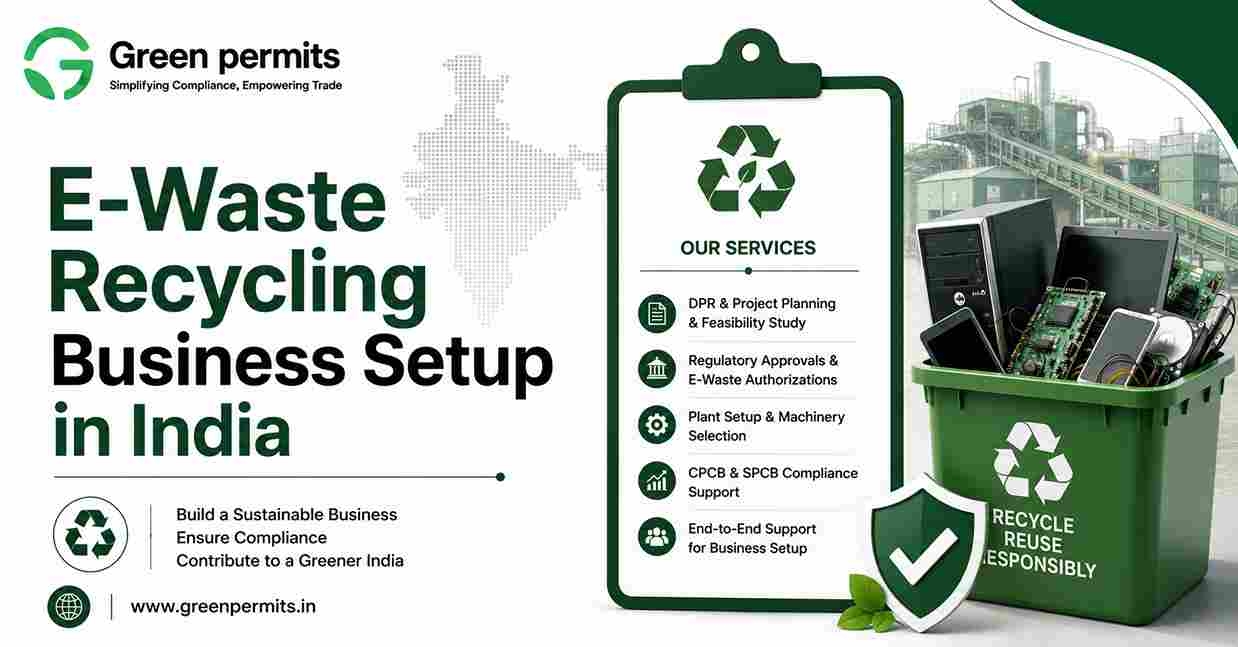
An E-Waste Recycling Business Setup Consultant helps businesses plan the project, prepare DPR, obtain approvals, register on the CPCB EPR portal, install proper systems, manage compliance, and operate legally.

What is E-Waste Recycling Business?

E-Waste Recycling Business means collection, dismantling, processing, recycling, and recovery of useful materials from discarded electrical and electronic equipment.

The business may include activities such as:

  • Collection of e-waste
  • Sorting and segregation
  • Dismantling of electronic equipment
  • Removal of reusable parts
  • Recovery of metals and plastics
  • Processing of printed circuit boards
  • Safe storage of hazardous components
  • Sale of recovered materials
  • Transfer of non-recyclable waste to authorized facilities
  • Generation of EPR certificates, where applicable

The exact business model depends on whether the unit works as a dismantler, recycler, refurbisher, or integrated e-waste processing facility.

Why E-Waste Recycling Business is Important

E-waste recycling is important because electronic waste can harm the environment if handled informally. Burning wires, acid leaching, unsafe dismantling, and open dumping can contaminate soil, water, and air.

A formal e-waste recycling business helps in:

  • Recovering valuable metals
  • Reducing landfill burden
  • Preventing informal waste handling
  • Supporting circular economy
  • Reducing environmental pollution
  • Creating organized recycling infrastructure
  • Supporting EPR compliance for producers
  • Generating employment
  • Improving material recovery
  • Reducing dependency on virgin raw materials

With EPR rules and digital compliance portals, formal recyclers have become important partners for producers and importers.

Who Can Start E-Waste Recycling Business in India?

Any eligible business entity can start an e-waste recycling business after obtaining required approvals and registrations.

The following entities may enter this sector:

  • Private limited companies
  • Limited liability partnerships
  • Partnership firms
  • Existing scrap businesses
  • Waste management companies
  • Electronics refurbishing companies
  • Recycling businesses
  • Industrial investors
  • Entrepreneurs in circular economy
  • Manufacturers planning reverse logistics
  • Producer responsibility organizations
  • Companies working with electronics brands

Before starting, the promoter should check investment requirement, land suitability, machinery, pollution control systems, approvals, and EPR business potential.

Types of E-Waste Recycling Business Models

E-waste recycling can be planned at different levels depending on investment, capacity, and technical capability.

Common business models include:

  • E-waste collection centre
  • E-waste dismantling facility
  • E-waste refurbishing unit
  • E-waste recycling plant
  • Printed circuit board processing unit
  • Integrated e-waste recycling plant
  • Material recovery facility
  • EPR certificate-linked recycling unit

A small facility may focus on collection and dismantling, while a larger plant may include shredding, separation, metal recovery, plastic processing, and EPR certificate generation.

Role of E-Waste Recycling Business Setup Consultant

An E-Waste Recycling Business Setup Consultant helps businesses manage the complete setup and approval process.

Consulting support generally includes:

  • Project feasibility assessment
  • Business model planning
  • Land suitability review
  • DPR preparation
  • Machinery planning support
  • Approval checklist preparation
  • Consent to Establish filing
  • Consent to Operate filing
  • CPCB EPR portal registration support
  • Recycler registration support
  • Pollution control compliance planning
  • Document preparation
  • Query response support
  • Inspection coordination
  • EPR certificate advisory
  • Ongoing compliance support

Professional support helps businesses avoid wrong investment, incomplete documentation, unsuitable site selection, and approval delays.

Approvals Required for E-Waste Recycling Business

An e-waste recycling unit requires multiple approvals depending on state, capacity, process, and business model.

Common approvals may include:

  • Company registration
  • GST registration
  • Land use approval
  • Factory licence, where applicable
  • Consent to Establish from State Pollution Control Board
  • Consent to Operate from State Pollution Control Board
  • CPCB EPR portal registration as recycler
  • E-waste recycler registration
  • Hazardous waste authorization, where applicable
  • Fire NOC, where required
  • Local body trade licence, where applicable
  • Electricity connection approval
  • Labour and safety compliance
  • Weighbridge approval, where applicable

The exact approval requirement should be checked before purchasing land or ordering machinery.

Documents Required for E-Waste Recycling Plant Setup

Proper documentation is essential for approval and registration.

Common documents may include:

  • Company Incorporation Certificate
  • PAN Card
  • GST Registration Certificate
  • Land ownership or lease agreement
  • Site layout plan
  • Factory layout plan
  • Project report
  • Detailed Project Report
  • Process flow chart
  • Machinery list
  • Installed capacity details
  • E-waste category details
  • Pollution control system details
  • Storage area details
  • Hazardous waste handling plan
  • Fire safety plan
  • Manpower details
  • Electricity and water requirement details
  • Consent to Establish
  • Consent to Operate
  • Authorization letter
  • Authorized signatory documents
  • Undertaking and declaration

Additional documents may be required depending on CPCB, SPCB, state policy, and plant process.

Machinery Required for E-Waste Recycling Business

Machinery requirement depends on the scale and process of the plant.

Common machinery and equipment may include:

  • Manual dismantling tools
  • Work benches
  • Conveyor system
  • Weighing machine
  • Weighbridge, for larger units
  • Shredder
  • Hammer mill, where required
  • Magnetic separator
  • Eddy current separator
  • Air separator
  • Dust collection system
  • Cable stripping machine
  • PCB processing equipment, where applicable
  • Plastic granulator, where applicable
  • Material storage bins
  • Forklift or material handling equipment
  • Fire safety equipment
  • Air pollution control system

Machinery should be selected based on capacity, waste type, recovery target, safety, and environmental requirements.

E-Waste Recycling Business Setup Process

The setup process should be planned step by step so that the project does not face approval or operational delays.

Step 1: Feasibility Study

The first step is preparing a feasibility study for the project.

This includes checking:

  • E-waste availability
  • Target collection area
  • Plant capacity
  • Land requirement
  • Machinery requirement
  • Investment requirement
  • Approval requirement
  • Recovered material market
  • EPR certificate potential
  • Revenue model
  • Operational cost

A feasibility study helps the promoter decide whether the project is commercially viable.

Step 2: Site Selection

Site selection is important because e-waste recycling involves storage, dismantling, processing, and waste handling.

The site should be checked for:

  • Industrial land use
  • Road access
  • Availability of power
  • Space for storage
  • Space for dismantling area
  • Space for machinery
  • Space for recovered material
  • Fire safety suitability
  • Pollution control feasibility
  • Distance from sensitive locations

Wrong site selection can lead to approval rejection or local compliance issues.

Step 3: DPR Preparation

A Detailed Project Report is required for planning, finance, and approvals.

The DPR generally includes:

  • Promoter profile
  • Project objective
  • Plant capacity
  • Land and building details
  • Process description
  • Machinery list
  • Waste input details
  • Output recovery details
  • Pollution control measures
  • Safety systems
  • Investment cost
  • Revenue projection
  • Manpower requirement
  • Approval roadmap
  • Implementation timeline

A strong DPR helps investors, banks, and authorities understand the project clearly.

Before construction or machinery installation, the unit may need Consent to Establish from the State Pollution Control Board.

The CTE application generally includes:

  • Unit details
  • Site details
  • Process information
  • Capacity details
  • Waste handling details
  • Pollution control proposal
  • Storage plan
  • Supporting documents

CTE allows the unit to proceed with setup as per approved conditions.

Step 5: Install Machinery and Infrastructure

After receiving setup approval, the business can install machinery and prepare the facility.

This stage may include:

  • Civil work
  • Machinery installation
  • Dismantling area setup
  • Storage area preparation
  • Hazardous component storage
  • Fire safety installation
  • Pollution control system installation
  • Worker safety arrangement
  • Digital recordkeeping system

The facility should be developed as per approved layout and environmental conditions.

After setup completion, the unit must apply for Consent to Operate before starting commercial operations.

During CTO review, the authority may verify:

  • Installed machinery
  • Process area
  • Pollution control systems
  • Storage arrangement
  • Fire safety measures
  • Waste handling system
  • Compliance with CTE conditions
  • Site readiness

CTO is required before regular processing begins.

Step 7: CPCB EPR Portal Registration

E-waste recyclers must register on the CPCB EPR portal as per applicable rules.

The registration may include:

  • Company details
  • Facility details
  • Plant capacity
  • Machinery details
  • Process details
  • Consent documents
  • Waste category details
  • Supporting documents
  • Declaration and undertaking

After registration, the recycler must follow portal-based compliance requirements.

Step 8: Start Operations and Maintain Records

After approvals, the plant can start operations.

The recycler should maintain records such as:

  • E-waste procurement records
  • Source details
  • Quantity received
  • Quantity dismantled
  • Quantity recycled
  • Output material records
  • Sale records
  • Hazardous waste records
  • EPR certificate records
  • Return filing records
  • Pollution control monitoring records

Good recordkeeping is important for inspection, audit, and EPR certificate generation.

EPR Certificate Generation for E-Waste Recyclers

Registered e-waste recyclers may generate EPR certificates through the portal based on eligible recycling activity.

This generally involves:

  • Uploading e-waste procurement details
  • Uploading recycling data
  • Uploading end-product details
  • Uploading sale records
  • Maintaining supporting documents
  • Following portal verification
  • Receiving certificate generation through the portal
  • Transferring certificates to obligated producers

EPR certificate generation can become an important revenue stream for compliant recyclers.

Cost of E-Waste Recycling Business Setup

The cost depends on plant size, location, process, machinery, and approval scope.

Major cost factors include:

  • Land cost
  • Building cost
  • Machinery cost
  • Pollution control system cost
  • Fire safety system cost
  • Storage area development
  • Labour cost
  • Electricity connection cost
  • Approval and registration cost
  • Working capital requirement
  • Consultant professional charges

A small dismantling unit may need lower investment, while a full recycling plant with advanced material recovery systems may require higher capital.

Timeline for E-Waste Recycling Business Setup

The timeline depends on land readiness, approval processing, machinery procurement, installation, and registration review.

The general timeline may include:

  • Feasibility study: 3 to 7 working days
  • DPR preparation: 5 to 15 working days
  • Consent to Establish: depends on SPCB processing
  • Machinery procurement: depends on supplier
  • Machinery installation: depends on capacity
  • Consent to Operate: depends on inspection and approval
  • CPCB recycler registration: depends on document review and queries

Businesses should plan the project timeline carefully because approvals and setup may take several months.

Common Mistakes During E-Waste Recycling Plant Setup

Many projects face delays because of weak planning or incomplete compliance.

Common mistakes include:

  • Starting setup without CTE
  • Selecting unsuitable land
  • Preparing weak DPR
  • Installing wrong machinery
  • Not planning pollution control systems
  • Ignoring hazardous component storage
  • Not preparing fire safety systems
  • Submitting incomplete documents
  • Starting operations without CTO
  • Not registering on CPCB portal
  • Poor recordkeeping
  • Dealing with unregistered entities

Professional guidance helps avoid these mistakes and improves approval efficiency.

Benefits of E-Waste Recycling Business

A compliant e-waste recycling business can provide environmental and commercial benefits.

It helps in:

  • Recovering valuable materials
  • Supporting producer EPR compliance
  • Reducing informal recycling
  • Creating organized waste infrastructure
  • Generating employment
  • Supporting circular economy
  • Reducing environmental pollution
  • Creating EPR certificate opportunities
  • Building long-term recycling business
  • Supporting ESG and sustainability goals

As electronic consumption increases, formal e-waste recycling can become an important sector in India’s waste economy.

Why Hire E-Waste Recycling Business Setup Consultant?

E-waste recycling setup involves technical planning, environmental approvals, CPCB registration, machinery selection, pollution control systems, EPR portal compliance, and ongoing reporting.

An experienced consultant can assist with:

  • Project feasibility
  • DPR preparation
  • Approval roadmap
  • Consent to Establish filing
  • Consent to Operate filing
  • CPCB recycler registration
  • Document preparation
  • Query response
  • Inspection coordination
  • EPR certificate advisory
  • Compliance record management

Professional support helps businesses reduce delays and set up the project correctly.

Learn More About E-Waste Recycling Business Setup

If you are planning to start an e-waste recycling business in India, understanding approvals, machinery, land requirements, CPCB registration, EPR certificate system, and pollution compliance is essential before investment.

Read the complete guide here:

👉 https://www.greenpermits.in/11/start-e-waste-recycling-business-in-india/

📞 Get Expert Assistance for E-Waste Recycling Business Setup

If you need help with E-Waste Recycling Business Setup, CPCB registration, approvals, DPR, machinery planning, compliance, or EPR certificates, Green Permits Consulting can assist you.

🌐 Website: https://www.greenpermits.in/

📞 Phone: +91 78350 06182

📧 Email: wecare@greenpermits.in
Book a consultation with Green Permits Consulting today for expert assistance with E-Waste Recycling Business Setup in India and complete CPCB e-waste compliance support.

Talkfever - Growing worldwide https://talkfever.com