English
 Arabic
 French
 Spanish
 Portuguese
 Deutsch
 Turkish
 Dutch
Dutch
 Italiano
 Russian
 Romaian
 Portuguese (Brazil)
 Greek
Greek
 Creator, Content & Commerce (3C)
 IMS for Investors
 Global News
 Vdo Junction
 Talkfever App
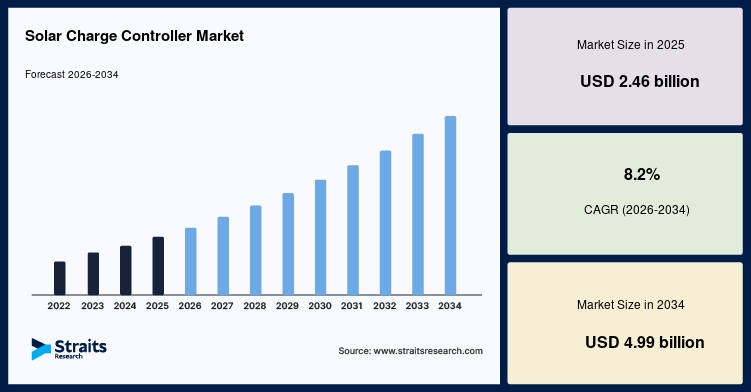
Renewable Energy Investments Supporting the Solar Charge Controller Market
Other |
2026-07-13 11:31:34
In-Mold Electronics Market: Growth Trends, Segments, and Regional Outlook (2025–2034)
The global In-Mold Electronics Market was valued at USD 208.94 million in 2024 and is projected to grow at a compound annual growth rate of 27.5% from 2025 to 2034, reaching approximately USD 2,367.34 million by the end of the forecast period, with the market estimated at USD 265.87 million in 2025. This exceptional growth trajectory is driven by the rising demand for lightweight and compact electronic components, particularly within the automotive and consumer electronics sectors, alongside a growing industry-wide focus on sustainable manufacturing practices and smart surface integration. In-mold electronics, an advanced manufacturing technique that embeds electronic functions directly into plastic parts during the molding process, is rapidly transforming how manufacturers approach product design, replacing traditional wiring harnesses and mechanical switches with seamless, integrated circuits. Asia Pacific led the market in 2024, supported by extensive manufacturing capabilities and strong consumer electronics demand, while North America and Europe continue to expand adoption through robust automotive innovation and research investment.
Market Overview
In-mold electronics (IME) combines traditional manufacturing processes such as printing and injection molding to create seamless, smart surfaces with embedded circuits, sensors, and lighting directly built into plastic parts. This integration eliminates the need for bulky wiring harnesses, circuit boards, and mechanical switches, resulting in thinner, lighter, and more durable products across automotive, consumer electronics, home appliance, and industrial applications. The technology's ability to combine several production steps into one process reduces part counts and simplifies assembly, aligning closely with broader industry efforts toward more sustainable, resource-efficient manufacturing. As industries increasingly prioritize interactive, button-free surfaces and cleaner product aesthetics, IME has become a critical enabling technology for next-generation smart product design.
Growth Drivers
Increasing demand for lightweight and compact designs remains the market's foremost growth driver, as automotive manufacturers and consumer electronics companies continue to prioritize weight and size reduction. In vehicles, lighter components directly improve fuel efficiency and extend range for electric vehicles, while in consumer gadgets, compactness enhances portability and convenience; research published in April 2024 highlighted that a 10% reduction in vehicle weight can improve fuel economy by 6% to 8%, underscoring the critical role lightweighting plays in meeting energy efficiency goals. Enhanced design flexibility and aesthetics represent another significant catalyst, as manufacturers increasingly seek seamless surfaces free of visible buttons and complex wiring, with in-mold electronics enabling the integration of touch sensors and lighting directly into curved, three-dimensional surfaces. Industry research examining human-machine interface design in connected vehicles has reinforced the growing focus on intuitive, integrated interfaces, a demand that in-mold electronics is well positioned to meet. High initial investment requirements remain a key restraint, as the specialized equipment and process integration required for IME manufacturing can pose a barrier for smaller market participants.
Segment Insights
By components, capacitive touch sensing dominated the market in 2024, driven by widespread consumer preference for sleek, button-free interfaces across automotive interiors, home appliances, and consumer electronics, with the technology's ability to withstand harsh environments while enabling gesture recognition and multi-touch capabilities reinforcing its leading position. The lighting segment is projected to register the fastest growth, fueled by rising demand for advanced, aesthetically pleasing lighting solutions, particularly in automotive interior ambient lighting and exterior illumination, alongside growing adoption in smart home devices and wearables. By technology, screen printing led the market in 2024 due to its cost-effectiveness, scalability, and proven reliability in depositing conductive inks onto flexible substrates, while inkjet printing is expected to grow fastest as its digital, on-demand pattern creation reduces setup times and enables more intricate, customized circuit designs. By end use, the automotive segment held the largest share, propelled by the industry's push for lightweight vehicles and advanced human-machine interfaces, while consumer electronics is projected to be the fastest-growing end-use segment as smartphones, wearables, and smart home devices increasingly adopt seamless touch interfaces.
𝐄𝐱𝐩𝐥𝐨𝐫𝐞 𝐓𝐡𝐞 𝐂𝐨𝐦𝐩𝐥𝐞𝐭𝐞 𝐂𝐨𝐦𝐩𝐫𝐞𝐡𝐞𝐧𝐬𝐢𝐯𝐞 𝐑𝐞𝐩𝐨𝐫𝐭 𝐇𝐞𝐫𝐞:
https://www.polarismarketresearch.com/industry-analysis/in-mold-electronics-market
Regional Trends
Asia Pacific accounted for the largest share of the in-mold electronics market in 2024, fueled by the region's vast manufacturing capabilities in consumer electronics and automotive production, alongside booming demand for smart and connected devices. China stands out as a dominant force within the region, rapidly integrating IME across smartphones, home appliances, and electric vehicles, supported by expansive manufacturing infrastructure and a strong focus on technological advancement. North America represents a significant market as well, driven by its robust automotive and aerospace sectors and strong government support for advanced manufacturing initiatives, with the U.S. standing out due to its rapid transition toward electric and autonomous vehicles, which is creating substantial demand for lightweight, multifunctional interior components alongside a large, smart-device-savvy consumer electronics sector. Europe represents a substantial landscape as well, characterized by a mature automotive industry and strong emphasis on vehicle weight reduction and sustainable production practices, with Germany playing a pivotal role as a global hub for automotive manufacturing and engineering innovation in touch-sensitive control panels and advanced lighting features.
Competitive Landscape
The in-mold electronics market features a dynamic competitive landscape shaped by continuous technological advancement, strategic partnerships, and expanding product portfolios tailored to automotive and consumer electronics applications. Key players include DuPont (Celanese Corporation), Nissha Co., Ltd., TactoTek, Butler Technologies, Eastprint Incorporated, Golden Valley Products, InMold Solution, YOMURA TECHNOLOGIES, INC., Canatu Oy, Henkel AG & Co. KGaA, Sumitomo Bakelite Co., Ltd., and SABIC. These companies compete through continuous improvement in material science, manufacturing process optimization, and the integration of new functionalities into IME components. Recent developments underscore the pace of innovation shaping the space: in March 2025, Valeo licensed TactoTek's IMSE (In-Mold Structural Electronics) technology to advance interior and exterior lighting applications in vehicles, reflecting the automotive industry's continued move toward integrated smart surfaces. Meanwhile, DuPont announced in May 2024 plans to separate into three distinct, publicly traded companies, with its Electronics business proposed for spinoff, signaling a broader industry shift toward more focused electronics-specific business strategies.
In-Mold Electronics Market growth through 2034 will be shaped by continued innovation in touch sensing and lighting technologies, expanding automotive and consumer electronics applications, and sustained industry focus on sustainable, weight-reducing manufacturing methods. As smart surfaces become increasingly central to product design across vehicles, appliances, and personal devices, companies that prioritize material science innovation, manufacturing efficiency, and strategic partnerships across automotive and electronics sectors will be best positioned to capture the substantial growth this market is projected to deliver over the next decade.
More Trending Latest Reports By Polaris Market Research:
Ultrasound Needle Guides Market