English
 Arabic
 French
 Spanish
 Portuguese
 Deutsch
 Turkish
 Dutch
Dutch
 Italiano
 Russian
 Romaian
 Portuguese (Brazil)
 Greek
Greek
Does Robinhood have calls?
Other |
2025-04-22 13:25:14
 Social Networth OS
 Creator Commerce
 Launch Startup
 Global News
 Creator Award
 Talkfever App
Alle anzeigen
Talkfever App
Alle anzeigen

Upgrade auf Pro
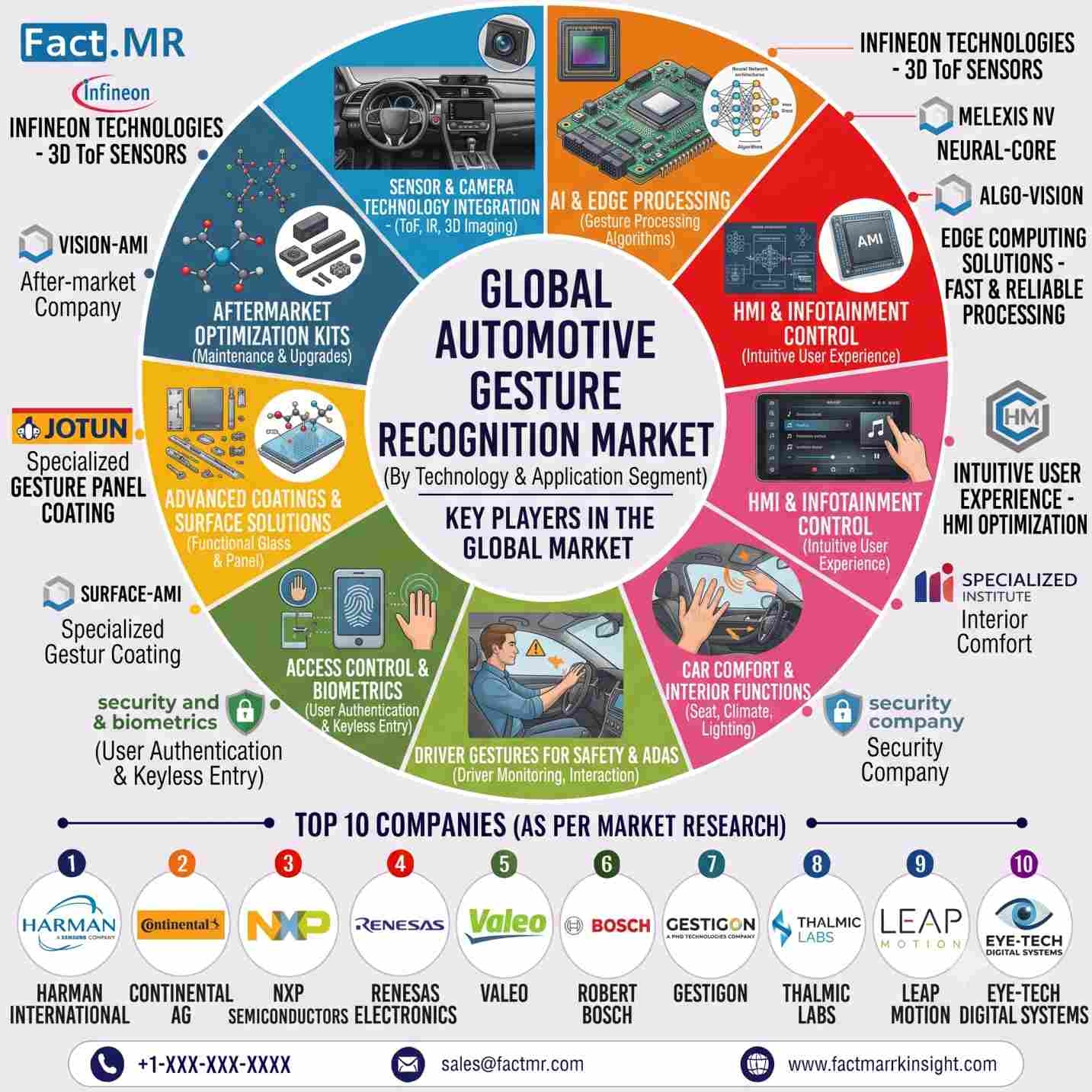
HARMAN announced in January 2025 a series of new partnerships aimed at advancing automotive solutions spanning in-car connectivity, infotainment, and gesture recognition technologies. The move reflects a wider shift in vehicle interfaces, where manufacturers are seeking alternatives to physical controls and touchscreens that can reduce driver interaction time. Against this backdrop, the global Automotive Gesture Recognition Market is projected by Fact.MR to rise from USD 3.08 billion in 2026 to USD 16.82 billion by 2036, expanding at an 18.5% CAGR.
Touchless systems account for 63.4% of the component-type segment in 2026, while infotainment represents 39.6% of application demand. Hand-based authentication holds 34.7% of the authentication segment, highlighting the importance of intuitive motion-based commands inside connected vehicles.
Get Detailed Market Forecasts, Competitive Benchmarking, and Pricing Trends: https://www.factmr.com/connectus/sample?flag=S&rep_id=20
Why is gesture recognition moving beyond luxury vehicles?
Automotive gesture recognition was once closely associated with premium vehicle cabins. That positioning is changing as sensor prices decline and machine-learning inference becomes more efficient.
Camera-based systems, radar sensors, ultrasonic technologies, and embedded software can now work together to identify defined movements and convert them into vehicle commands. This allows drivers and passengers to interact with selected functions without touching a screen or physical surface.
The commercial opportunity is substantial. Fact.MR estimates an absolute dollar opportunity of USD 13.74 billion between 2026 and 2036, reflecting the expected migration of gesture control toward mid-segment and higher-volume vehicle platforms.
The technology also fits a broader vehicle-design shift. Connected cars contain more digital functions, while automakers are under pressure to make those functions easier to access without creating additional visual or manual workload for drivers.
An important procurement detail is emerging: gesture recognition suppliers are no longer competing only on sensor hardware. Recognition accuracy across sunlight, nighttime conditions, cabin glare, different hand positions, and varying gesture speeds can determine whether an OEM system earns platform-wide adoption.
What makes touchless systems the leading technology segment?
Touchless systems hold 63.4% of the component-type segment in 2026. Their appeal comes from the ability to interpret movements without physical contact.
A typical architecture can combine cameras or other sensors with image processing and machine-learning models. The system identifies a defined gesture and maps it to a vehicle function such as changing audio settings, controlling navigation, adjusting climate functions, or operating lighting.
This approach addresses several limitations of conventional interfaces.
Physical controls can experience mechanical wear. Touchscreens can require visual attention. Touchless interfaces provide another interaction layer while preserving access to digital vehicle functions.
Fact.MR identifies several technology categories within the broader market, including:
For OEMs, the challenge is balancing accuracy, response time, packaging requirements, processing power, and system cost.
Why does infotainment lead automotive gesture recognition applications?
Infotainment accounts for 39.6% of the application segment in 2026, making it the largest identified use case.
Audio control, navigation interaction, connected services, and related functions generate frequent driver and passenger interactions. Gesture recognition can provide a supplementary control method for these functions.
The technology can also support multimodal human-machine interfaces. Instead of relying on one input method, vehicle systems can combine gesture, voice, touch, and conventional controls depending on the task.
That creates an important design opportunity. Gesture control does not need to replace every physical or digital interface. It can be deployed selectively where hands-free or reduced-touch interaction provides the greatest usability benefit.
Which countries offer the strongest growth opportunities?
China leads the highlighted country outlook with a projected 17.6% CAGR from 2026 to 2036.
The country benefits from rapid intelligent-vehicle development, strong domestic automotive technology activity, and consumer familiarity with motion-controlled digital interfaces.
The United States follows with a 15.8% CAGR, supported by OEM interest in hands-free interaction and growing attention to driver distraction.
India is projected to expand at 15.4%, while Germany reaches 14.6%. Japan, the United Kingdom, and Brazil post slower but still substantial growth.
Fact.MR's country projections are:
Germany is particularly significant within Western Europe. The country is projected to account for 30.4% of the regional market, with an 18.0% CAGR between 2026 and 2036, according to Fact.MR.
German vehicle manufacturers' focus on premium HMI, autonomous mobility, and advanced cabin technologies creates a strong environment for gesture recognition suppliers.
How could regulation and vehicle safety affect demand?
Driver distraction is becoming a key consideration in vehicle interface design.
Automakers increasingly need to provide access to digital functions without creating unnecessary visual or manual workload. Gesture recognition can support this objective when systems are designed around clear, simple, and reliable commands.
However, the technology is not automatically safer. Poor recognition accuracy can create unexpected commands and reduce driver confidence.
This makes validation important. Suppliers must demonstrate that systems perform consistently under real cabin conditions rather than only controlled demonstrations.
Cost remains another barrier. Cameras, radar, processing hardware, software development, testing, and integration can increase system expense. Privacy concerns may also affect consumer acceptance where sensing technologies monitor movements inside the cabin.
What technology trends will shape the market through 2036?
Three development paths are becoming commercially relevant.
First, sensor-cost reductions are widening the addressable vehicle base. Lower-cost camera, infrared, radar, and related sensing technologies can make gesture control more practical for volume platforms.
Second, machine-learning improvements are increasing the number of gestures that systems can classify and improving their ability to distinguish intentional commands from unrelated movements.
Third, multimodal interfaces are changing how gesture recognition is positioned. Gesture control can operate alongside voice, touch, and traditional switches instead of functioning as an isolated interface.
The result is a broader HMI architecture in which different input methods are selected according to the driving context.
Who is competing in the Automotive Gesture Recognition Market?
The competitive landscape includes automotive electronics suppliers, HMI technology companies, semiconductor manufacturers, and specialized gesture-recognition developers.
Fact.MR profiles:
In January 2025, HARMAN's announcement of new partnerships provided a visible example of how major automotive technology suppliers are expanding collaboration around connected and intelligent cabin technologies.
Competition is likely to increasingly focus on system-level integration rather than individual sensors. Suppliers able to combine sensing, processing, software, automotive qualification, and OEM integration can pursue larger platform opportunities.
What does the 2036 forecast mean for automotive technology suppliers?
The market's rise from USD 3.08 billion in 2026 to USD 16.82 billion in 2036 represents a major expansion in the commercial addressable market.
The strongest opportunities are likely to emerge where three conditions overlap: declining hardware costs, higher vehicle software content, and demand for simpler human-machine interaction.
For suppliers, the strategic priority is moving from demonstration-grade gesture recognition toward automotive-grade reliability. For OEMs, the decision increasingly involves whether gesture recognition can provide measurable usability and distraction benefits at an acceptable system cost.
The technology's transition into higher-volume platforms could therefore be more important than its continued presence in luxury vehicles.
Automotive Gesture Recognition Market Snapshot
The complete Automotive Gesture Recognition Market Size, Market Forecast and Outlook report is available from Fact.MR.
https://www.factmr.com/report/20/automotive-gesture-recognition-market
About the Automotive Gesture Recognition Market Report
The Fact.MR study examines the market across component type, authentication type, application, region, and country.
The report evaluates touch-based and touchless technologies, gesture sensing architectures, hand and other authentication approaches, and applications spanning infotainment, navigation, climate control, windows and sunroofs, and lighting.
Related Report:
https://plaza.rakuten.co.jp/factmr01/diary/202609040002/
About Fact.MR
Fact.MR provides syndicated and custom market research across automotive, technology, consumer goods, healthcare, chemicals, and industrial sectors. Its research process combines primary research, secondary research, market modelling, triangulation, and validation.