English
 Arabic
 French
 Spanish
 Portuguese
 Deutsch
 Turkish
 Dutch
Dutch
 Italiano
 Russian
 Romaian
 Portuguese (Brazil)
 Greek
Greek
Handheld Ultrasonic Flow Meter Market Global Updates | Research Overview 2025 to 2034
Networking |
2025-04-11 06:44:45
 Social Networth OS
 Creator Commerce
 Launch Startup
 Global News
 Creator Award
 Talkfever App
Ver Todos
Talkfever App
Ver Todos

Atualize para o Pro
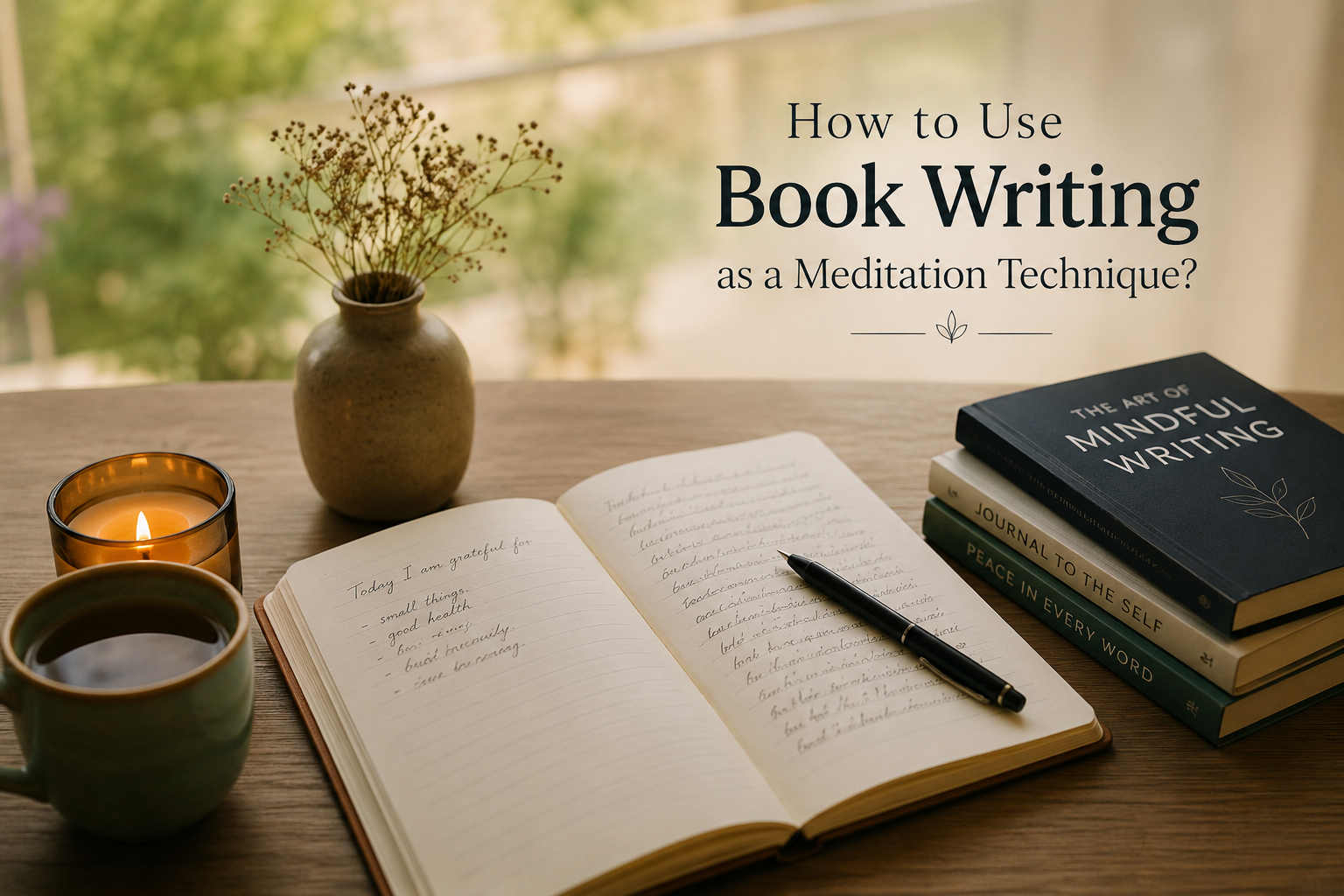
Meditation does not always mean sitting cross-legged in silence, closing your eyes and trying to empty your mind. Also, for many people, sitting still for even ten minutes is not easy, as their thoughts jump from incomplete work to future plans, old memories, random worries, and so on.
However, there is another way to cultivate mindfulness: book writing. It is a powerful meditation technique in which we fully discover ourselves and our subconscious thoughts. When we write with clear intention, rather than worrying about grammar or publication, the entire writing process can help us slow down, observe our thoughts, and become fully immersed in the moment.
If you are struggling to meditate, but you like the idea of book writing as a meditation, then you are in the right place.
First, let's discuss what meditation is. It is the practice of focus, loss of focus, and return to focus. It actually means focusing on one thing, like a breath, point, or idea, to calm the mind and achieve a state of relaxed awareness. It mainly involves mental focus, deep contemplation, relaxation, and calm.
Also, when meditating, your mind can wander to random thoughts. It can be frustrating, but the key to successful meditation is practice.
Writing meditation is the process of combining mindfulness with writing. Instead of stopping your thoughts, it involves observing them and putting them into words without immediately judging or correcting them. Traditional meditation asks you to focus on your body, breath, or surroundings. However, writing meditation focuses on the words.
However, the goal is not to craft a best-selling novel or write polished paragraphs; instead, the goal is to become aware of what you are thinking and feeling as you write.
Imagine sitting with a blank page, and you write: I don't know what to write today. My mind feels busy, and I keep thinking about everything I need to do.
As you continue to write without stopping to criticize yourself, your thoughts naturally become more organized. This is the core of mindful writing.
Book writing requires attention, and when you become deeply absorbed in describing a character or story, explaining an idea, or exploring a personal experience, it moves your attention away from distractions, which leads to the creation of focused awareness.
Moreover, book writing can also encourage you to notice the small details. It also pushes you to observe things like how sunlight falls through a window, how a character feels through complex conversation, and how a particular memory makes you feel.
As a meditation writer, you will start paying attention instead of rushing.
Your environment is really crucial. Actually, you don't need a perfect home or expensive equipment; instead, you just need a comfortable chair, a notebook or laptop, and a quiet corner for this technique.
Before you start with meditation, you must put your phone on silent, close unnecessary browser tabs, keep your workspace comfortable, take a few slow breaths, decide how much time you want to write, and also remind yourself that perfection is not the goal. Therefore, 10-15 minutes can be enough to start with.
Before you start putting words on your page, you must spend a lot of time focusing on your breathing. You don't need to perform complex breathing exercises, but you need to notice your natural breath.
You need to feel it entering and leaving the body. Also, notice whether your breathing feels fast or slow, and if your mind wanders, then you must bring your attention back; after a few minutes, begin writing.
The major obstacle in mindful writing is the inner critic… thoughts like the sentence sounds terrible, the idea is stupid, nobody would want to read this, my grammar is not good enough. These judgmental thoughts can interrupt the contemplative style of writing. Instead, you must adopt the writing first and judge later technique.
Also, you must not worry about whether your sentences are beautiful, whether your vocabulary is great, or whether your punctuation is perfect.
Instead, let the words come.
Note that your first draft isn't your final draft; therefore, you can also consider working with a book writing company.
Stream of consciousness is essential for meditation. You can set a timer for 10-15 minutes and write continuously. Just continue writing until suddenly another thought appears that you didn't know was occupying your mind.
So, the next step is to consider your own experiences to transform them into mindful book writing.
You must think about a moment that changed you; it can be a difficult decision, an unexpected friendship, a personal achievement, a journey, or a moment where you learned something really crucial.
You can recreate that experience through writing. However, you will have to ask questions such as: What could I see? What could I hear? What was I feeling? What was happening around me?
What did I understand at that moment? What do I understand about it now?
This exercise can help you revisit those past experiences, and storytelling can become a form of reflection.
Another enjoyable writing technique is to write about something ordinary or random as you are experiencing it for the first time. For this, you must choose an object near you. It can be a cup of tea, a plant, a window, a book, or even your writing desk.
Instead of simply writing, this cup is blue; look and observe more details, such as what shade of blue it is. What kind of surface does it have? Does it have any scratches? What does the tea smell like, and what memories does it bring to the mind?
This exercise can train your attention to remain attentive to one subject rather than jumping between thoughts.
Many authors begin exploring these genres through quiet, unedited writing sessions long before submitting a completed manuscript to established book publishing companies.
Book writing as a meditation technique isn't only about creativity; it also supports mental and emotional well-being.
Book writing isn’t all about creativity; it can also be a personal practice to encourage reflection, creativity, concentration, and mindfulness.
Furthermore, by creating a quiet environment, focusing on your breath, writing without judgment, exploring your emotions, and allowing your thoughts to flow naturally, you can transform the writing process into a form of meditation.
However, the best part is that you don't have to choose between mindfulness and creativity, as you can practice both at the same time.