 English
 Arabic
 French
 Spanish
 Portuguese
 Deutsch
 Turkish
 Dutch
Dutch
 Italiano
 Russian
 Romaian
 Portuguese (Brazil)
 Greek
Greek
How can i speak to someone at Lobstr Wallet Support Number?
Food |
2025-04-18 09:39:56
 Social Networth OS
 Creator Commerce
 Launch Startup
 Global News
 Creator Award
 Talkfever App
Alle anzeigen
Talkfever App
Alle anzeigen

Upgrade auf Pro
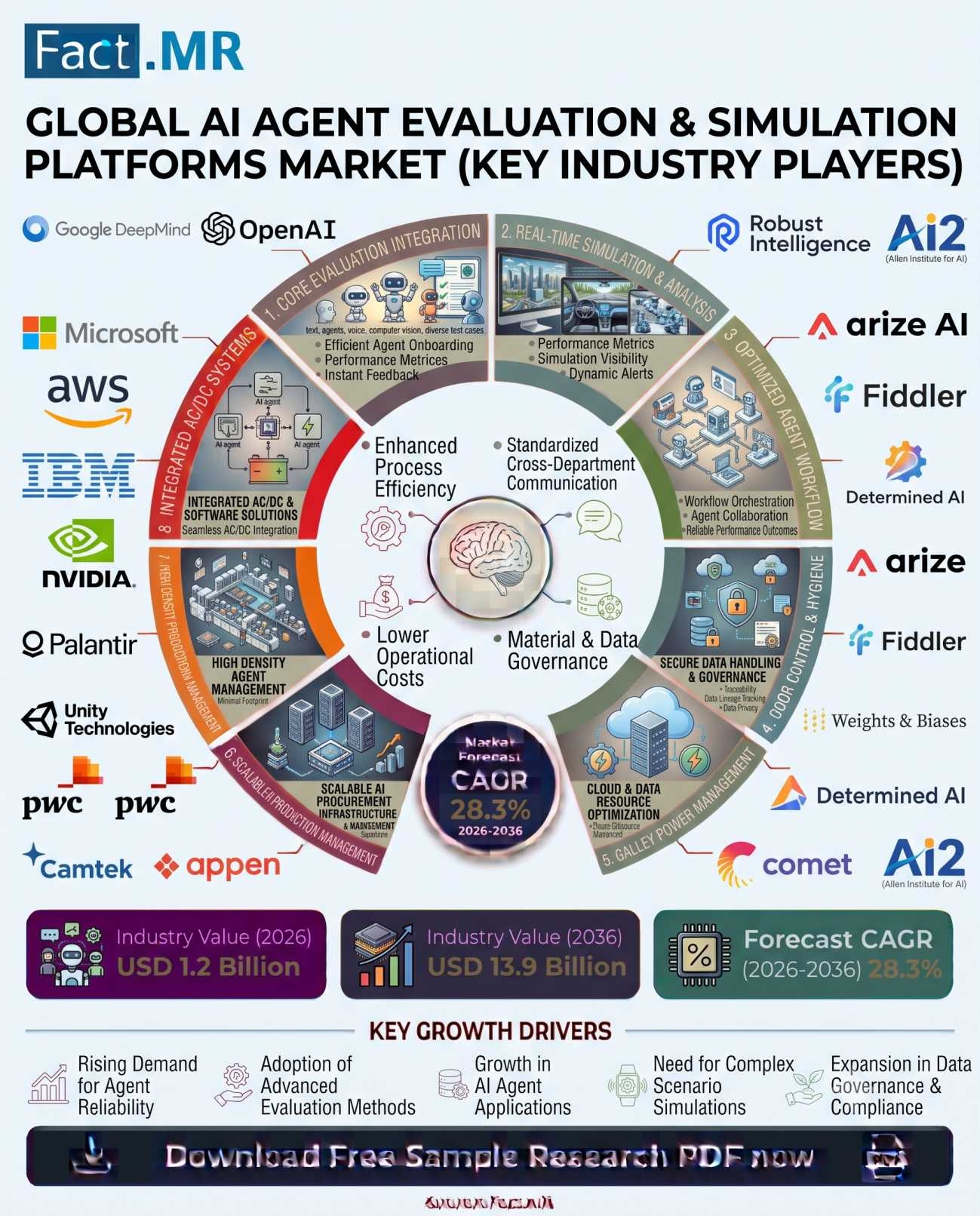
A large-scale AI security red-teaming competition generated more than 250,000 attack attempts from over 400 participants in March 2026, highlighting the growing need to test AI agents against adversarial behavior before they are deployed in business workflows. The development comes as companies increasingly use evaluation and simulation platforms to assess agent reliability, tool use, safety, and task completion.
The AI Agent Evaluation & Simulation Platforms Market is projected to increase from USD 980 million in 2026 to USD 11,039 million by 2036, according to Fact.MR. The market is forecast to expand at a 27.4% CAGR from 2026 to 2036 as software teams and regulated enterprises seek repeatable evidence before releasing AI agents into production.
Get Detailed Market Forecasts, Competitive Benchmarking, and Pricing Trends: https://www.factmr.com/connectus/sample?flag=S&rep_id=16066
Why are companies testing AI agents before production?
AI agents can make decisions across multiple steps, select external tools, retrieve information, and change course based on previous actions. That makes traditional single-response testing less useful for applications where an agent must complete an entire business task.
Evaluation platforms are increasingly being used to score task completion, compare agent responses with business objectives, simulate multi-turn workflows, and identify failed tool calls before they reach customers or employees. Security teams are also looking at red-teaming workflows that can expose unsafe actions and unexpected agent behavior.
The shift matters because evaluation is moving closer to the software release process. Instead of treating testing as a one-time quality check, enterprises are beginning to require evidence showing whether an agent meets predefined reliability and safety thresholds before deployment.
Evaluation and benchmarking lead platform demand
Evaluation & benchmarking is projected to account for 31.0% share of the market in 2026, making it the leading capability segment. Enterprises are using structured scoring to compare agent performance, identify weaknesses, and establish release gates.
Cloud/SaaS deployment is expected to dominate with 72.0% share in 2026. Hosted platforms allow engineering teams to run evaluations, maintain shared dashboards, and collaborate across locations without building the entire evaluation infrastructure internally.
Software & internet companies are anticipated to represent 34.0% share in 2026, as these businesses are among the earliest adopters of agent-based features across products, developer tools, and support workflows. Large enterprises are expected to account for 58.0% share, supported by formal policy reviews, permission controls, audit requirements, and structured release processes.
Market Snapshot
USD 980 million - estimated market value in 2026
USD 11,039 million - projected market value by 2036
27.4% - projected CAGR from 2026 to 2036
31.0% - 2026 share projected for Evaluation & benchmarking
72.0% - 2026 share projected for Cloud/SaaS
58.0% - 2026 share projected for large enterprises
Browse full Report: https://www.factmr.com/report/ai-agent-evaluation-and-simulation-platforms-market
What's driving near-term demand?
Agent reliability benchmarking is identified as the strongest driver, with an estimated +5.0% impact on CAGR. Companies need repeatable scoring that assesses task completion, tool selection, refusal behavior, and other agent actions before software reaches customer or employee workflows.
Multi-turn simulation environments are another important driver, with an estimated +4.3% impact on CAGR. These environments allow teams to recreate longer workflows and identify failures that may not appear during isolated prompt testing.
Production observability and tracing are projected to contribute a +3.9% impact on CAGR. Connecting evaluation results with production traces can give engineering and risk teams evidence of how an agent behaves when selecting tools, changing direction, or completing a task.
Red-teaming for tool-use agents is expected to contribute +3.2%, while regulated workflow evidence carries an estimated +2.5% impact on CAGR. BFSI, healthcare, and public-sector organizations have stronger requirements for records that can support internal reviews and release decisions.
At the same time, weak benchmark validity represents an estimated -2.0% restraint on CAGR. Static tests can miss failures that emerge only during long, changing workflows, creating pressure for evaluation platforms to keep test scenarios aligned with real operating conditions.
Singapore leads country-level growth
Singapore is projected to record the fastest growth among the countries covered, with a 29.5% CAGR from 2026 to 2036. Canada follows at 28.8%, while the United States is expected to grow at 28.0%. The United Kingdom, Germany, and France are forecast to record CAGRs of 27.5%, 27.4%, and 27.1%, respectively.
Singapore's growth is supported by national AI programs and growing demand for assurance-oriented deployment. The report notes that IMDA reported SME AI adoption increasing from 4.2% in 2023 to 14.5% in 2024.
Canada's market is expected to benefit from wider business AI adoption and demand from regulated service providers. In the United States, large software teams and enterprise AI operations are creating a strong environment for evaluation and simulation platforms.
The United Kingdom is also seeing growing demand as large businesses formalize AI review processes, while Germany's industrial enterprises are adding AI controls to software and automation programs.
Analyst Perspective
Shambhu Nath Jha, Principal Consultant at Fact.MR, states:
"Agent evaluation is becoming a release discipline."
He adds that enterprise teams are expected to judge agents on task completion and safe tool use before rollout, while providers that combine simulation with observability are likely to gain more platform commitments.
About the Report
The AI Agent Evaluation & Simulation Platforms Market study examines software platforms used to evaluate, simulate, red-team, observe, and benchmark AI agents across multi-step tasks, tool calls, traces, and business workflow outcomes.
The report analyzes the market by:
Capability: Evaluation & benchmarking; Simulation environments; Observability & tracing; Red-teaming & safety
Deployment: Cloud/SaaS; Self-hosted
End-Use: Software & internet; BFSI; Healthcare; Customer service; Public sector
Organization Size: Large enterprises; SMEs & startups
Regions: North America; Latin America; Europe; East Asia; South Asia and Pacific; Middle East and Africa
Countries: Singapore; Canada; United States; United Kingdom; Germany; France
Explore More Related Studies Published by Fact.MR Research:
https://www.openpr.com/news/4596799/marketing-performance-management-mpm-software-market
https://www.openpr.com/news/4596822/artificial-intelligence-in-food-and-beverages-market
https://www.openpr.com/news/4597880/data-center-and-ai-server-printed-circuit-board-market-forecast
https://www.openpr.com/news/4597921/digital-cold-chain-management-market-revenue-set-to-increase
Key companies profiled include LangChain, Inc. (LangSmith), Braintrust, Galileo, Arize AI, Patronus AI, and Scale AI.
The analysis draws on 120+ sources, 35+ company portfolios, 25+ countries, and more than 20 industry interviews. The research combines primary interviews with AI platform teams, software vendors, security reviewers, risk officers, product managers, and procurement teams with desk research covering government statistics, regulator publications, company announcements, technical studies, standards, and public policy.
Contact:
US Sales Office
11140 Rockville Pike
Suite 400
Rockville, MD 20852
United States
Tel: +1 (628) 251-1583, +353-1-4434-232
Email: sales@factmr.com
About Fact.MR
Fact.MR is a global market research and consulting firm, trusted by Fortune 500 companies and emerging businesses for reliable insights and strategic intelligence. With a presence across the U.S., UK, India, and Dubai, we deliver data-driven research and tailored consulting solutions across 30+ industries and 1,000+ markets. Backed by deep expertise and advanced analytics, Fact.MR helps organizations uncover opportunities, reduce risks, and make informed decisions for sustainable growth.

