English
 Arabic
 French
 Spanish
 Portuguese
 Deutsch
 Turkish
 Dutch
Dutch
 Italiano
 Russian
 Romaian
 Portuguese (Brazil)
 Greek
Greek
MF DOOM Merch Pieces Worth Adding To Collections
Other |
2026-08-22 17:38:49
 Social Networth OS
 Creator Commerce
 Launch Startup
 Global News
 Creator Award
 Talkfever App
Смотреть все
Talkfever App
Смотреть все

Обновить до Про
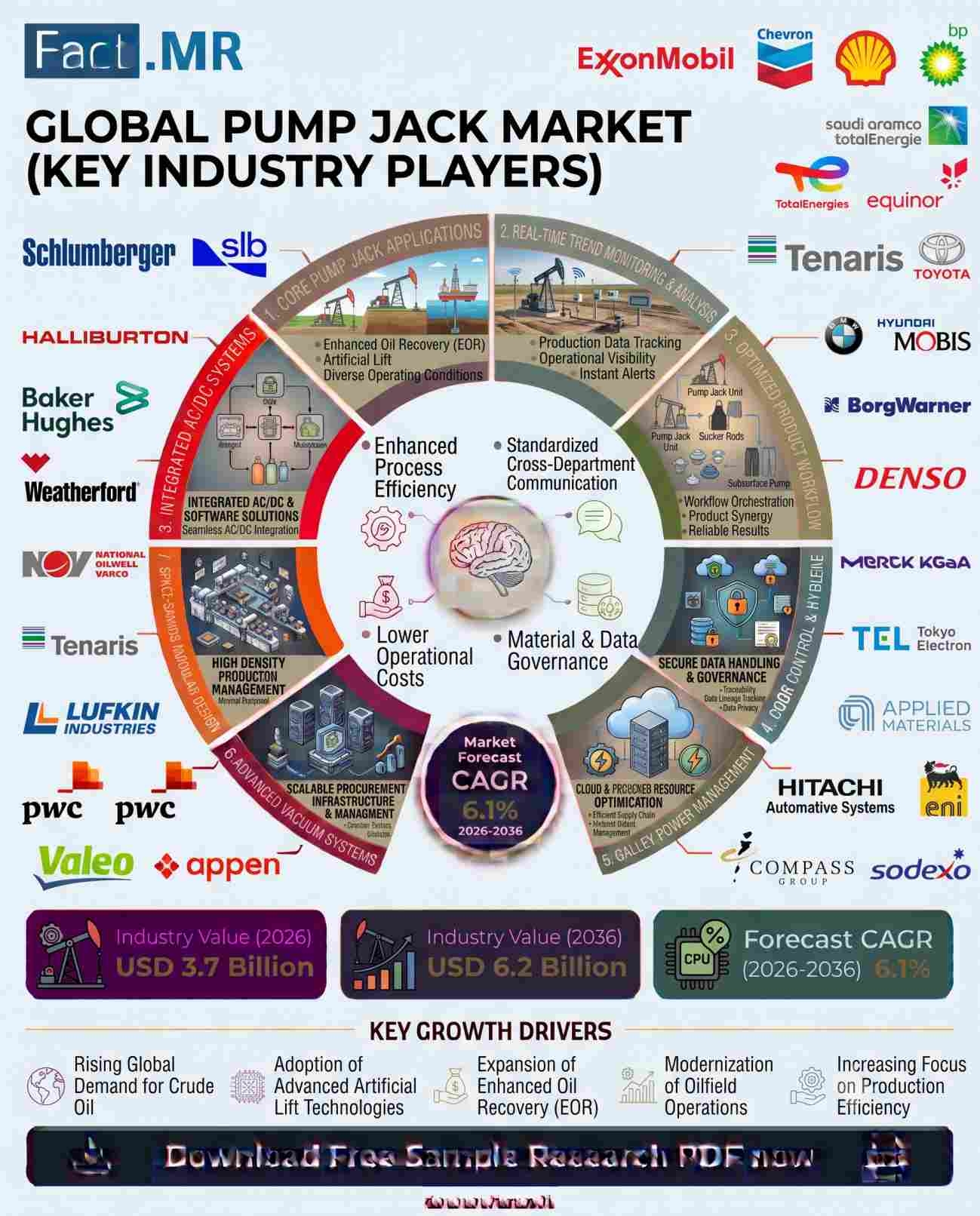
The global pump jack market is projected to reach USD 7.3 billion by 2036, up from USD 4.2 billion in 2026, expanding at a 5.7% CAGR during the forecast period, according to Fact.MR. The market was valued at USD 3.9 billion in 2025. Growth is expected to generate an absolute dollar opportunity of USD 3.1 billion between 2026 and 2036.
Pump jacks remain essential across mature onshore oilfields where declining reservoir pressure makes artificial lift necessary to maintain production. Demand is being supported by replacement of aging equipment, increasing adoption of electric drives, automation, remote monitoring, and enhanced oil recovery programs. However, oil price volatility, upstream capital spending discipline, OPEC+ production decisions, and the global shift toward lower-carbon energy systems are limiting the pace of new installations in some markets.
Get Detailed Market Forecasts, Competitive Benchmarking, and Pricing Trends: https://www.factmr.com/connectus/sample?flag=S&rep_id=14382
Mature Oilfields Keep Artificial Lift Demand Strong
Approximately 90% of producing wells require artificial lift at some stage of their lifecycle, creating a structural requirement for equipment such as pump jacks.
Pump jacks, also known as beam pumps or nodding donkeys, convert rotary power into reciprocating movement that drives rods and subsurface pumps. Their relatively simple design, established service infrastructure, and suitability for low-pressure wells make them an important solution for mature onshore production.
Operators increasingly focus on extending the productive life of existing wells rather than relying only on new drilling. This supports demand for pump jack replacement, refurbishment, modernization, and performance optimization.
The installed base is therefore an important source of future revenue for manufacturers and service providers.
Electric Pump Jacks Gain Competitive Advantage
Electric pump jacks are expected to account for approximately 40.2% of the market in 2026.
Their growing adoption is linked to lower operating costs, reduced dependence on fuel-powered engines, lower emissions, and compatibility with modern control systems. Electric units can also be integrated with variable frequency drives, allowing operators to adjust pump speed and stroke performance according to well conditions.
This capability is increasingly important as operators seek to optimize production while reducing energy consumption.
The shift toward electrification is creating an opportunity for manufacturers to generate revenue not only from new equipment but also from conversion and modernization programs for older mechanical systems.
Automation Becomes a Key Purchasing Criterion
Automated pump jacks are projected to hold 43.7% share in 2026.
Large oilfield operators often manage hundreds of producing wells with lean field teams. Manual inspection and adjustment across such extensive assets can increase labor requirements and delay responses to equipment problems.
Automated systems address this challenge through remote monitoring, automated stroke optimization, performance alerts, and predictive maintenance capabilities.
Digital controls can help operators identify abnormal operating conditions before they result in major equipment failure. This improves uptime and reduces unnecessary field visits.
As a result, automation is increasingly becoming part of pump jack procurement decisions rather than an optional upgrade.
Low-Capacity Wells Represent a Major Application Base
Pump jacks are widely used in mature, low-production wells where operators need economical artificial lift.
The up-to-100 BPD capacity segment is estimated to hold 35.2% share in 2026. These wells are particularly important across mature onshore fields in North America and other established producing regions.
For low-rate wells, equipment economics are critical. Operators generally prefer reliable systems with manageable installation, energy, and maintenance costs.
This makes pump jacks an attractive option where production volumes do not justify more complex artificial lift technologies.
Asia Pacific Emerges as a High-Growth Region
Asia Pacific is expected to be the fastest-growing regional market as national oil companies and energy producers invest in mature field production and equipment modernization.
China is expanding production from established onshore basins, while Japan and South Korea are focusing on modernization and energy infrastructure. Regional investment in automation and equipment efficiency is creating additional opportunities for pump jack suppliers.
Country-level CAGR projections for 2026–2036 include:
China Pump Jack Market
China is forecast to expand at a 6.9% CAGR through 2036. Continued investment in mature oilfields, including major production areas operated by national energy companies, supports demand for artificial lift equipment.
Modernization programs are also encouraging the adoption of automated and digitally monitored pump systems.
Japan Pump Jack Market
Japan is projected to register a 7.5% CAGR. Demand is supported by efforts to improve productivity from existing assets and modernize oilfield equipment. Industrial maintenance and specialized equipment applications provide additional demand opportunities.
South Korea Pump Jack Market
South Korea leads the highlighted countries with an 8.9% CAGR. Growth is associated with industrial equipment modernization, refinery infrastructure investment, and participation in overseas oil production assets requiring artificial lift technologies.
United Kingdom Pump Jack Market
The United Kingdom is expected to grow at a 7.7% CAGR. Mature North Sea assets and efforts to improve production efficiency are creating opportunities for equipment replacement, electrification, and enhanced recovery technologies.
United States Pump Jack Market
The United States market is projected to grow at a 6.5% CAGR. The Permian Basin, Eagle Ford, Bakken, and other mature onshore production areas provide a large installed base of artificial lift equipment.
A significant portion of future spending is expected to focus on replacement, efficiency upgrades, electrification, and automation rather than purely new installations.
Energy Transition Creates Both Pressure and Opportunity
The energy transition presents a complex outlook for pump jack manufacturers.
Lower long-term investment in conventional oil production could restrict new equipment purchases. At the same time, operators continue to require artificial lift for producing existing wells.
Environmental requirements are also encouraging the replacement of conventional gas-engine equipment with electric alternatives.
This creates a transition opportunity for suppliers capable of offering energy-efficient pump jacks, remote monitoring, variable frequency drives, and emissions-conscious solutions.
The market is therefore shifting from simple equipment supply toward lifecycle optimization.
Digital Monitoring Strengthens Aftermarket Opportunities
Connected pump jacks can generate additional revenue through monitoring, analytics, maintenance, and optimization services.
Operators can use digital platforms to monitor pump performance, identify potential failures, and adjust operating parameters remotely.
This is particularly valuable for geographically dispersed well portfolios.
Manufacturers and oilfield service companies that combine equipment with digital services can create longer-term customer relationships and recurring aftermarket revenue.
Procurement Focuses on Total Lifecycle Cost
Oilfield operators increasingly evaluate pump jacks based on total ownership cost rather than initial purchase price alone.
Important procurement considerations include:
Suppliers with strong field-service capabilities can gain an advantage because pump jack buyers often require technical assistance throughout installation and operation.
Competitive Landscape
The global pump jack market includes major artificial lift and oilfield equipment companies alongside regional manufacturers and specialized service providers.
Key players include:
Competition is increasingly moving toward integrated offerings. Equipment manufacturers are adding automation, digital monitoring, predictive maintenance, and optimization capabilities to differentiate their products.
The acquisition of ChampionX by SLB in 2025 further strengthened SLB's artificial lift portfolio and increased the strategic importance of integrated production solutions.
Analyst Perspective
Shambhu Nath Jha, Principal Consultant at Fact.MR, notes that the transition from mechanical to electric and automated pump jack architectures is reshaping supplier economics. As operators prioritize energy efficiency, remote monitoring, and predictive maintenance, digitally capable manufacturers can capture additional aftermarket revenue alongside traditional equipment sales.
Pump Jack Market Outlook Through 2036
Fact.MR estimates that the global pump jack market will rise from USD 4.2 billion in 2026 to USD 7.3 billion by 2036, representing a 5.7% CAGR and creating a USD 3.1 billion incremental opportunity.
Mature oilfield depletion will remain a fundamental demand driver, while electrification and automation will increasingly influence product selection. North America will continue to benefit from its extensive installed base, while Asia Pacific offers strong growth potential through national oilfield modernization and production-support programs.
For pump jack manufacturers, the largest opportunities will increasingly come from electric equipment, automated operation, digital monitoring, replacement programs, and lifecycle services. Companies that combine reliable mechanical performance with energy efficiency and digital capabilities will be better positioned to capture the next phase of market development.
Other Related Reports:
https://www.openpr.com/news/4578187/battery-thermal-pump-couplings-market-is-expanding-at-usd-804
https://www.openpr.com/news/4578189/bidirectional-charging-safety-accessories-market-growing-at
https://www.openpr.com/news/4578203/high-temperature-fuel-delivery-systems-market-is-projected
https://www.openpr.com/news/4578210/automotive-control-arm-assemblies-market-is-predicted-to-hit-usd
About Fact.MR
Fact.MR is a global market research and consulting firm providing market intelligence, syndicated research, and customized business insights across industries. Its research helps organizations evaluate market size, growth trends, competitive dynamics, investment opportunities, and changing industry requirements.