English
 Arabic
 French
 Spanish
 Portuguese
 Deutsch
 Turkish
 Dutch
Dutch
 Italiano
 Russian
 Romaian
 Portuguese (Brazil)
 Greek
Greek
Digital Business Card Market Growth Trends With Detailed Forecast 2030.
Other |
2025-07-11 09:32:49
 Social Networth OS
 Creator Commerce
 Launch Startup
 Global News
 Creator Award
 Talkfever App
Mostra tutti i risultati
Talkfever App
Mostra tutti i risultati

Passa a Pro
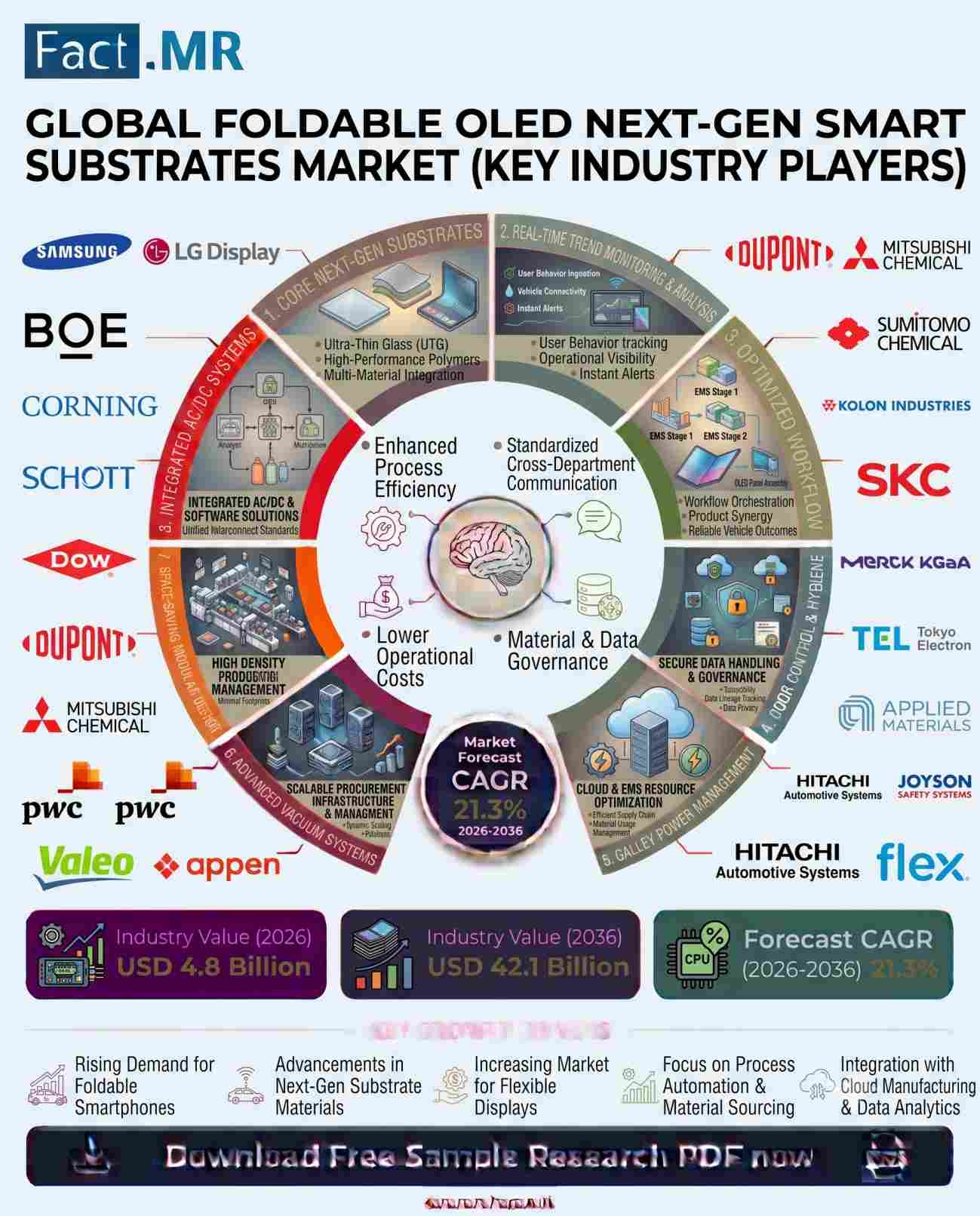
The global foldable OLED next-gen smart substrates market is projected to reach USD 2.45 billion by 2036, rising from USD 1.06 billion in 2026 at a CAGR of 8.8%, according to Fact.MR. The market is expanding as foldable OLED displays move from premium novelty products toward broader adoption across smartphones, tablets, PCs, wearables, and emerging flexible devices.
The opportunity is significant. Between 2026 and 2036, the market is expected to add approximately USD 1.39 billion in value, representing a 131.1% increase. As manufacturers push foldable devices toward thinner designs, longer fold-cycle life, lower crease visibility, and improved optical quality, substrate performance is becoming a critical differentiator.
Get Detailed Market Forecasts, Competitive Benchmarking, and Pricing Trends: https://www.factmr.com/connectus/sample?flag=S&rep_id=13402
Foldable OLED Growth Is Increasing Demand for Advanced Substrates
Foldable OLED smart substrates form a foundational layer of flexible display structures. These materials must combine mechanical flexibility with dimensional stability, optical clarity, surface quality, and resistance to repeated folding.
The rapid commercialization of foldable smartphones is the primary demand driver. Device manufacturers are competing to offer larger screens in compact form factors, increasing the need for substrates capable of surviving repeated bending without cracking, developing visible defects, or compromising display performance.
Next-generation substrates are also gaining importance as manufacturers explore rollable, slidable, and multi-fold displays. These emerging formats place even greater demands on material fatigue resistance and manufacturing consistency.
Ultra-Thin Glass Maintains Market Leadership
Ultra-thin glass (UTG) accounts for approximately 51% of substrate type demand in 2026, making it the leading substrate category. Its combination of optical clarity, dimensional stability, surface hardness, and barrier performance makes it particularly suitable for premium foldable OLED displays.
Advances in glass thinning and strengthening have improved UTG's ability to withstand folding while retaining a glass-like surface feel. This gives it an advantage over conventional polymer substrates in applications where manufacturers prioritize durability and optical performance.
However, colorless polyimide (CPI) and hybrid glass-polymer substrates remain important alternatives. CPI offers high flexibility, while hybrid structures seek to combine the flexibility of polymers with the hardness and stability of glass.
Smartphones Drive Nearly Two-Thirds of Substrate Demand
Smartphones represent approximately 64% of device-type demand in 2026, making them the primary commercial driver of the market.
Foldable smartphones require substrates that can withstand frequent daily opening and closing while maintaining touch sensitivity, optical performance, and structural integrity. Because smartphones are produced at much higher volumes than other foldable device categories, improvements in substrate yield and cost can have a direct impact on overall market adoption.
Tablets, PCs, and wearables provide additional opportunities as flexible display technology expands beyond smartphones. Larger foldable screens require substrates capable of handling greater surface areas while maintaining uniformity and resistance to mechanical stress.
Inward-Fold Displays Remain the Dominant Architecture
The inward-fold mechanism accounts for approximately 45% of the market in 2026. Inward-fold designs place the flexible display on the inside of the folded device, helping protect the sensitive display surface from external scratches and impacts.
However, the architecture creates demanding compressive stresses on the substrate around the fold radius. Manufacturers therefore continue to focus on improving fatigue resistance, reducing crease formation, and maintaining optical quality after repeated folding.
Outward-fold, rollable, and multi-fold architectures represent longer-term opportunities. These designs could broaden substrate demand if manufacturers overcome durability, cost, and production-yield challenges.
Substrate Innovation Becomes a Competitive Battleground
The central technical challenge is balancing properties that traditionally conflict with one another. A substrate must be thin and flexible enough to survive repeated bending while remaining smooth, stable, and resistant to environmental exposure.
This requirement is driving investment in:
The shift toward rollable and multi-fold devices could further increase the need for materials with greater fatigue resistance and lower mechanical stress.
China Leads Country-Level Growth
China is projected to record the fastest growth among the major markets, with a 9.5% CAGR from 2026 to 2036. Large-scale investments in OLED manufacturing and supply-chain localization are supporting demand for advanced substrate materials.
Companies such as BOE and Visionox are expanding capabilities in flexible display manufacturing, creating opportunities for domestic substrate suppliers and material technology developers.
South Korea follows with a projected 9.0% CAGR. Its established leadership in OLED manufacturing and foldable device commercialization gives the country a strong position across the substrate value chain. Close collaboration between display manufacturers and material suppliers is supporting development of high-performance UTG technologies.
Taiwan is forecast to grow at 8.9% CAGR, supported by expertise in semiconductor materials, precision chemical processing, thin-film technologies, and advanced manufacturing.
Japan is projected to expand at 8.4% CAGR, with its market opportunity linked strongly to specialty materials, precision manufacturing equipment, polyimide technologies, and advanced glass production.
East Asia Remains the Core Manufacturing Hub
East Asia is expected to remain central to the foldable OLED substrate ecosystem because of its concentration of display manufacturers, electronics OEMs, materials suppliers, and precision manufacturing capabilities.
China and South Korea provide strong demand from OLED panel manufacturing and foldable-device production. Japan contributes high-value materials and manufacturing technologies, while Taiwan supports specialized materials and process capabilities.
North America and Europe remain important demand centers because of premium consumer electronics adoption and continued investment in next-generation display technologies.
High Production Costs Remain a Major Constraint
Advanced substrate manufacturing remains capital- and technology-intensive. Producing extremely thin glass with sufficient mechanical strength requires sophisticated processing and quality-control systems. Polymer and hybrid substrates also require specialized chemistry, coatings, and manufacturing processes.
Low production yields can increase costs and restrict the use of advanced substrates to premium devices. Manufacturers therefore face pressure to improve yield while maintaining tight specifications for thickness, optical clarity, surface quality, and fold-cycle performance.
Supply-chain concentration for specialized materials and equipment presents another strategic consideration. Companies with access to reliable materials, proprietary processing technologies, and strong relationships with display manufacturers can gain an advantage.
Hybrid Substrates Create the Next Growth Opportunity
Hybrid glass-polymer substrates represent one of the most promising development areas. These materials aim to combine the flexibility and impact resistance of polymers with the surface hardness, optical properties, and dimensional stability associated with glass.
The opportunity extends beyond smartphones. Rollable displays, flexible tablets, automotive displays, wearable electronics, and connected devices could become new demand centers as manufacturers develop commercially viable flexible form factors.
The ability to produce these substrates at high yield and competitive cost will determine how quickly such applications move from prototypes to mass-market products.
Analyst Perspective
Fact.MR analysis indicates that foldable OLED substrates are shifting from a supporting material to a strategic technology layer. As device manufacturers compete on durability, thinness, crease visibility, and premium user experience, substrate performance is becoming increasingly important to the overall success of flexible display architectures.
The market's next phase will depend on improving material durability, manufacturing yield, cost efficiency, and compatibility with emerging rollable and multi-fold display designs.
Competitive Landscape
The foldable OLED next-gen smart substrates market is characterized by strong participation from major display manufacturers and technology suppliers.
Samsung Display, BOE Technology, and LG Display hold important positions through their integration with advanced OLED manufacturing and foldable display development. Tianma, Visionox, and AUO are also strengthening their capabilities as flexible display adoption expands.
Competition is centered on:
Companies capable of delivering reliable substrates at higher production yields are likely to capture increasing value as foldable devices move toward broader commercialization.
Key Companies in the Foldable OLED Next-Gen Smart Substrates Market
Foldable OLED Next-Gen Smart Substrates Market Outlook
The market is entering a period in which substrate technology will play a larger role in determining the reliability and commercial viability of flexible displays. The transition from conventional flat OLED panels to foldable, rollable, and multi-fold architectures is increasing the technical requirements placed on foundational display materials.
With the market projected to grow from USD 1.06 billion in 2026 to USD 2.45 billion by 2036, substrate suppliers and display manufacturers have a substantial opportunity to improve material performance while reducing manufacturing costs.
The strongest opportunities are expected to emerge around ultra-thin glass, hybrid substrates, foldable smartphones, and next-generation flexible display architectures, with East Asia remaining the industry's primary innovation and manufacturing center.
Other Related Reports:
https://www.openpr.com/news/4535520/global-cold-plasma-food-processing-market-climbs-to-usd-330
https://www.openpr.com/news/4535530/senior-specific-texture-modified-food-market-records-5-4
https://www.openpr.com/news/4535542/menopause-targeted-functional-food-and-beverage-market
https://www.openpr.com/news/4535557/on-the-go-food-packaging-industry-projected-to-grow-at-6-8
About Fact.MR
Fact.MR provides market research and industry analysis covering market size, segmentation, growth forecasts, competitive developments, regional trends, and strategic opportunities. Its research methodology combines primary interviews with manufacturers, distributors, retailers, and industry participants with secondary research covering company disclosures, technical publications, industry benchmarks, and market developments.