English
 Arabic
 French
 Spanish
 Portuguese
 Deutsch
 Turkish
 Dutch
Dutch
 Italiano
 Russian
 Romaian
 Portuguese (Brazil)
 Greek
Greek
The Future of Underwater Technology: Key Developments in the Sonar Systems Market
Home |
2026-08-26 17:44:23
 Social Networth OS
 Creator Commerce
 Launch Startup
 Global News
 Creator Award
 Talkfever App
Смотреть все
Talkfever App
Смотреть все

Обновить до Про
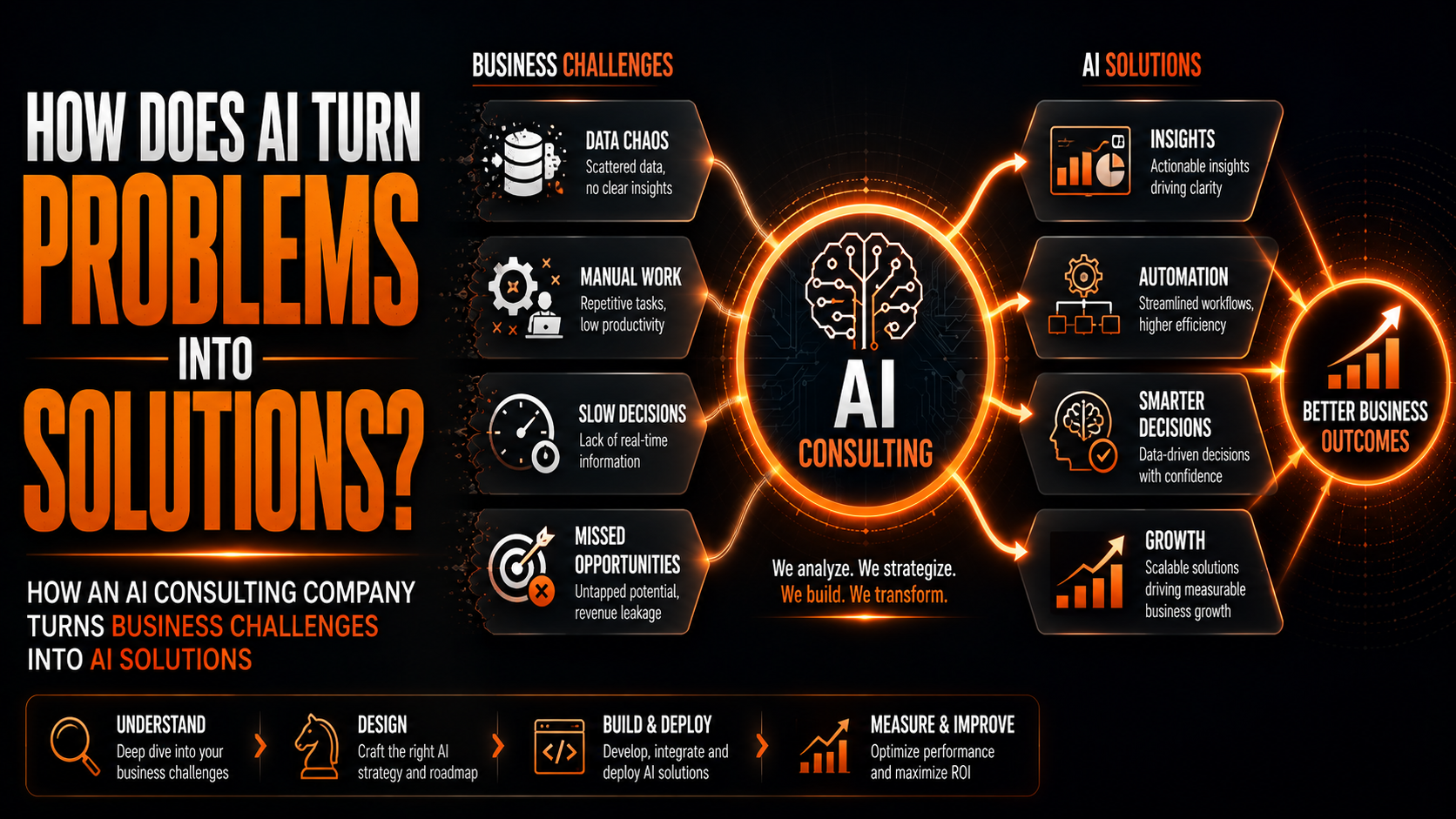
Artificial intelligence is no longer limited to experimental projects or large technology companies. Businesses across industries are using AI to improve operations, understand customers, automate repetitive work, and make faster decisions. However, identifying where AI can genuinely create value is often more difficult than choosing an AI tool. This is where an experienced AI consulting company can make a significant difference.
AI consulting is not simply about recommending the latest technology. It involves understanding a company's existing challenges, processes, data, goals, and technical environment before designing a practical AI strategy. The result is a solution built around a specific business need rather than technology being adopted simply because it is trending.
Many organizations know they want to use AI but are unsure where to begin. They may have large amounts of data, repetitive processes, customer-service challenges, or inefficient workflows, but turning these problems into viable AI use cases requires technical and business expertise.
An AI consulting company can help businesses answer questions such as:
Where can AI provide the greatest business value?
Which processes should be automated?
Is the available data suitable for AI?
Should the company build, buy, or integrate an AI solution?
Which AI technologies are appropriate for the business?
How can AI be implemented without disrupting existing operations?
How should the return on investment be measured?
This initial assessment helps prevent businesses from investing in AI solutions that do not address meaningful problems.
Effective AI implementation usually starts with the problem rather than the technology.
Instead of saying, "We need generative AI," a business might identify a specific challenge such as:
Customer support teams are spending too much time answering repetitive questions.
That challenge could potentially lead to an AI-powered support assistant.
Similarly:
Sales teams are struggling to identify high-quality leads.
This could become a predictive lead-scoring or AI-assisted qualification solution.
The consulting process therefore begins by understanding what the business is trying to improve, followed by determining whether AI is the right solution.
Once business challenges are understood, consultants analyze workflows and identify areas where AI could produce measurable improvements.
Common opportunities include:
Processes involving large amounts of repetitive work may be suitable for automation.
AI assistants and conversational systems can help businesses handle frequently asked questions and support requests.
AI can help organizations analyze large datasets and identify patterns that may be difficult to detect manually.
AI can support lead analysis, personalization, customer segmentation, content workflows, and forecasting.
Businesses dealing with large volumes of documents may use AI for classification, extraction, summarization, or information retrieval.
AI and machine learning models can support demand, sales, inventory, or other forms of business forecasting when appropriate data is available.
The important point is that AI opportunities should be evaluated according to business value, feasibility, and risk.
Data is one of the foundations of many AI systems. A business may have large amounts of information but still lack the quality or structure needed for a particular AI application.
Consultants may evaluate:
Data availability
Data quality
Data formats
Data sources
Data consistency
Data accessibility
Data security
Data governance
For example, a company may want to build a predictive model but discover that historical records are incomplete or inconsistent.
In such cases, improving the data foundation may need to happen before AI development begins.
There is no single AI technology that works for every business problem.
Depending on the use case, a solution might involve:
Machine learning
Natural language processing
Generative AI
Large language models
Computer vision
Predictive analytics
Recommendation systems
Conversational AI
Intelligent automation
The technology should follow the business requirement.
For example, a document-processing problem may require natural language processing or an LLM-based system, while an image-analysis problem may require computer vision.
Choosing technology based on the problem rather than popularity can lead to more practical AI investments.
One of the important decisions during AI consulting is determining whether a business should build a solution from scratch, customize an existing model or platform, or integrate a third-party AI service.
This can be suitable when the business needs a common capability that is already available.
Customization can make sense when a business needs AI to work with its own data, terminology, workflows, or requirements.
A custom solution may be appropriate when the business has unique requirements that cannot be addressed effectively through existing products.
An experienced consultant can evaluate the trade-offs involving cost, scalability, performance, security, customization, and maintenance.
After identifying a suitable use case, the next step is translating the concept into a technical solution.
This may involve defining:
Business objectives
Functional requirements
Data requirements
AI model or technology
System architecture
Integration requirements
Security considerations
Testing criteria
Deployment approach
Performance measurements
This process creates a bridge between business strategy and technical implementation.
Without this bridge, an AI initiative can remain an interesting concept without becoming a useful business system.
Businesses rarely operate with AI in isolation. Existing CRM systems, ERP platforms, websites, mobile applications, databases, communication tools, and internal software may already support critical operations.
AI solutions therefore often need to integrate with existing infrastructure.
For example, an AI sales assistant may need access to CRM information. A customer-service assistant may need information from a knowledge base. An internal AI tool may need secure access to company documents.
Integration allows AI to become part of an existing workflow instead of creating another disconnected system.
AI projects can involve technical, financial, operational, and security risks.
A structured consulting process can help identify these risks before significant resources are committed.
Potential areas of concern include:
Poor-quality data
Unrealistic expectations
Integration complexity
Security vulnerabilities
Privacy concerns
Model inaccuracies
Unexpected operating costs
Lack of user adoption
Difficult maintenance
Identifying these issues early allows businesses to adjust the solution before moving too far into development.
A proof of concept, or POC, can help determine whether an AI idea is technically and commercially viable before full-scale development.
A POC may answer questions such as:
Can the AI solve the intended problem?
Is the available data sufficient?
Is the model accurate enough?
Can it integrate with existing systems?
Will users find it useful?
Are the operating costs reasonable?
The objective is not necessarily to create a production-ready product immediately. Instead, the POC provides evidence that can guide the next investment decision.
Generative AI has expanded the number of AI applications businesses can consider. Companies can use generative systems for tasks involving text, documents, knowledge retrieval, customer interactions, coding assistance, and content workflows.
However, simply adding a large language model to an application does not automatically create business value.
A consulting approach may involve determining:
Which business process should use generative AI
What information the model needs
Whether retrieval-augmented generation is appropriate
How outputs should be evaluated
How sensitive information should be protected
Where human oversight is required
This helps ensure that generative AI becomes a controlled business capability rather than an isolated chatbot.
When appropriately designed, AI can help businesses improve efficiency in several ways.
AI can reduce manual involvement in repetitive workflows.
AI-powered search and knowledge systems can help employees find relevant information more quickly.
AI can analyze patterns and provide insights that support business decisions.
AI can help businesses tailor experiences, recommendations, and communications.
Predictive systems can help identify trends and potential problems earlier.
However, the actual impact depends on the use case, implementation quality, data, and adoption.
A successful AI project should have measurable objectives.
Depending on the application, businesses may track:
Time saved
Cost reduction
Productivity improvement
Response time
Customer satisfaction
Conversion rates
Accuracy
Revenue impact
User adoption
Operational efficiency
For example, if an AI support assistant is introduced to reduce customer-service workload, measuring average response time and the number of queries successfully handled can provide useful indicators.
Clear metrics turn AI from a technology investment into a measurable business initiative.
Security should be considered from the beginning rather than after an AI solution has been developed.
Consultants may need to evaluate:
Data access
User permissions
Sensitive information
API security
Model access
Data storage
Authentication
Monitoring
Compliance requirements
Businesses handling confidential customer or internal information need particularly careful controls.
The exact security approach depends on the organization's industry, infrastructure, data, and regulatory environment.
AI can automate many tasks, but not every decision should be fully automated.
Human oversight can be valuable when AI outputs involve:
Financial decisions
Sensitive customer interactions
Legal or compliance matters
High-impact business decisions
Critical operational processes
A well-designed AI workflow can combine automation with human review where necessary.
This creates a more practical balance between AI efficiency and human judgment.
Developing an AI model or application is only one part of the journey. The solution must also be deployed into the business environment.
Deployment may involve:
Connecting APIs
Integrating databases
Configuring cloud infrastructure
Implementing authentication
Setting up monitoring
Testing performance
Training users
Establishing support processes
A consulting partner can help coordinate these technical and operational requirements so the AI system can move from development into real-world use.
AI systems should not necessarily be treated as one-time projects.
Business requirements change. Data changes. Users provide feedback. Models and AI platforms evolve. New risks may also appear.
Continuous improvement can involve:
Monitoring performance
Reviewing AI outputs
Updating knowledge sources
Improving prompts
Retraining models where appropriate
Optimizing infrastructure
Collecting user feedback
Updating security controls
This ongoing process helps ensure that the AI solution continues to deliver value after launch.
Choosing a consulting partner requires looking beyond a list of AI technologies.
Consider factors such as:
Does the company understand your industry or business problem?
Can it work with the AI technologies, APIs, cloud platforms, and systems required for your project?
Does the team focus on measurable outcomes rather than technology alone?
Can the proposed solution connect with your existing software?
Does the company address data protection and access requirements?
Can it support the solution beyond the initial strategy stage?
Can technical concepts and project decisions be explained clearly to business stakeholders?
A strong partner should be able to connect business objectives with technical execution.
AI developers primarily focus on building the technical solution. AI consulting can begin much earlier by determining whether a solution should be built, what problem it should solve, and how success should be measured.
Consulting may therefore cover:
Business analysis → AI opportunity identification → Feasibility → Strategy → Technology selection → Solution design → Development → Integration → Deployment → Optimization
This broader approach can help businesses avoid spending resources on AI projects that do not have a clear purpose.
The value of AI consulting extends beyond implementing one AI feature. A well-planned project can help an organization understand how AI fits into its broader digital strategy.
Over time, businesses can develop:
Repeatable AI workflows
Better data practices
AI-ready infrastructure
Stronger automation capabilities
More informed technology decisions
A clearer AI roadmap
This can make future AI initiatives easier to evaluate and implement.
An AI consulting company helps businesses move from "We should use AI" to "Here is exactly where AI can solve a meaningful business problem." The process starts with understanding business challenges and continues through data assessment, use-case identification, technology selection, solution design, integration, deployment, and ongoing improvement.
The strongest AI strategies are not built around technology alone. They are built around measurable business outcomes. Whether the objective is automating repetitive work, improving customer experiences, analyzing information, supporting employees, or developing intelligent products, the right consulting approach can turn an AI idea into a practical solution.
For businesses planning a broader AI initiative, partnering with an experienced AI development company can provide the technical expertise needed to transform an AI strategy into a scalable and business-focused digital solution.
An AI consulting company helps businesses identify valuable AI opportunities, evaluate feasibility, select suitable technologies, design solutions, and support implementation and optimization.
The process typically begins by understanding the company's business objectives, operational challenges, workflows, data, and existing technology environment.
Yes. Selecting the technology is generally part of the consulting process. The appropriate technology should be determined by the business problem and technical requirements.
No. Businesses of different sizes can use AI consulting to identify practical automation, analytics, customer-service, or productivity opportunities appropriate to their resources and goals.
A proof of concept can help validate technical feasibility, data suitability, expected performance, integration requirements, and potential business value before committing to a larger implementation.
It can. Depending on the consulting provider and project scope, services may extend from strategy and planning through development, integration, deployment, and ongoing optimization.
Success can be measured using business-specific metrics such as cost savings, time reduction, productivity, accuracy, customer satisfaction, conversion rates, revenue impact, or user adoption.