 English
 Arabic
 French
 Spanish
 Portuguese
 Deutsch
 Turkish
 Dutch
Dutch
 Italiano
 Russian
 Romaian
 Portuguese (Brazil)
 Greek
Greek
Achieve Smooth Skin with Freckle and Blemish Removal
Health |
2026-07-02 11:25:25
 Social Networth OS
 Creator Commerce
 Launch Startup
 Global News
 Creator Award
 Talkfever App
Mostra tutti i risultati
Talkfever App
Mostra tutti i risultati

Passa a Pro
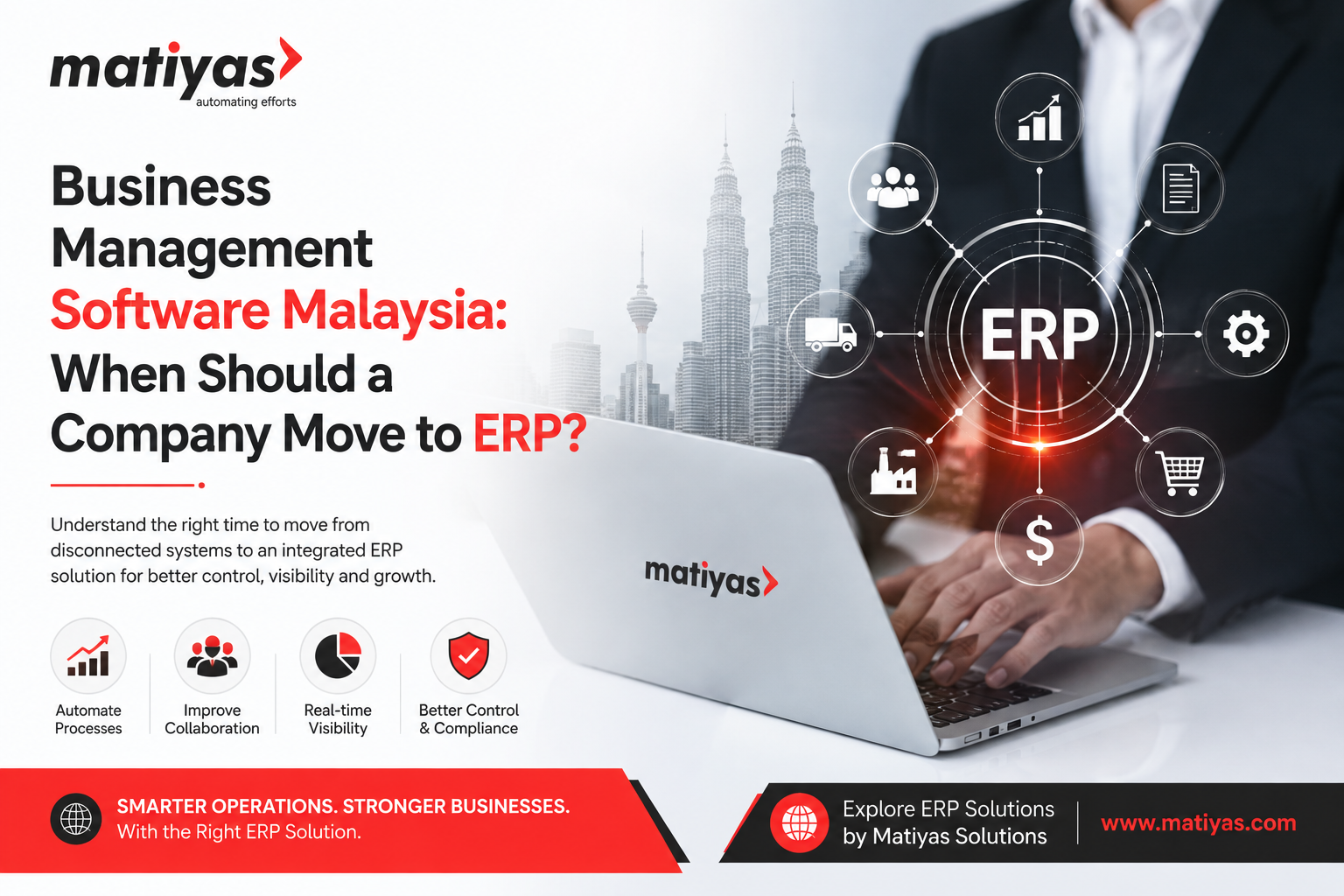
For many growing companies, managing daily operations with spreadsheets, accounting software, emails, and separate business applications may seem practical at first. As the business expands, however, these disconnected systems can make it harder to manage finances, inventory, sales, purchasing, employees, and other critical processes efficiently. This is where business management software in Malaysia can become an important part of business growth.
An ERP system brings different business functions together on a single platform, allowing companies to manage and access operational data more efficiently. Instead of relying on multiple systems that do not communicate with each other, businesses can use ERP software to connect finance, inventory, sales, purchasing, manufacturing, and other operations.
But when is the right time for a Malaysian company to move to ERP?
The answer depends less on company size and more on the complexity of its operations. A small or mid-sized business may need ERP software sooner than expected if manual processes are already creating delays, errors, or limited visibility.
Business management software is designed to help companies organize and manage different areas of their operations through digital tools. Depending on the solution, it can support accounting, inventory management, purchasing, sales, customer management, production, reporting, and other business activities.
Basic business software may focus on a specific function, such as accounting or inventory. As a company grows, it may start using several different applications for different departments. This can create information silos and require employees to manually transfer data between systems.
Modern business management software in Malaysia can help address this challenge by providing a more connected environment for business operations.
An ERP system takes this concept further by integrating multiple business functions into one centralized system.
A company does not necessarily need ERP because it has reached a certain number of employees or revenue level. The need often appears when existing processes can no longer support the company's operational complexity.
For example, a business may start with accounting software, spreadsheets for inventory, email for purchase approvals, and separate tools for sales management. This setup can work when transaction volumes are low.
As operations expand, the same setup can become difficult to maintain.
Employees may spend more time entering the same information into multiple systems. Managers may struggle to get accurate reports. Inventory information may not match accounting records. Sales teams may not have real-time visibility into stock. Finance teams may have to wait for information from other departments before preparing reports.
These are common signs that a company may be ready for an ERP system.
One of the clearest signs is the growing number of disconnected business applications.
If your finance team uses one system, your warehouse uses spreadsheets, your sales team uses another application, and purchasing is managed through emails or manual documents, your business may be operating with fragmented information.
ERP software can connect these functions and reduce the need to move information manually between departments.
Manual data entry becomes increasingly risky as transaction volumes increase.
For example, a sales order may need to be entered into one system, inventory updated in another, and financial information transferred separately. Every additional manual step creates an opportunity for incorrect quantities, duplicate entries, missing information, or delays.
ERP automation can help reduce repetitive data entry by allowing information captured in one business process to flow into connected processes.
Inventory problems are another important reason businesses consider ERP.
If employees cannot quickly determine current stock levels, incoming inventory, reserved stock, or inventory across different locations, decision-making becomes more difficult.
Inventory management software integrated with ERP can provide a centralized view of stock movements and related purchasing and sales activities.
This is especially valuable for Malaysian businesses managing multiple warehouses, branches, product categories, or high transaction volumes.
When accounting and operational systems are disconnected, reconciling information can take considerable time.
For example, finance may need sales, purchasing, inventory, or production information from other departments before completing financial reporting. If this information is maintained separately, discrepancies can be difficult to identify.
An integrated ERP system can connect financial information with operational transactions, giving businesses better visibility into the relationship between revenue, costs, inventory, purchasing, and other activities.
Business leaders need timely information to make informed decisions.
If management has to ask different departments to prepare spreadsheets before understanding sales performance, inventory levels, purchasing commitments, or operational costs, the reporting process may be too dependent on manual work.
ERP reporting can provide centralized business information and help management access relevant operational and financial data more efficiently.
Expansion often increases the complexity of business management.
A company operating from multiple branches, warehouses, offices, or production locations may find it difficult to maintain consistent information across locations using spreadsheets and disconnected applications.
Multi-location ERP software can provide a centralized approach to managing information while allowing businesses to monitor operations across different sites.
The right time to implement ERP is usually before operational problems become serious enough to affect growth.
Waiting until employees are overwhelmed, inventory problems become frequent, or reporting becomes unreliable can make the transition more difficult. At the same time, implementing ERP too early without clearly defined business requirements can create unnecessary complexity.
A company should consider ERP when its existing systems are becoming a limitation rather than a support mechanism.
For Malaysian SMEs, this can happen during periods of rapid growth, expansion into new markets, increased product complexity, additional warehouses, higher transaction volumes, or the introduction of new departments.
The key is to evaluate business processes rather than simply looking at company size.
A properly implemented ERP system can create a more connected operating environment.
Finance can work with information generated by sales and purchasing. Inventory teams can work with information from sales orders and purchase orders. Manufacturing teams can connect production planning with materials and inventory. Management can use centralized information for reporting and decision-making.
This integration is one of the major advantages of modern ERP solutions.
For companies searching for ERP solutions in Malaysia, the objective should not simply be to replace existing software. The goal should be to create a system that supports the way the business operates today while providing enough flexibility for future growth.
Centralized information can make it easier for managers to understand what is happening across different business functions.
Instead of depending on separate spreadsheets and manual reports, businesses can work with information stored within a connected ERP environment.
Automation can reduce repetitive tasks such as data entry, approvals, document processing, and routine reporting.
This allows employees to spend more time on activities that require analysis, customer interaction, planning, and decision-making.
When business processes are connected, management can establish more consistent workflows and approval processes.
This can help companies improve control over purchasing, inventory, financial transactions, sales processes, and other operations.
Before selecting an ERP system, Malaysian companies should first identify their most important operational challenges.
A business should evaluate which processes are currently manual, where information is duplicated, which departments require better integration, and what reporting information management needs.
The company should also consider scalability. An ERP system should not only address today's problems but also support future business requirements.
Important areas to evaluate can include accounting, inventory management, purchasing, sales, customer management, manufacturing, reporting, workflow automation, integrations, user management, and customization requirements.
The implementation partner is also important. A technically capable ERP platform may still fail to deliver the expected results if the implementation does not properly address business processes and user requirements.
Choosing the right ERP partner is an important step for companies planning to move from disconnected business applications to an integrated system.
Matiyas Solutions helps businesses evaluate and implement ERP solutions based on their operational requirements. Instead of treating ERP as simply another software application, businesses can approach implementation around their actual workflows, departments, data, and growth objectives.
If your company is dealing with disconnected applications, increasing manual work, inventory challenges, reporting delays, or operational complexity, it may be time to evaluate whether ERP is the right next step.
Looking for business management software in Malaysia that can support your company's growth? Contact Matiyas Solutions to discuss your business requirements and explore an ERP approach suited to your operations.
The decision to move to ERP should not be based solely on employee count or company revenue. The more important question is whether your current business management processes can continue supporting your company's growth.
When spreadsheets become difficult to control, separate applications create information silos, manual data entry consumes employee time, inventory visibility becomes unreliable, and management reporting takes too long, an ERP system may provide a more sustainable solution.
For Malaysian SMEs and growing companies, adopting the right business management software at the right stage can help create more connected processes, better visibility, and stronger operational control.
The best time to consider ERP is when your existing systems are starting to hold the business back, but before those limitations become major obstacles to growth.


