English
 Arabic
 French
 Spanish
 Portuguese
 Deutsch
 Turkish
 Dutch
Dutch
 Italiano
 Russian
 Romaian
 Portuguese (Brazil)
 Greek
Greek
Electronic Grade Arsine (AsH3) Market Growth in 2025-2034: Dynamics, Opportunities, and Strategies
Other |
2025-08-23 07:44:24
 Social Networth OS
 Creator Commerce
 Launch Startup
 Global News
 Creator Award
 Talkfever App
Ver Todos
Talkfever App
Ver Todos

Atualize para o Pro
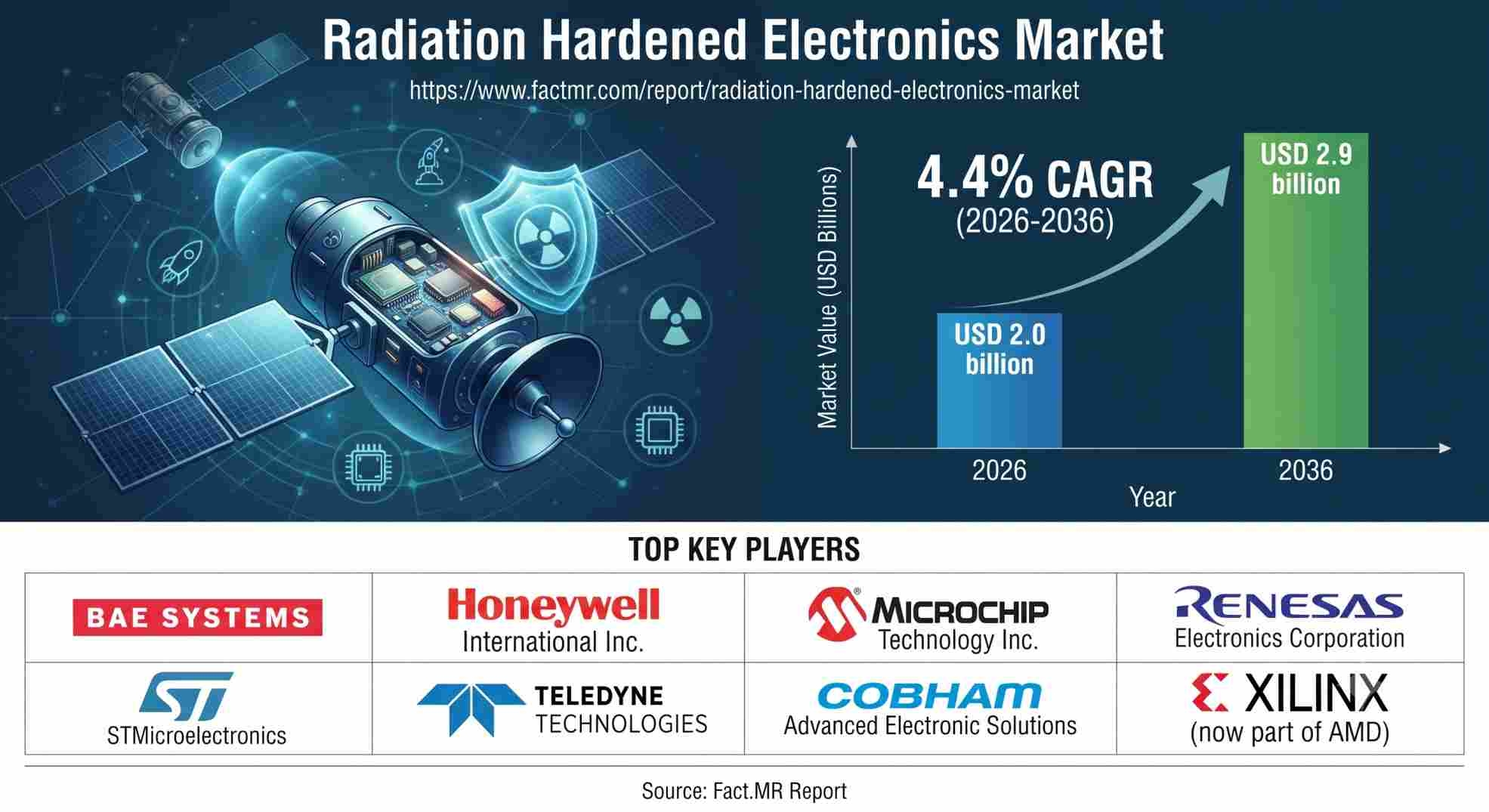
The global radiation hardened electronics market is projected to reach USD 2.9 billion by 2036, rising from USD 2.0 billion in 2026 at a 4.4% CAGR, according to Fact.MR. The market was valued at USD 1.9 billion in 2025 as demand remains closely linked to space, defence, nuclear, and high-energy physics applications.
The opportunity is steady. Between 2026 and 2036, the market is expected to add approximately USD 0.9 billion in value. The market remains concentrated among fewer than 50 major global space and defence programme offices, while new radiation-hardened devices can require 18 to 36 months before receiving flight certification.
Get Detailed Market Forecasts, Competitive Benchmarking, And Pricing Trends: https://www.factmr.com/connectus/sample?flag=S&rep_id=14296
Radiation Hardened Electronics Market Growth Follows Space and Defence Procurement
Radiation hardened electronics are specialised semiconductor components designed to operate reliably in high-radiation environments such as space, nuclear plants, and defence systems, where standard commercial chips can fail because of ionising damage.
The market includes processors, memory, power management ICs, mixed-signal devices, and sensors designed to withstand total ionising dose and single-event effects. The report covers component types, manufacturing techniques, pricing trends, export-control impacts, and regional demand from 2026 to 2036.
Commercial low Earth orbit satellite constellations are creating another source of demand. Starlink, Project Kuiper, and OneWeb require multiple radiation-tolerant processors and memory devices on each satellite to support long-term orbital reliability.
India's IN-SPACe framework is also creating compliance-driven demand for domestically qualified radiation-hardened electronics. Nuclear plant life-extension programmes in the United States, France, and South Korea are supporting upgrades to radiation-qualified digital control systems.
Processors and Controllers Maintain Market Leadership
The processors and controllers segment accounts for 32.8% share of the radiation hardened electronics market in 2025, making it the leading component category. These devices form the computational core of satellites, launch vehicles, nuclear control systems, and research platforms.
Processor qualification can determine the full system approval timeline. The devices also represent the highest per-unit-value component in the bill of materials for many radiation-hardened systems.
Microchip Technology's fiscal year 2024 report highlighted development of a 65nm RHBD space-grade FPGA targeting commercial LEO satellites at USD 800 to USD 1,200 per unit, with Sandia testing expected by Q3 2025.
BAE Systems introduced the 28nm RHBD-based RAD5545 processor, delivering 12,000 MIPS at 15W, while meeting MIL-PRF-38535 Class V standards for NASA and defence missions.
Radiation Hardening by Design Holds 33.4% Share
The Radiation Hardening by Design (RHBD) segment holds 33.4% share in 2025, making it the leading manufacturing technique. RHBD provides radiation tolerance through circuit architecture on commercial CMOS nodes, supporting advanced performance and cost structures.
RHBD is gaining attention as commercial LEO constellations shift procurement toward higher volumes and lower unit costs. Fact.MR analysis indicates that RHBD techniques can enable 30% to 50% price reductions for LEO applications, while benefiting from 20 to 50 times higher unit volumes compared with traditional low-volume GEO procurement.
Renesas Electronics disclosed an RHBD initiative for its RH850 microcontrollers using 40nm CMOS and triple modular redundancy architecture, with JAXA qualification testing underway as of Q2 2024.
Honeywell's SiGe RHBP platform continues supporting applications exceeding 1 MRad Si, particularly nuclear instrumentation and deep-space analogue circuits.
LEO Constellations Increase Component Volumes
SpaceX filings indicate that approximately 6,000 Starlink Gen 2 satellites were planned through 2026, with each satellite incorporating multiple radiation-tolerant processors. Fact.MR identifies this volume as exceeding the previous decade of GEO satellite procurement combined.
The commercial LEO model is changing the economics of radiation-hardened components. Traditional procurement has relied on low-volume, high-price devices for GEO missions, while newer LEO programmes emphasize volume, cost control, and qualification efficiency.
The US MIL-PRF-38535 Class V specification requires documented testing above 100 kRad Si, immunity to single-event latch-up, and full lot acceptance testing for space-level microcircuits. These requirements restrict procurement to fewer than 500 qualified device families.
India Leads Country-Level Growth
India is projected to record the strongest country-level growth, reaching a 9.0% CAGR through 2036. The country's expansion is supported by rising ISRO launch activity, private space companies operating under the IN-SPACe framework, and government-backed semiconductor initiatives targeting domestic radiation-hardened production capability by 2027.
China follows with a 6.8% CAGR, supported by BeiDou maintenance, Guowang LEO constellation plans, and investment under the Integrated Circuit Industry Investment Fund for domestic radiation-hardened manufacturing.
The United States is projected to grow at 4.9% CAGR, while France is forecast at 4.3% CAGR and Brazil at 3.2% CAGR through 2036.
North America remains the primary qualification and sovereignty hub, supported by MIL-PRF-38535 Class V standards and ITAR controls. Europe operates as the second major qualification centre, with ESA ESTEC and ESCC standards shaping procurement.
Nuclear Upgrades Create Long-Term Demand
Nuclear plant modernization represents another market opportunity. The IAEA revision of IEC 61513 requires digital safety systems in nuclear plants to use components qualified for reactor radiation conditions over the plant lifetime.
Fact.MR estimates that the resulting global digital upgrade cycle is valued at approximately USD 3.5 billion through 2030, with radiation-hardened microcontrollers and signal-conditioning ICs representing high-value components in each project.
Competitive Landscape Remains Highly Concentrated
The radiation hardened electronics market is highly concentrated within the defence and space segment. Microchip Technology, BAE Systems Microelectronics, Honeywell Defense Electronics, and Texas Instruments together account for roughly 55% to 65% of global revenue for space-level qualified devices.
Key players include Microchip Technology Inc., Renesas Electronics Corporation, Infineon Technologies AG, STMicroelectronics N.V., BAE Systems plc, Texas Instruments Incorporated, Analog Devices, Inc., Honeywell International Inc., Advanced Micro Devices, Inc. (AMD), and NXP Semiconductors N.V.
Entry barriers remain high because new device families require radiation testing, qualification investment, and extended approval timelines. Supplier strength is closely connected to Qualified Parts List coverage because replacing certified components in flight systems can be costly and disruptive.
Recent Developments Support Rad-Hard Power and FPGA Demand
In October 2025, Infineon Technologies AG announced an industry-first radiation-hardened buck controller with integrated gate drive for power rails in commercial space systems and extreme environments.
In 2025, NanoXplore and STMicroelectronics jointly announced space qualification of the NG-ULTRA radiation-hardened system-on-chip FPGA under the ESCC 9030 standard. The device is aimed at satellite onboard systems including Galileo and Copernicus constellations.
Analyst Perspective
Lisa Napolitano, VP & General Manager, Space, Honeywell Aerospace Technologies, states, “Honeywell's foundry business has grown rapidly. and we are committed to supporting the space community with technology that will increase performance, reduce risk, and improve mission success.”
Shambhu Nath Jha, Principal Consultant at FACT.MR, said the report is essential for understanding how commercial LEO constellation growth is restructuring radiation-hardened component qualification economics and the value captured by RHBD, RHBP, and RHBS manufacturing approaches.
Top Trending Reports:
https://www.openpr.com/news/4596814/medical-drone-delivery-services-market-valued-at-usd-2-9-billion
https://www.openpr.com/news/4596799/marketing-performance-management-mpm-software-market
https://www.openpr.com/news/4596822/artificial-intelligence-in-food-and-beverages-market
https://www.openpr.com/news/4597880/data-center-and-ai-server-printed-circuit-board-market-forecast
About Fact.MR
Fact.MR provides market research and industry analysis covering market size, segmentation, growth forecasts, competitive developments, regional trends, and strategic opportunities.
The Radiation Hardened Electronics Market study uses primary interviews with space-programme procurement officers, satellite-bus application engineers, nuclear instrumentation specialists, high-energy physics electronics specialists, and radiation-effects test facility managers. Desk research incorporates NASA and ESA mission budgets, U.S. Department of Defense procurement data, national space-agency launch manifests, JEDEC and MIL-PRF-38535 standards, and company disclosures.