English
 Arabic
 French
 Spanish
 Portuguese
 Deutsch
 Turkish
 Dutch
Dutch
 Italiano
 Russian
 Romaian
 Portuguese (Brazil)
 Greek
Greek
Dental Tourism Market Growth, Overview with Detailed Analysis
Other |
2025-07-15 09:58:18
 Social Networth OS
 Creator Commerce
 Launch Startup
 Global News
 Creator Award
 Talkfever App
Tout voir
Talkfever App
Tout voir

Mise à niveau vers Pro
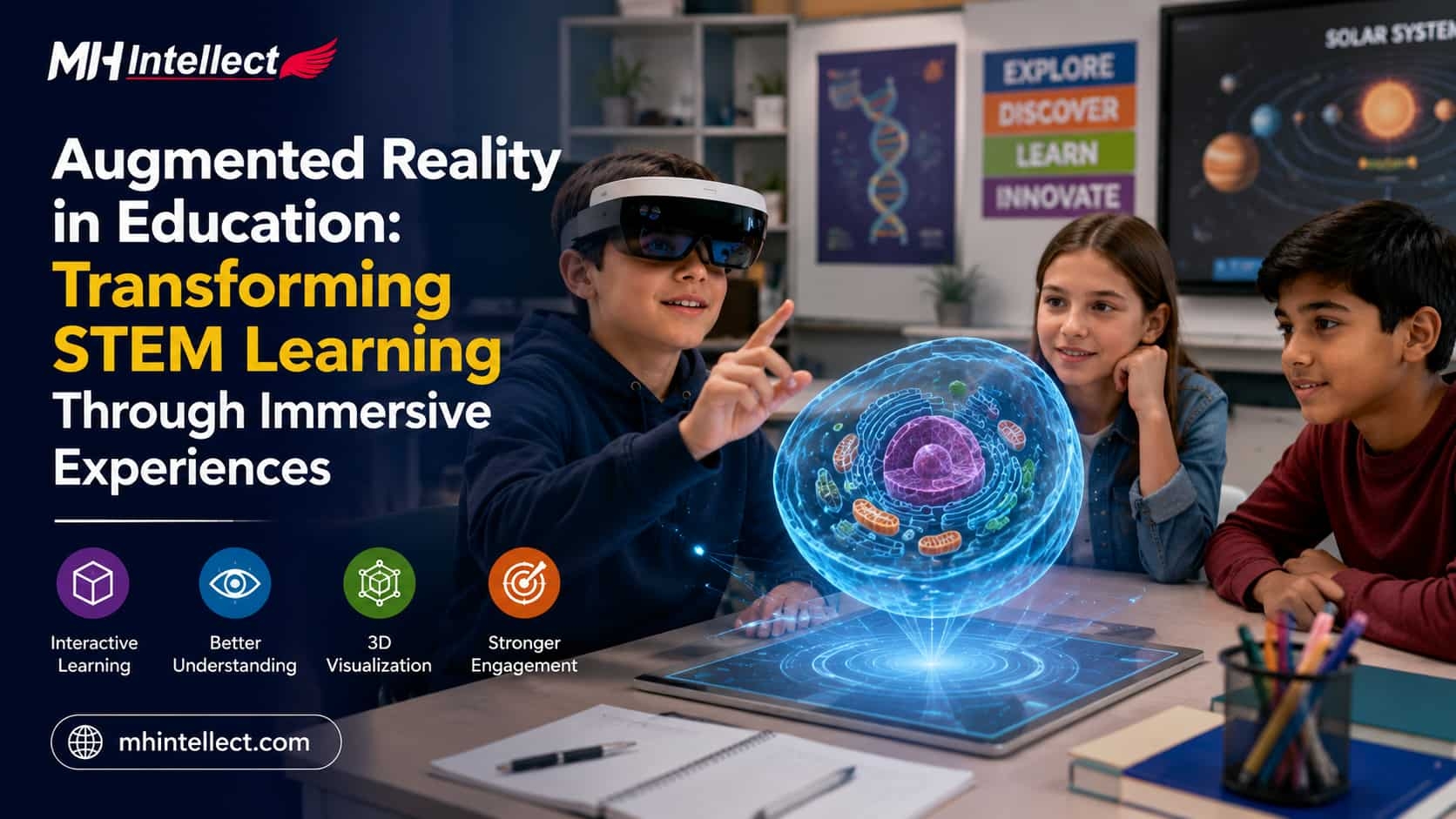
Imagine a student trying to understand how a cell divides by looking at a flat diagram in a textbook. The student can memorise the stages, but visualising what is actually happening inside the cell can be difficult. Now imagine that same student viewing an interactive three-dimensional model and being able to explore the process from different angles. Suddenly, something that felt abstract becomes something the student can observe and understand. This is where augmented reality can make a meaningful difference in STEM learning.
AR in education uses digital models, animations, and interactive information overlaid onto the physical environment through devices such as tablets, smartphones, or AR headsets. Unlike virtual reality, which places learners inside a completely digital environment, AR keeps students connected to their physical classroom while adding an interactive digital layer.
This makes AR particularly useful for subjects where students need to visualise things that are too small, too large, invisible, or difficult to recreate physically. Molecules, cells, electromagnetic fields, planetary systems, engineering structures, and other complex concepts can become more accessible when students can interact with them spatially.
Many STEM concepts require students to create mental models of things they cannot directly observe. A two-dimensional diagram can explain a concept, but it may not provide the spatial understanding needed to truly visualise it.
Augmented reality in education can help close this gap by turning static information into something students can explore. Instead of only reading about a molecule, learners can examine its three-dimensional structure. Instead of studying a diagram of a physical force, they can interact with a visual representation and observe how it changes.
The technology is most effective when it solves a specific learning challenge rather than being introduced simply because it looks impressive.
A well-designed Augmented reality for STEM learning programme can support several disciplines:
Biology: Students can explore 3D cells, organs, biological structures, and processes that are difficult to observe directly.
Chemistry: Interactive molecular models can help students understand atomic structures, molecular shapes, and bonding.
Physics: AR can visualise forces, waves, electromagnetic fields, and other invisible phenomena.
Mathematics: Three-dimensional geometry and spatial relationships can become more interactive and easier to visualise.
Engineering: Students can examine virtual structures, explore design variables, and investigate prototypes before physical construction.
The common thread is interaction. Students are not simply looking at another digital presentation; they are exploring concepts and developing mental models through experience.
Engagement matters, but it should not be confused with learning. An AR experience may capture students' attention for a few minutes, but meaningful educational value comes from what happens after that initial interest.
Teachers can use AR to encourage students to make predictions, investigate a model, explain what they observe, and apply their understanding to another problem. For example, after exploring a virtual engineering structure, students could discuss why certain design choices affect stability and then apply those principles to a physical building challenge.
This combination of digital exploration and practical application can create a richer learning experience.
Introducing AR successfully requires more than purchasing devices. Schools need to consider the quality of educational content, teacher confidence, curriculum alignment, device availability, and the learning outcomes each AR activity is designed to achieve.
Teachers should know when AR adds genuine value and when a physical experiment, model, demonstration, or traditional explanation may be more effective. This balanced approach prevents immersive technology from becoming a novelty and keeps learning objectives at the centre.
For school leaders, AR can therefore be viewed as one component within a broader STEM Education for schools strategy that can also include robotics, coding, AI, engineering, IoT, and project-based learning.
As educational technology develops, immersive learning may become increasingly integrated into science, mathematics, engineering, and technology classrooms. Students could explore complex systems, conduct virtual experiments, manipulate three-dimensional models, and investigate scenarios that would otherwise require expensive equipment or specialist facilities.
However, technology should support not replace effective teaching. The strongest results are likely to come when teachers combine immersive experiences with discussion, experimentation, collaboration, reflection, and real-world projects.
MH Intellect helps schools develop practical STEM learning experiences that connect emerging technologies with meaningful educational outcomes. Its approach can bring together STEM education, robotics, coding, AI, IoT, engineering, and immersive learning to create progressive experiences for different age groups.
Schools and educators can also explore the Student Gallery to see examples of students engaging with practical and technology-focused learning experiences.
Augmented reality has the potential to make difficult STEM concepts easier to visualise, explore, and understand. Its greatest value is not simply that it makes lessons more exciting, but that it can help students experience concepts that are otherwise difficult to see or manipulate.
When AR is supported by strong teaching, appropriate content, and clear learning objectives, it can become a valuable part of a modern STEM learning environment.
If your school is exploring innovative ways to make STEM learning more interactive and future-focused, book a consultation with MH Intellect to discuss STEM education, augmented reality, robotics, coding, AI, and other practical learning solutions tailored to your school's goals.