English
 Arabic
 French
 Spanish
 Portuguese
 Deutsch
 Turkish
 Dutch
Dutch
 Italiano
 Russian
 Romaian
 Portuguese (Brazil)
 Greek
Greek
Mounjaro Injection in Islamabad and the Connection Between Routine Fatigue and Weight Gain
Fitness |
2026-06-03 10:02:33
 Social Networth OS
 Creator Commerce
 Launch Startup
 Global News
 Creator Award
 Talkfever App
عرض كل النتائج
Talkfever App
عرض كل النتائج

ترقية الحساب
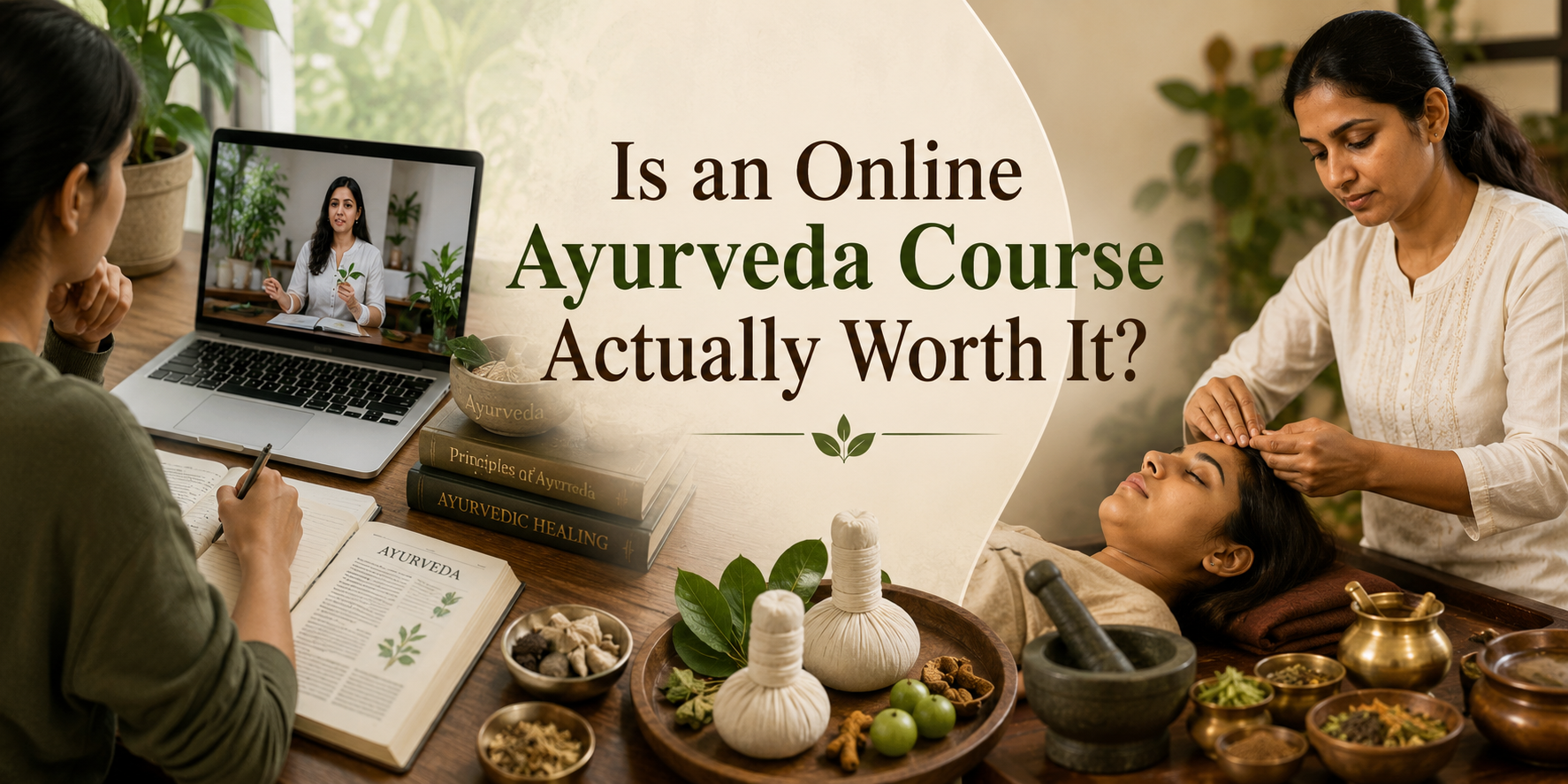
Ayurveda was never meant to be learned from a screen. For most of its 3,000-year history, it was passed down face to face as a teacher watching a student's pulse, correcting their hand placement, catching what a textbook never could. So it makes sense that when people start looking into ayurveda certification canada, the first question they ask is simple: can you really learn this online, or are you just buying a certificate that looks good on paper? It's a fair worry. The good news is, the answer isn't a flat yes or no. It depends on what you're studying, how the course is built, and what you plan to do with it once you're done. Let's walk through what actually matters.
Before comparing online and in-person study, it helps to be honest about why you want to learn Ayurveda in the first place, because the right answer changes depending on your goal.
You want it for yourself. You're curious about your own body, your energy, your digestion, and how daily habits affect all three.
You want a new career. You're aiming to become a working Ayurvedic Health Counselor or Practitioner.
You want to add to what you already do. Maybe you're a yoga teacher, a nutritionist, or a nurse, and Ayurveda is one more tool in your kit.
Each of these needs a different amount of training. A weekend of self-care lessons won't prepare you to see clients, and a full clinical program is overkill if you just want to understand your own dosha. Most ayurveda courses are built with this in mind; they're split into levels, so you only pay for the depth you actually need.
There's a common belief that online classes are the "easier," less serious option. The data doesn't really back that up. In a large BestColleges survey, most graduates of online programs said their education was just as good as or better than in-person study, and almost all of them said they'd recommend the online route to someone else. A separate 2025 study published in Technology, Knowledge and Learning compared face-to-face, online, and blended adult courses directly, and found that a well-built online or blended course can hold up just as well for long-term memory and understanding.
The word doing the heavy lifting there is "well-built." A course can be online and still be excellent, or online and still be thin. The format isn't the deciding factor. Instructor access, real feedback, and structure matter more.
For Ayurveda specifically, this plays out in a useful way. The theory side the doshas, the six tastes, digestion, daily and seasonal routines, herbs and their properties teaches well on video and through readings. The hands-on side pulse reading, marma point therapy, bodywork genuinely needs a real person in the room correcting your technique.
|
What matters |
Online Course |
In-Person Program |
|
Tuition |
Usually lower — no facility or travel costs |
Usually higher — includes clinic space, materials, campus fees |
|
Your schedule |
Self-paced or evenings/weekends |
Set class times, often full days |
|
Where you live |
Study from anywhere in Canada |
You need to live near a city that offers it |
|
Hands-on practice |
Limited, unless the program includes in-person sessions |
Built directly into the training |
|
Best for |
Health Educator level, self-care, first-time learners |
Advanced Wellness Counselor and clinical-level work |
This is exactly why the strongest Canadian schools now run a hybrid model theory delivered online, with in-person sessions built in for the parts you genuinely can't learn through a screen. CAISH's programs follow this approach, mixing virtual coursework with hands-on components so students get both flexibility and real practice time.
Here's something worth knowing before you enroll anywhere: Canada has no federal or provincial law that licenses the title "Ayurvedic Practitioner." Unlike a nurse or a naturopathic doctor, there's no government body checking who's allowed to use that title. In theory, anyone could call themselves an Ayurvedic practitioner with zero training.
That might sound like it makes certification pointless. It's actually the opposite. In a field with no legal gatekeeper, your certification is the gatekeeper. It's how a future client, or a clinic considering hiring you, tells the difference between someone properly trained and someone who isn't. This is exactly why ayurveda certification canada matters as much as it does the credential is doing the job a license would normally do.
So what actually builds credibility, if not a government license? Three things:
A recognized designation body. In Canada, that's the Examining Board of Natural Medicine Practitioners (EBNMP Canada) the organization that reviews training and grants designations to Ayurvedic doctors, practitioners, counselors, and educators.
Real, published training hours. Most professional bodies and employers look for around 500–600 hours for foundational practice, roughly 700 hours for a full Health Educator designation, and up to 1,500 hours for an Advanced Wellness Counselor-level credential.
Alignment with global standards. The World Health Organization's Traditional Medicine Strategy pushes for shared safety and training benchmarks across countries, so programs that map to WHO-recognized standards carry more weight internationally.
If you've done any research at all, you've probably run into NAMA the National Ayurvedic Medical Association and its certification arm, NAMACB, which certifies Health Counselors, Practitioners, and Advanced Practitioners in the United States.NAMA isn't a Canadian body, but its hour requirements are widely used as an informal quality benchmark, even by Canadian schools. If there's any chance you'll want to practice in the U.S. down the road, it's worth checking whether your program's hours line up with what NAMA expects.
Run any program you're considering through this list first:
Does it lead to a real designation through a body like EBNMP Canada or just a certificate of completion?
Are the instructors actually certified practitioners with real clinical experience, not just people who took the same course a few years earlier?
Are the training hours published clearly, and do they match the level you're aiming for?
Is there live interaction, real classes, live Q&A, feedback on your work or is it just pre-recorded videos?
Is there a supervised, in-person practicum if you're going for a practitioner-level credential?
Will they accept credit for prior training, if you've already studied yoga or holistic health?
How long has the school been around, and can you find real graduates working in the field?
If a school can't answer most of these clearly, that's your signal to keep looking.
Online study tends to work best for:
People with full-time jobs who need evenings or weekends, not fixed class hours.
People who don't live near a major city, since most in-person Ayurveda schools are clustered in a handful of places.
Yoga teachers and wellness practitioners layering Ayurveda onto work they already do, without needing full clinical hours.
Anyone testing the waters before committing to years of in-person, clinical-level study.
It's a weaker fit if your end goal is full clinical practice, working with real client cases. That level of skill is built through supervised, in-person practice; there's no real shortcut around it.
Yes as long as it's tied to a real designation body, not just a generic certificate. What matters is the designation, not whether you studied from a laptop or a classroom.
Not fully, and be cautious of any program that claims otherwise. This is exactly why the better schools use hybrid formats online for theory, in-person for hands-on skills.
Not necessarily. Run it through the checklist above. A lower price with clear hours, qualified instructors, and a real designation path can be a solid entry point. A low price with vague claims and no accreditation trail usually isn't.
For self-care and foundational learning, yes a well-built online Ayurveda course is a genuinely good way to learn, and the research on online education backs that up. For practitioner-level training, the honest answer is "online plus in-person" the hands-on skills still need a real teacher watching your technique. Either way, the format matters less than what's behind it: real hours, qualified instructors, and a clear path to a recognized designation.
If you're weighing your options for ayurveda certification canada, start with your goal personal, career, or add-on and work backward from there. CAISH's designation programs lay out exactly this kind of structured, hour-based path for students at different stages, which makes for a useful benchmark when you're comparing schools.
Read this article, When Should You Consider Refinancing Your Mortgage in Canada?