 English
 Arabic
 French
 Spanish
 Portuguese
 Deutsch
 Turkish
 Dutch
Dutch
 Italiano
 Russian
 Romaian
 Portuguese (Brazil)
 Greek
Greek
U4GM - Grow A Garden Items with 8 Currency-Saving Tricks
Games |
2025-08-14 02:53:25
 Social Networth OS
 Creator Commerce
 Launch Startup
 Global News
 Creator Award
 Talkfever App
Tout voir
Talkfever App
Tout voir

Mise à niveau vers Pro
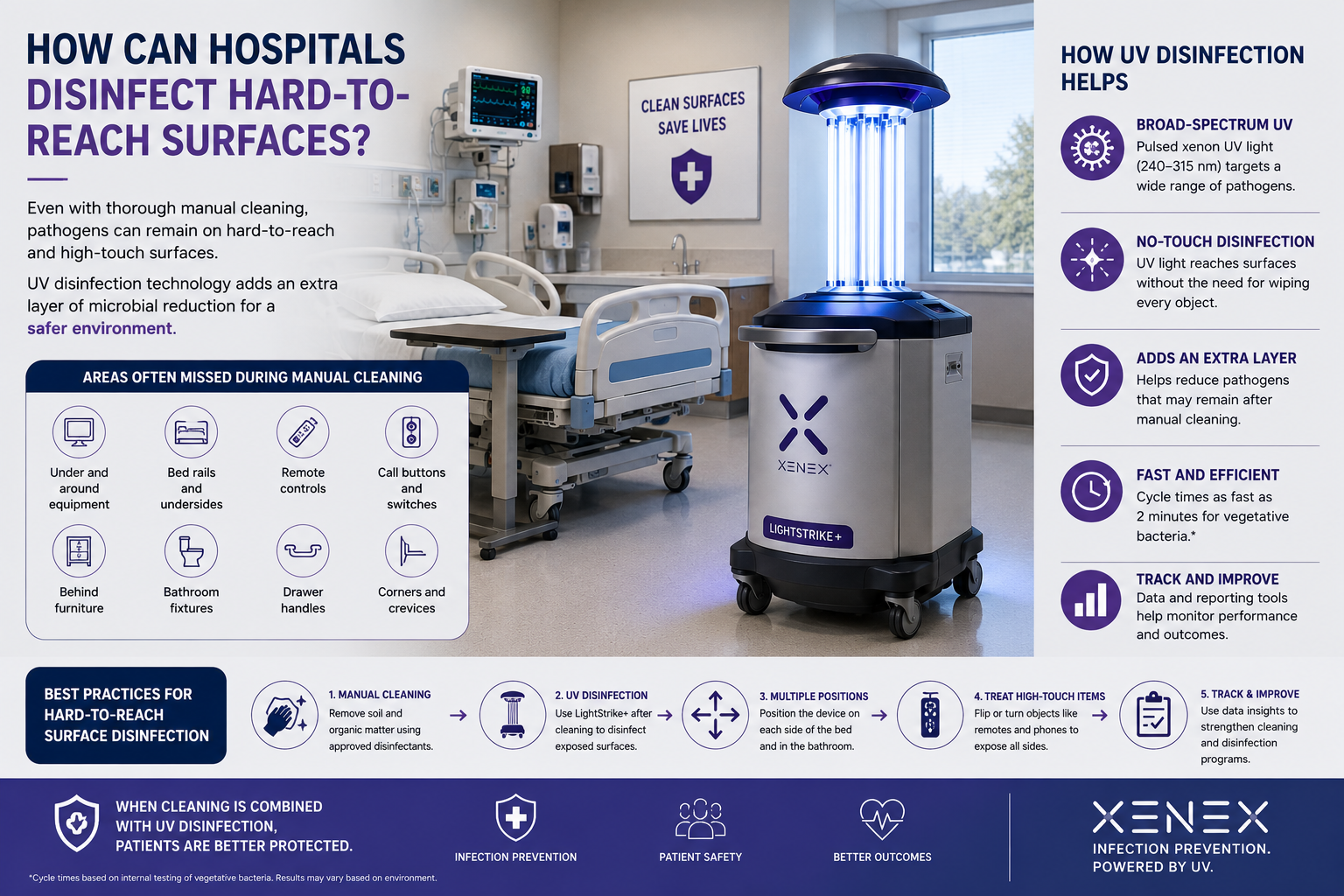
Hospitals contain countless surfaces that are difficult to clean consistently, from equipment controls and bed rails to bathroom fixtures and objects tucked behind medical equipment. While manual cleaning remains essential, UV disinfection technology can provide an additional microbial reduction step for exposed surfaces that may be missed during traditional liquid chemical cleaning. Xenex explains that LightStrike+ is designed to supplement existing hospital disinfection programs and help reduce pathogens that survive routine cleaning.
A hospital room is much more than a bed and a few visible surfaces. It can contain medical equipment, cables, monitors, tables, chairs, drawers, switches, call buttons, remote controls, and other frequently touched objects.
These surfaces can create several challenges for environmental services (EVS) teams. Some are physically difficult to reach, while others may have small components or multiple sides that require additional attention.
For example, a healthcare worker may easily wipe the top of a bedside table but overlook its underside. A remote control may be cleaned on one side while the other remains contaminated. Equipment positioned close to a wall can also create difficult areas for routine cleaning.
Xenex cites research showing that more than 48% of hospital room surfaces may not be properly disinfected during liquid chemical cleaning.
Hard-to-reach areas vary by room and facility, but some commonly overlooked surfaces include:
Bed rails and their undersides
Patient call buttons
Remote controls
Telephone receivers
Medical equipment controls
Blood pressure cuffs
Drawer handles
Door handles
Bathroom fixtures
Workstations
Equipment positioned behind or beside furniture
Mobile medical devices
Many of these are also high-touch surfaces, meaning they can be contacted repeatedly by patients, visitors, nurses, physicians, and other healthcare workers.
Because high-touch areas can play a role in environmental pathogen transmission, consistent disinfection is an important part of an effective infection prevention program.
Manual cleaning is fundamental to hospital environmental hygiene, but achieving complete and consistent coverage can be challenging.
EVS professionals must work within room-turnover schedules while following cleaning protocols, selecting appropriate disinfectants, allowing required contact or dwell times, and navigating medical equipment. Human variability can also affect whether every surface receives the intended treatment.
This does not mean manual cleaning is ineffective. Instead, it highlights why hospitals may benefit from a layered disinfection strategy.
Xenex describes LightStrike+ as a technology that works after liquid chemical cleaning to reduce pathogens that remain on treated surfaces.
UV disinfection provides a no-touch microbial reduction step. Instead of requiring a staff member to physically wipe each exposed surface, a UV device delivers germicidal UV energy to surfaces within its treatment area.
Xenex's LightStrike+ uses patented pulsed xenon UV technology and produces broad-spectrum germicidal UV light across approximately 240–315 nanometers. The company states that this technology is designed to deactivate pathogens at wavelengths where they are susceptible.
This can be particularly useful after manual cleaning because UV can provide an additional treatment for exposed surfaces that may have been missed or incompletely disinfected.
However, UV technology has an important limitation: it needs a clear line of sight.
UV light cannot effectively disinfect a surface that does not receive sufficient UV exposure. Furniture, equipment, walls, and other objects can create shadows that prevent UV energy from reaching certain areas.
Xenex specifically warns against assuming that a single UV position can adequately treat an entire room. The company's recommended LightStrike+ best practice includes positioning the device on each side of a patient bed and running a cycle in the bathroom when applicable.
This approach helps address the physics of UV light. Intensity decreases as distance from the source increases, while objects can block the light completely.
Therefore, proper device positioning is just as important as the UV technology itself.
High-touch objects require special attention because many have multiple sides or surfaces.
Xenex recommends flipping or turning objects such as phone receivers and remote controls between UV cycles so that both sides receive appropriate exposure.
A practical workflow can include:
Complete routine manual cleaning.
Identify high-touch surfaces.
Position the UV device according to the validated protocol.
Run the appropriate cycle.
Flip or reposition objects that have multiple exposed sides.
Perform additional cycles from another position when required.
Document the disinfection activity.
This approach can help hospitals avoid treating UV disinfection as a simple "place-and-run" process.
UV technology can help treat exposed surfaces around medical equipment, but it cannot disinfect surfaces that are completely blocked from the UV source.
This is why room preparation and device positioning matter. Equipment may need to be repositioned where appropriate so that important surfaces are exposed to the UV light.
Hospitals should also follow equipment manufacturers' instructions and the UV system's validated operating procedures. The objective is to maximize exposure to relevant surfaces without compromising patient-care equipment or workflow.
The goal of whole-room microbial reduction is to address environmental contamination across a treatment area rather than focusing only on individual surfaces.
Xenex describes LightStrike+ as an FDA-authorized medical device intended for reducing pathogens on non-porous, high-touch surfaces in healthcare environments. The device is designed to provide high-intensity, broad-spectrum UV light and can be customized for different room types and positions.
This can help healthcare facilities create a more standardized additional disinfection step after routine cleaning.
UV should not be considered a replacement for physical cleaning.
Surfaces hidden behind objects, inside enclosed spaces, or outside the UV device's direct exposure area still require appropriate manual cleaning and disinfection.
The strongest strategy is therefore a combination of:
Manual environmental cleaning
Chemical disinfection
Proper UV positioning
Multiple treatment positions where appropriate
Attention to high-touch surfaces
Staff training
Infection prevention oversight
Disinfection tracking and monitoring
This layered approach recognizes the strengths and limitations of each method.
Xenex's approach extends beyond the UV device itself. The company says it works with infection control teams to analyze and identify implementation processes, beginning with high-priority areas. It also provides implementation, training, ongoing support, and monitoring reports.
LightStrike+ also includes cloud-based reporting capabilities, allowing healthcare facilities to track important disinfection metrics.
This combination of technology, workflow, training, and data can help EVS and infection prevention teams make UV disinfection a consistent part of their environmental cleaning program.
There is no single technique that solves every hospital cleaning challenge. Manual cleaning remains necessary for removing dirt, organic material, and contamination from surfaces.
UV disinfection can then provide an additional microbial reduction step for surfaces that are exposed to the UV source. The key is to use appropriate positioning, account for shadows, treat multiple sides of high-touch objects, and follow validated procedures.
Xenex emphasizes that its LightStrike+ best practices are designed specifically to address the line-of-sight limitations of UV technology rather than relying on surface reflectivity.
So, how can hospitals disinfect hard-to-reach surfaces? The answer is a layered approach that combines thorough manual cleaning with technologies and procedures designed to improve environmental microbial reduction.
Hard-to-reach and high-touch surfaces can create gaps in traditional cleaning because of room layouts, equipment, time constraints, and human variability. UV technology such as Xenex LightStrike+ can add a no-touch microbial reduction step after liquid chemical cleaning, provided the device is positioned correctly and surfaces receive adequate UV exposure.
For hospitals, the goal is not to choose between manual cleaning and UV disinfection. Instead, combining EVS expertise, chemical disinfection, pulsed xenon UV, validated positioning, and monitoring can create a more comprehensive environmental infection prevention strategy.
Hard-to-reach surfaces include areas such as the underside of bed rails, equipment controls, bathroom fixtures, drawer handles, remote controls, and surfaces located around or behind medical equipment.
UV can treat exposed surfaces within its line of sight, but objects can create shadows that block UV energy. Proper positioning and multiple treatment locations may therefore be necessary.
No. UV disinfection is intended to complement manual cleaning and chemical disinfection. Xenex recommends using LightStrike+ after liquid chemical cleaning as an additional microbial reduction step.
UV intensity decreases with distance, and objects can create shadows. Xenex recommends positions on both sides of a patient bed and additional positioning, such as a bathroom cycle, to improve exposure across relevant surfaces.
UV can treat exposed surfaces of high-touch objects when they receive adequate UV exposure. Xenex recommends flipping or turning items such as remote controls and phone receivers between cycles so both sides can be exposed.


