 English
 Arabic
 French
 Spanish
 Portuguese
 Deutsch
 Turkish
 Dutch
Dutch
 Italiano
 Russian
 Romaian
 Portuguese (Brazil)
 Greek
Greek
Button Cell Market, Global Business Emerging Trends, Technological Advancements, and Business Strategies 2026-2034
Music |
2026-04-16 11:55:22
 Social Networth OS
 Creator Commerce
 Launch Startup
 Global News
 Creator Award
 Talkfever App
Ver Todo
Talkfever App
Ver Todo

Upgrade to Pro
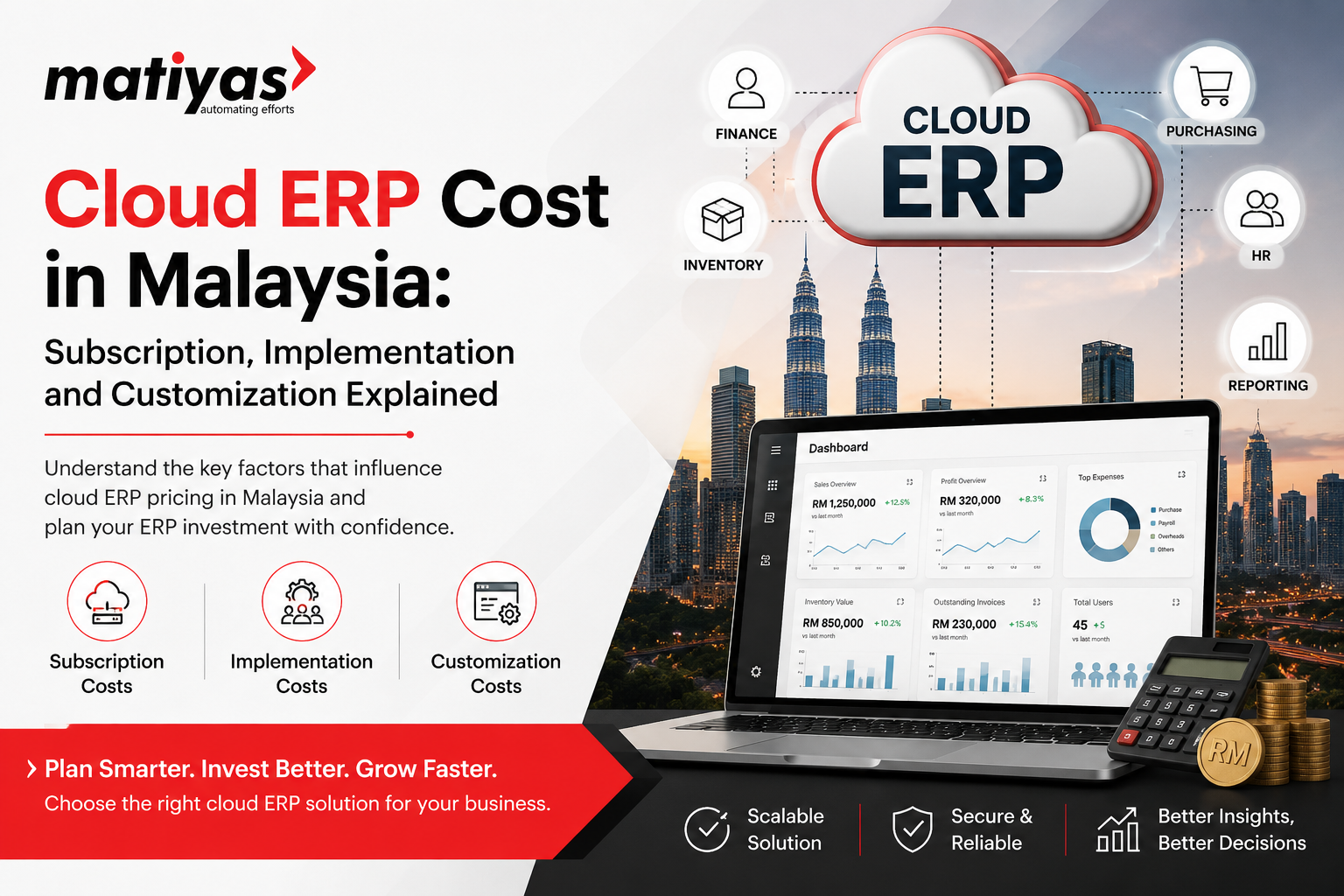
For Malaysian businesses planning to replace disconnected accounting, inventory, sales, HR, or operational systems, understanding cloud ERP cost in Malaysia is an important part of the buying decision. Cloud ERP can help businesses centralize financial management, automate workflows, improve reporting, and connect departments through a single platform. However, the total cost is not limited to the monthly or annual subscription.
A realistic cloud ERP Malaysia budget usually includes three major components: software subscription, ERP implementation, and customization. Depending on the size of the company, number of users, business processes, integrations, and level of customization required, the overall investment can vary significantly.
This guide explains the main factors that influence cloud ERP pricing in Malaysia and what businesses should consider before selecting an ERP solution.
Cloud ERP is an enterprise resource planning system hosted on cloud infrastructure rather than being installed and maintained entirely on a company's own servers. Employees can access the system through an internet connection, allowing finance, sales, purchasing, inventory, manufacturing, HR, and other departments to work with centralized business data.
For Malaysian companies, cloud ERP can be particularly useful when operations involve multiple branches, warehouses, departments, or locations. Instead of maintaining separate applications and manually transferring information between them, businesses can use an integrated ERP system to connect their core processes.
A cloud ERP platform can include accounting, invoicing, purchasing, inventory management, customer management, manufacturing, project management, payroll, reporting, and other business functions.
There is no single fixed price for cloud ERP in Malaysia because ERP projects differ considerably from one organization to another.
The total cost is generally influenced by:
Number of users
Required ERP modules
Subscription model
Implementation scope
Data migration requirements
Business process complexity
Third-party integrations
Custom workflows
Custom reports and dashboards
Training requirements
Ongoing support and maintenance
A small Malaysian business with relatively simple accounting, sales, purchasing, and inventory requirements may have a much smaller ERP investment than a manufacturing company operating multiple warehouses and requiring production planning, costing, advanced reporting, and integrations.
Therefore, businesses should evaluate the total cost of ownership of cloud ERP rather than comparing vendors only by their monthly subscription price.
The first cost businesses usually consider is the ERP subscription.
Cloud ERP providers commonly structure pricing around users, modules, features, or a combination of these factors. Some providers offer different plans for small businesses and larger organizations, while others provide more flexible pricing based on business requirements.
Several factors can influence the recurring cost of cloud ERP software in Malaysia.
The number of employees who require access can have a direct impact on the subscription cost. A company with ten users will generally have different requirements from an organization with 100 or more users.
However, businesses should not simply minimize the number of users to reduce costs. Restricting access too much can lead to manual processes and reduce the benefits of ERP automation.
Businesses may need different modules depending on their operations.
Common ERP modules include:
Accounting and financial management
Sales management
Purchasing
Inventory management
Manufacturing
Human resources
Payroll
CRM
Project management
Asset management
Reporting and analytics
A Malaysian trading company may primarily need accounting, purchasing, sales, and inventory, while a manufacturer may require production planning, bills of materials, work orders, inventory, costing, purchasing, and quality-related workflows.
A growing SME may require a relatively straightforward ERP implementation, while a larger organization may need multiple entities, branches, warehouses, approval workflows, and advanced reporting.
This is why comparing ERP prices without considering business complexity can be misleading.
Subscription is only one part of the overall investment. ERP implementation in Malaysia can represent a significant portion of the project cost.
Implementation involves configuring the ERP platform according to the company's business requirements and preparing employees to use the new system effectively.
A professional ERP implementation may include:
Business requirement analysis
ERP configuration
Workflow design
Data migration
User and role configuration
Integration setup
Testing
User training
Deployment
Post-go-live support
The more complex the business environment, the more effort may be required during implementation.
For example, a company that only needs standard accounting and inventory functionality may require relatively limited configuration.
On the other hand, a manufacturer may need to configure:
Bills of materials
Production workflows
Work orders
Material planning
Manufacturing costing
Warehouse processes
Approval workflows
Financial integration
This increases the implementation scope and therefore the project cost.
Another important component of cloud ERP cost in Malaysia is customization.
Standard ERP functionality can often support common business processes. However, companies sometimes have specialized workflows that require additional configuration, custom development, reports, dashboards, or integrations.
Customization can include:
Custom fields
Custom forms
Custom reports
Approval workflows
Automated notifications
Specialized dashboards
Industry-specific processes
API integrations
Third-party software integrations
Custom business logic
Businesses should avoid unnecessary customization because excessive modifications can increase implementation complexity and make future upgrades more difficult.
The better approach is to first determine whether the standard ERP functionality can support the requirement. Custom development should generally be considered when the business requirement provides meaningful operational or financial value.
Many Malaysian businesses already use accounting software, payroll platforms, e-commerce systems, payment gateways, CRM platforms, warehouse applications, or other business tools.
When implementing a new cloud ERP system, these systems may need to exchange data.
For example, a company may need integration between ERP and:
E-commerce platforms
Payment gateways
Banking systems
CRM software
Payroll systems
Warehouse systems
Point-of-sale systems
Shipping platforms
Existing accounting software
Integration requirements can affect both implementation time and overall ERP software cost in Malaysia.
The complexity depends on the systems involved, available APIs, data structure, synchronization requirements, and whether the integration needs to work in one direction or both directions.
Data migration is another area that businesses should include in their ERP budget.
Companies moving from spreadsheets or legacy systems may need to migrate customer records, suppliers, products, opening balances, inventory data, accounting information, and historical transactions.
Before migration, data may need to be cleaned, standardized, validated, and mapped to the new ERP structure.
Poor-quality data can create problems after implementation, so businesses should treat data migration as an important part of the ERP project rather than simply exporting and importing files.
Even a technically strong ERP implementation can fail if employees do not understand how to use the system.
Training may be required for finance teams, sales teams, purchasing departments, warehouse employees, production teams, HR personnel, and management.
Employees should understand not only which buttons to click, but also how their processes change after ERP implementation.
For example, instead of entering the same information into multiple systems, an integrated ERP workflow may allow one transaction to automatically update inventory, accounting, sales records, and management reports.
This can significantly improve efficiency, but users need proper training to adopt the new workflow.
Businesses do not necessarily need to choose the cheapest ERP system. Instead, they should focus on achieving the right balance between functionality, scalability, implementation effort, and long-term value.
Start by documenting the most important business processes. Identify which processes are currently manual, duplicated, or difficult to monitor.
Next, separate essential requirements from optional features. This helps prevent unnecessary customization and reduces implementation complexity.
Businesses should also consider future growth. Choosing an ERP that only supports the company's current size may create another technology replacement project later.
A scalable cloud ERP system in Malaysia can allow businesses to add users, modules, workflows, branches, and integrations as their operations expand.
Cloud ERP and traditional on-premise ERP have different cost structures.
With traditional on-premise systems, businesses may need to consider server infrastructure, hardware maintenance, backups, security management, software upgrades, and internal IT resources.
Cloud ERP generally shifts more of the infrastructure responsibility to the cloud provider. Businesses pay recurring subscription costs while the underlying infrastructure is managed as part of the cloud service.
However, cloud ERP is not automatically cheaper in every situation. The right choice depends on the organization's requirements, security policies, scalability needs, integrations, and long-term operating model.
For many growing Malaysian businesses, cloud ERP can provide a more flexible approach because it reduces the need to maintain dedicated ERP infrastructure internally.
When evaluating cloud ERP Malaysia options, businesses should look beyond the advertised subscription price.
Consider the complete solution, including:
Functional coverage
Implementation expertise
Customization capabilities
Integration options
Data migration support
Training
Technical support
Scalability
Reporting capabilities
Security
Upgrade process
Long-term ownership cost
A provider that appears inexpensive initially may become more expensive if important functionality requires extensive customization or third-party tools.
Conversely, a slightly higher initial investment can provide better value if the ERP automates significant manual work and scales with the business.
Choosing the right ERP implementation partner is as important as choosing the ERP platform itself.
Matiyas helps Malaysian businesses implement ERP solutions designed around their operational requirements. The approach can cover business process analysis, ERP configuration, customization, integrations, data migration, training, and ongoing support.
Whether your business operates in manufacturing, trading, distribution, retail, logistics, construction, healthcare, or another industry, the objective should be to create an ERP environment that connects financial management with day-to-day business operations.
If you are evaluating cloud ERP software in Malaysia and want to understand the likely subscription, implementation, customization, and integration requirements for your business, explore Matiyas' ERP solutions in Malaysia and discuss your requirements with the team.
The true cloud ERP cost in Malaysia is more than a monthly software subscription. Businesses need to consider implementation, customization, integrations, data migration, training, support, and future scalability when calculating the total investment.
The best ERP solution is not necessarily the cheapest platform. It is the system that provides the right functionality, supports business processes efficiently, integrates with existing applications, and can grow alongside the organization.
For Malaysian SMEs and growing enterprises, a well-planned cloud ERP implementation can provide centralized financial management, better inventory visibility, automated workflows, improved reporting, and stronger control over business operations.
Before selecting an ERP provider, evaluate the complete project scope and calculate the expected long-term value. With the right implementation strategy and a scalable ERP platform, businesses can turn their ERP investment into a foundation for more efficient and connected operations in Malaysia.


