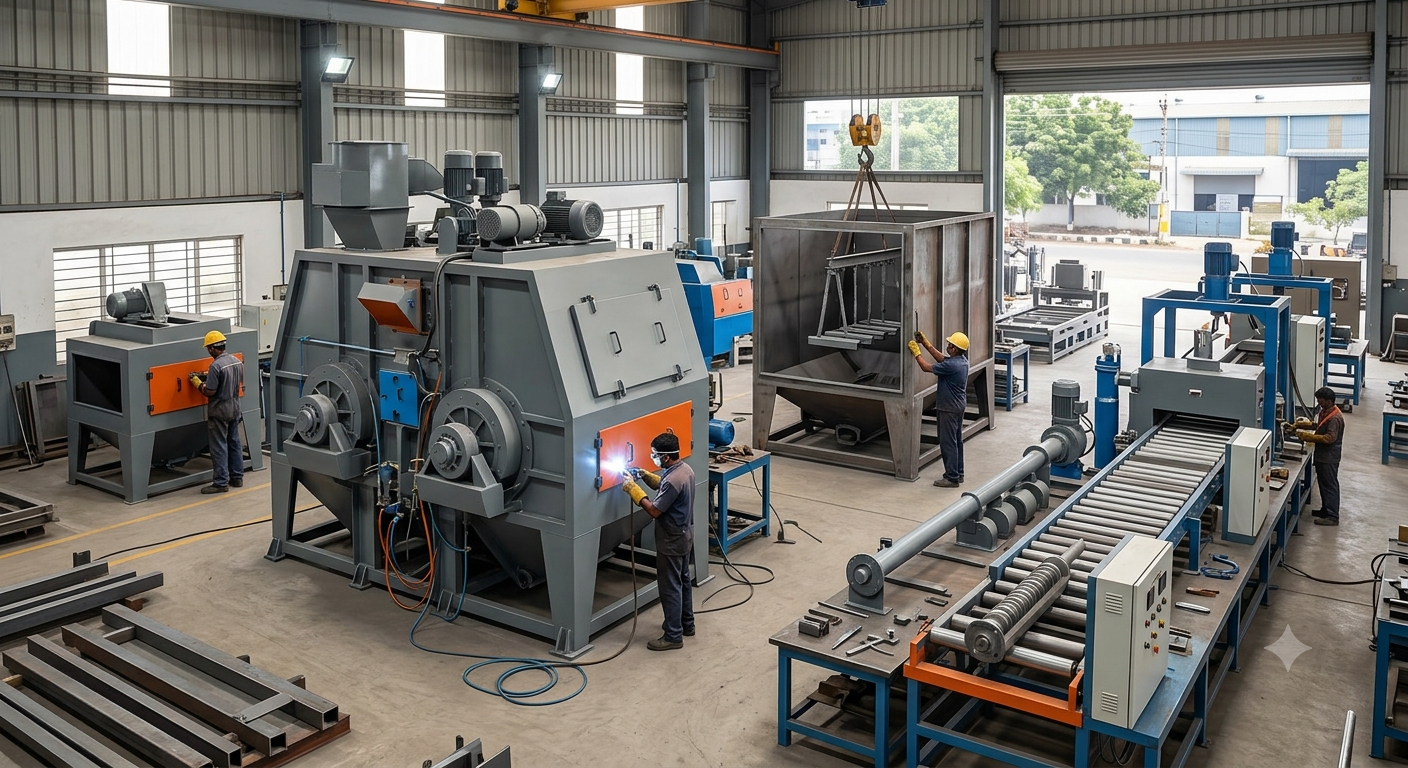
Understanding the Role of Surface Preparation
Surface preparation is an essential stage in industrial manufacturing. Before components are painted, coated, welded, or finished, unwanted materials such as rust, mill scale, casting sand, corrosion, and old coatings often need to be removed.
Traditional cleaning methods can become difficult when manufacturers handle large components, high production volumes, or complex surface conditions. Mechanical blasting provides a more controlled approach by using abrasive media to clean and prepare surfaces.
Modern shot blasting equipment is designed to improve the efficiency and consistency of this process while reducing excessive manual intervention. The right system can become an important part of a streamlined production workflow.
What Is Shot Blasting Equipment?
Shot blasting equipment uses abrasive particles that are propelled at high velocity toward a workpiece. The impact of the abrasive media removes contaminants and prepares the surface for subsequent manufacturing or finishing processes.
Depending on the machine configuration, components may be blasted individually, in batches, or as part of a continuous production line.
The basic process involves:
• Loading the component
• Positioning the workpiece
• Propelling abrasive media
• Removing surface contaminants
• Collecting used abrasive
• Separating reusable media
• Unloading the processed component
The equipment configuration determines how efficiently these stages can be performed.
Why Industries Use Shot Blasting
Industrial manufacturers require consistent surface conditions to achieve reliable results in downstream processes. Poorly prepared surfaces can affect coating adhesion, finishing quality, and the durability of protective treatments.
Shot blasting can provide several advantages:
• Faster surface cleaning
• Consistent treatment quality
• Reduced manual cleaning
• Improved coating preparation
• Better production repeatability
• Efficient handling of large batches
For industries processing metal components regularly, mechanized surface preparation can provide greater process control than labor-intensive cleaning techniques.
Selecting Equipment Based on Component Characteristics
There is no universal blasting machine suitable for every application. Equipment selection should begin with an assessment of the components being processed.
Important factors include:
• Component size
• Component weight
• Component geometry
• Material composition
• Production quantity
• Required surface finish
• Processing time
• Available installation space
For example, small components that can withstand controlled movement may be suitable for batch processing, while large or irregularly shaped components may require a different handling arrangement.
Understanding these factors helps manufacturers choose a system that fits their actual production environment.
Different Types of Blasting Systems
Shot blasting systems are available in multiple configurations, each designed for specific applications.
Tumble systems are commonly considered for batches of smaller components. Hanger systems can accommodate larger or irregular workpieces by suspending them during blasting. Table-based systems can provide controlled positioning for suitable components.
Conveyor-based systems may be preferred when blasting needs to be integrated into a continuous manufacturing process.
Specialized systems can also be designed for particular component shapes, production requirements, or surface treatment objectives.
The appropriate configuration should always be determined by the application rather than by equipment availability alone.
Abrasive Media Management
Abrasive media is one of the most important operational elements in a blasting process. The media must be circulated efficiently to maintain consistent blasting performance.
A properly designed recovery system collects used abrasive and separates reusable particles from dust, debris, and contaminants. Reusable media can then return to the blasting cycle.
Effective abrasive management can help manufacturers reduce unnecessary consumption while maintaining stable process conditions.
When evaluating shot blasting equipment, manufacturers should therefore consider the abrasive recovery and separation system alongside the primary blasting mechanism.
Improving Production Efficiency Through Automation
Automation can make surface preparation more efficient, particularly in high-volume manufacturing environments. Automated handling systems can reduce repetitive manual work and provide more consistent processing cycles.
Depending on the equipment design, automation may control:
• Loading and unloading
• Component movement
• Blasting duration
• Abrasive circulation
• Dust extraction
• Process sequencing
Automation also helps integrate surface preparation into larger production workflows. However, the appropriate level of automation depends on production volume, labor requirements, component characteristics, and budget considerations.
The Importance of Dust Collection
Blasting operations generate dust as surface contaminants are removed. Without suitable extraction, dust can accumulate within the working environment and affect equipment performance and workplace conditions.
A suitable dust collection system helps capture airborne particles generated during blasting. Filtration capacity, airflow, maintenance requirements, and the nature of the material being removed should all be considered during equipment selection.
Effective dust management also contributes to cleaner production areas and easier routine maintenance.
Durability and Wear Protection
Blasting machines operate under demanding conditions because abrasive particles repeatedly impact internal surfaces. Components exposed to this environment require suitable wear protection and regular inspection.
Manufacturers should examine the construction of the blasting chamber, protective liners, blasting wheels, abrasive handling components, and other areas exposed to continuous abrasive action.
Durable construction can help reduce unexpected downtime and support reliable performance over the equipment's service life.
Maintenance and Operating Considerations
Regular maintenance is essential for maintaining consistent blasting performance. Wear components should be inspected periodically, while dust collection and abrasive recovery systems need appropriate cleaning and servicing.
Before selecting equipment, manufacturers should understand:
• Preventive maintenance requirements
• Wear component replacement
• Spare part availability
• Cleaning procedures
• Technical support
• Operator training
• Service requirements
A machine that is easy to inspect and maintain can help reduce interruptions and improve overall productivity.
Safety in Industrial Blasting
Safety should remain a fundamental consideration when installing and operating blasting equipment. Enclosed blasting areas, controlled access, emergency controls, suitable dust extraction, and appropriate operating procedures can help create a safer working environment.
Operators should receive training covering equipment operation, abrasive handling, inspection, cleaning, and maintenance procedures.
Safety measures should be incorporated into equipment planning rather than treated as an additional consideration after installation.
Evaluating Long-Term Equipment Value
The initial purchase price should not be the only factor considered when selecting industrial blasting equipment. Long-term operating costs can include abrasive consumption, energy usage, maintenance, replacement components, downtime, and technical support.
A system that provides consistent performance and efficient abrasive recovery may offer better long-term value than equipment selected solely because of its lower initial cost.
Manufacturers should compare equipment based on productivity, durability, maintenance requirements, operating efficiency, and suitability for future production needs.
Conclusion
Shot blasting is an important surface preparation technology that can help industries achieve cleaner, more consistent, and production-ready surfaces. Selecting the right equipment requires careful consideration of component characteristics, machine configuration, abrasive management, automation, dust collection, durability, maintenance, and safety.
Wewin Finishing Equipments Pvt. Ltd provides industrial finishing equipment solutions for different manufacturing applications. Businesses evaluating shot blasting equipment should focus on technical suitability, operational efficiency, reliability, and long-term value when selecting a system for their production environment.
 English
 Arabic
 French
 Spanish
 Portuguese
 Deutsch
 Turkish
 Dutch
Dutch
 Italiano
 Russian
 Romaian
 Portuguese (Brazil)
 Greek
Greek
 Social Networth OS
 Creator Commerce
 Launch Startup
 Global News
 Creator Award
 Talkfever App
Ver todos
Talkfever App
Ver todos