English
 Arabic
 French
 Spanish
 Portuguese
 Deutsch
 Turkish
 Dutch
Dutch
 Italiano
 Russian
 Romaian
 Portuguese (Brazil)
 Greek
Greek
How to Start Your Pilot Training Journey in India
Literature |
2026-08-25 11:26:23
 Social Networth OS
 Creator Commerce
 Launch Startup
 Global News
 Creator Award
 Talkfever App
Alle anzeigen
Talkfever App
Alle anzeigen

Upgrade auf Pro
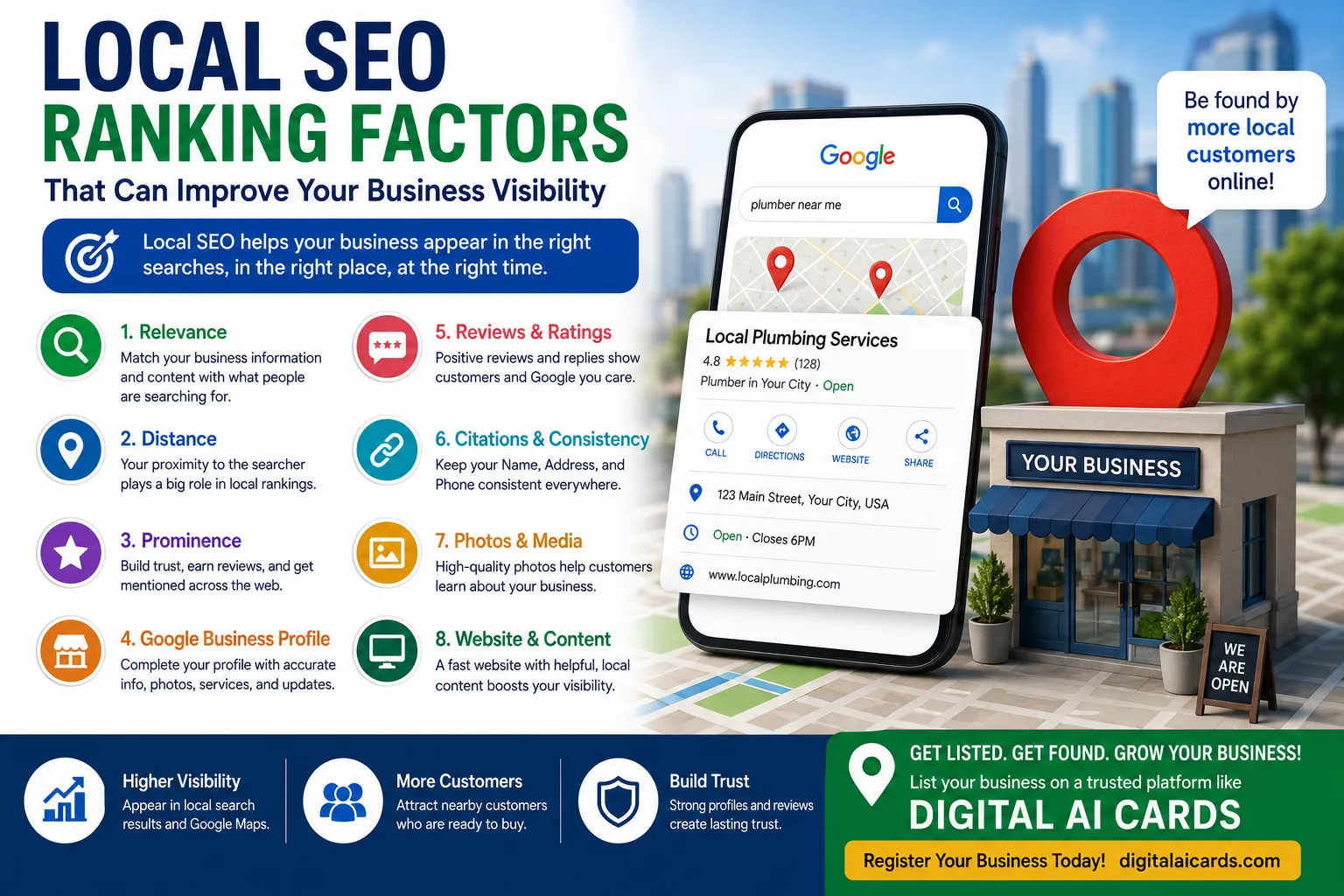
A business can have excellent products, professional services, and a well-designed website and still struggle to attract customers from nearby areas. One common reason is poor local search visibility.
When people search for a service in their area, they usually want quick and relevant answers. They may search for a nearby provider, compare several businesses, read reviews, check opening hours, and visit a company's website before making a decision. If your business information is incomplete, inconsistent, or difficult to find, competitors may receive those customers instead.
Understanding the important local SEO ranking factors can help business owners identify visibility problems and build a more effective local search strategy.
The goal is not to manipulate search engines. It is to make your business easier for search engines to understand and easier for real customers to discover, evaluate, and contact.
Traditional SEO focuses heavily on helping webpages appear for relevant searches. Local SEO adds another important dimension: location.
A customer searching for "accountant" has a broad intent. Someone searching for "accountant near me" or "accountant in Jacksonville" has a much stronger local intent.
Search engines need to determine which businesses are relevant to the service, appropriate for the location, and trustworthy enough to show to the searcher.
That is why local optimization involves more than simply adding a city name to your website.
One of the first things to check is whether your core business information is correct everywhere online.
Important details include:
If customers encounter different information across websites, they may become confused or lose confidence in the business.
Create a consistent foundation and update your information whenever something changes.
Your business category helps communicate what your company actually does.
Choosing an overly broad or unrelated category can make your listing less relevant to the searches you want to attract.
Think about your primary service from the customer's perspective.
If someone searched specifically for your main service, would your selected category make sense?
Choose the most accurate available category rather than selecting categories simply because they appear popular.
A partially completed profile creates missed opportunities.
Potential customers may want to know what you offer, where you operate, how to contact you, and what makes your business relevant to their needs.
Complete your profile with useful information such as:
A complete profile also gives search engines more context about your company.
Your website should support your local search presence rather than simply exist as an online brochure.
Create useful pages that explain your primary services and answer questions customers commonly ask.
For example, a home repair company could have separate pages explaining different repair services. A professional consultant could create pages explaining specific solutions offered to different types of clients.
Avoid creating dozens of nearly identical location pages with minimal information. Instead, prioritize genuinely useful pages that provide information customers need.
Keyword research is useful, but understanding search intent is even more important.
Consider the difference between:
"How does roof repair work?"
and
"Roof repair company near me"
The first search is informational. The second suggests stronger commercial intent.
Your website should provide content for different stages of the customer journey.
Educational articles can answer questions, while service pages can help customers who are ready to contact a provider.
Natural use of related terms such as local services, nearby businesses, service areas, customer reviews, business listings, and local providers can also help create context without repeating one keyword excessively.
Reviews can influence how potential customers perceive a business.
A large number of reviews does not automatically mean a company is the best choice, but genuine feedback can help customers evaluate whether a business is trustworthy.
Focus on providing excellent service first.
Then make it easy for satisfied customers to leave honest feedback.
Respond professionally to reviews as well. Thank customers for positive feedback and address legitimate concerns constructively.
Never rely on fake reviews or misleading testimonials. Long-term reputation is more valuable than short-term numbers.
Your website should not be the only place where your company exists online.
Relevant business directories, industry websites, professional associations, local organizations, and other legitimate platforms can create additional discovery opportunities.
For USA-based businesses, USA Business Directory can provide another place to showcase company information and make a business easier for potential customers to discover.
You can also Register Your USA Business Online and create a business profile that provides useful information about your company.
The focus should be on relevance and quality rather than submitting your business to every directory available.
A citation is an online reference to important business information.
Citations can appear on directories, industry websites, local platforms, and other business resources.
The most important thing is accuracy.
If your business moves to a new location, changes its phone number, or updates its website, review your important listings and make appropriate updates.
Consistent information creates a more reliable online presence and reduces confusion for customers.
If your business serves a particular city or region, clearly explain that on your website and business profiles.
For service-area businesses, describe the areas you genuinely serve.
However, avoid creating pages that simply repeat the same content while changing the city name.
Good local content should provide something useful about the area, service, customer needs, or business offering.
The purpose is to help people, not manufacture pages for search engines.
Many local searches happen when people are away from their computers.
A customer might search for a service from a smartphone and immediately visit a website.
If your website is difficult to navigate on a small screen, the visitor may leave before contacting you.
Make sure important information is easy to find on mobile devices.
Your phone number, contact form, service details, location information, and calls to action should be accessible without unnecessary scrolling or complicated navigation.
Photos can help potential customers understand your business before they make contact.
Depending on your industry, consider using:
Use authentic visuals that accurately represent your company.
For local businesses, genuine images can make an online profile feel more trustworthy and informative.
Local content doesn't have to be limited to articles containing city names.
Think about what people in your target market actually need to know.
You could create:
This type of content can attract informational searches while demonstrating your expertise.
Local visibility is also connected to how established and recognized a business appears online.
A company that is mentioned by relevant websites, receives genuine reviews, produces useful content, and maintains a professional digital presence can build stronger authority over time.
This is not something that happens overnight.
Instead of chasing hundreds of low-quality links, focus on earning relevant mentions and creating resources people genuinely find useful.
Businesses often make local optimization harder by using shortcuts.
Avoid:
These approaches may create short-term activity but rarely produce a sustainable customer acquisition strategy.
If your local search performance is weak, start with the basics instead of changing everything at once.
First, verify your business information.
Next, improve your website's service and location information. Then review your business profiles, categories, customer reviews, photos, and relevant directory listings.
After that, create useful content based on real customer questions.
Finally, monitor meaningful results such as phone calls, contact forms, website visits, direction requests, appointments, and qualified leads.
This makes local SEO a measurable business activity rather than a guessing game.
Local search visibility is built from many connected elements. Accurate business information, relevant categories, useful website content, customer reviews, mobile usability, quality business listings, local relevance, and a trustworthy online reputation all contribute to a stronger digital presence.
The most effective approach is to stop looking for one magic ranking factor and instead improve the complete customer experience.
When search engines can clearly understand what your business offers and customers can easily verify, trust, and contact your company, your local marketing foundation becomes much stronger.