 English
 Arabic
 French
 Spanish
 Portuguese
 Deutsch
 Turkish
 Dutch
Dutch
 Italiano
 Russian
 Romaian
 Portuguese (Brazil)
 Greek
Greek
A Comprehensive Evaluation of fc 25 coins’s Performance and Stability
Shopping |
2025-03-24 06:06:33
 Social Networth OS
 Creator Commerce
 Launch Startup
 Global News
 Creator Award
 Talkfever App
Ver Todos
Talkfever App
Ver Todos

Atualize para o Pro
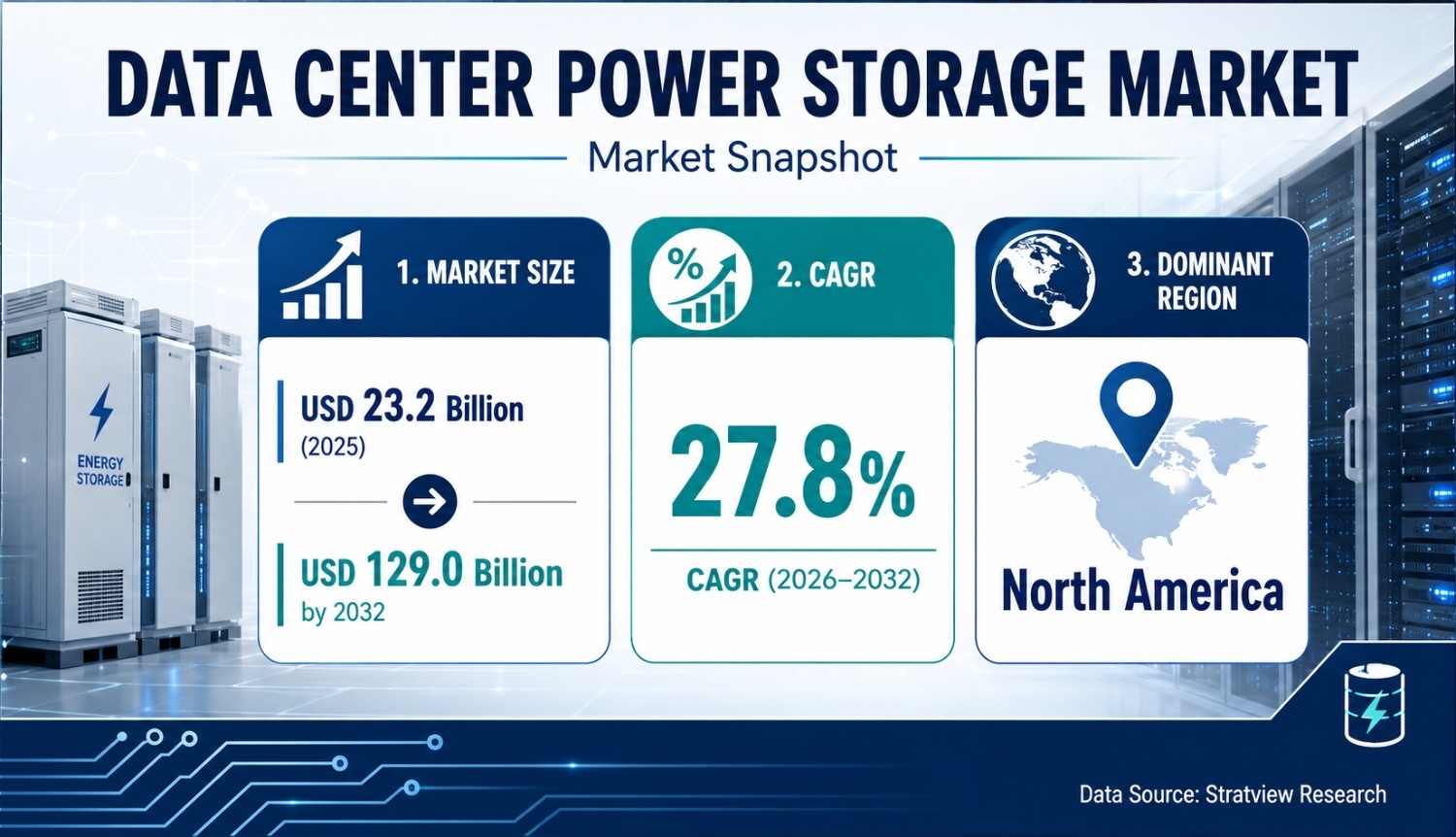
The Data Center Power Storage Market is entering a high-growth phase, with annual demand projected to increase from USD 29.6 billion in 2026 to USD 129.0 billion by 2032. The market is forecast to expand at 27.8% CAGR during 2026–2032, following a 27.3% year-over-year increase from 2025 to 2026.
“The Data Center Power Storage Market is expected to grow at a CAGR of 27.8% during 2026–2032.”
Modern data centers require power-storage infrastructure to maintain continuous availability during grid disturbances and outages. BESS and UPS technologies are becoming increasingly important as operators manage rapidly growing energy loads, renewable-energy integration, AI computing requirements, and stringent service-level expectations across hyperscale, colocation, enterprise, and edge environments.
The increasing Data Center Power Storage Market size reflects the scale of investment required to support AI and cloud infrastructure. GPU-intensive computing increases rack power density, while real-time digital services increase the operational cost of interruptions, strengthening requirements for resilient, responsive, and intelligently managed storage systems.
Request a free sample report:
https://www.stratviewresearch.com/Request-Sample/data-center-power-storage-market#form
The Storage Type segmentation comprises BESS and Uninterrupted Power Supply (UPS). BESS is expected to remain the dominant storage type throughout the forecast period, while UPS systems are projected to witness the fastest growth. Battery-system advantages include faster response, high energy density, renewable-energy integration, emissions reduction, and improving battery-cycle performance.
The increasing use of BESS as an alternative to diesel generators is particularly relevant for hyperscale and colocation facilities. Battery systems can reduce noise and emissions while providing a smaller footprint and rapid response during power disruptions, creating a stronger operational case as storage technology continues advancing.
The Data Center Type segmentation comprises Hyperscale, Colocation, Enterprise, and Edge. Hyperscale is expected to retain its dominant position and is identified as both the largest and fastest-growing demand segment. Utility-scale BESS deployments support renewable-energy integration, grid independence, and mission-critical AI workloads within these high-density facilities.
North America leads the global market and is expected to hold the largest share through the forecast period. Hyperscale concentration, advanced BESS deployment, clean-energy investment, regulatory support, and rapid AI data center construction reinforce demand for advanced storage infrastructure.
Asia-Pacific is projected to register the fastest growth. Data center investment is expanding across China, India, Japan, Singapore, South Korea, and Australia, supported by hyperscale and colocation development and growing regional digital demand.
BESS is increasingly becoming part of primary resilience strategies rather than serving only as supplemental backup. Recent deployments demonstrate its role in replacing diesel generators while simultaneously supporting renewable-energy integration and lower-emission data center operations.
Lithium-ion UPS systems are also advancing. Recent product development includes integrated battery management and real-time remote monitoring designed for high-density AI data centers, showing how storage equipment is becoming more digitally managed and closely aligned with demanding rack-level power environments.
Modularity is another important direction. Modular UPS architectures and intelligent battery management platforms help data centers respond to changing power requirements while improving monitoring, predictive maintenance, lifecycle management, and energy optimization.
ABB Group
Schneider Electric
Vertiv
Eaton (Electrical Sector)
Siemens
Legrand
Exide Technologies
Saft Group (TotalEnergies)
EnerSys
Fluence Energy
The Data Center Power Storage Market is forecast to expand from USD 29.6 billion in 2026 to USD 129.0 billion by 2032, achieving 27.8% CAGR. The projected cumulative sales opportunity of USD 483.5 billion during 2026–2032 reflects substantial capital deployment across the storage ecosystem.
Market growth is being driven by both capacity expansion and changing technology requirements. Storage providers increasingly need to deliver high-density, modular, digitally managed systems capable of supporting AI infrastructure, renewable-energy integration, and strict data center reliability requirements.
The Data Center Power Storage Market is projected to reach USD 129.0 billion by 2032, compared with USD 29.6 billion in 2026.
The market is expected to grow at a 27.8% CAGR from 2026 through 2032. Annual demand is forecast to expand rapidly as data center power requirements increase.
AI workloads, cloud computing, hyperscale development, renewable-energy integration, higher power densities, grid instability, and stronger uptime requirements are increasing storage investment.
North America is expected to remain the largest market, while Asia-Pacific is projected to grow fastest. Both regions are experiencing substantial hyperscale and colocation investment.
Critical-material availability, battery costs, lifecycle management, degradation, recycling, and thermal safety can affect project economics. Long-term sourcing and improved battery technologies are therefore strategically important.


