English
 Arabic
 French
 Spanish
 Portuguese
 Deutsch
 Turkish
 Dutch
Dutch
 Italiano
 Russian
 Romaian
 Portuguese (Brazil)
 Greek
Greek
The Art of Subtle Enhancement: Exploring Botox in Islamabad
Health |
2026-08-06 05:01:12
 Social Networth OS
 Creator Commerce
 Launch Startup
 Global News
 Creator Award
 Talkfever App
Ver Todos
Talkfever App
Ver Todos

Atualize para o Pro
Choosing the right Enterprise Resource Planning (ERP) system is an important decision for Malaysian businesses looking to improve efficiency, control costs, and connect their operations. The right ERP software can bring accounting, inventory, purchasing, sales, manufacturing, human resources, payroll, and reporting into one centralized system. However, selecting an ERP without properly evaluating its features, implementation requirements, scalability, and local business needs can lead to unnecessary costs and operational challenges.
For Malaysian businesses, ERP selection requires more than comparing software features. Businesses should also consider Malaysia-specific requirements such as SST, LHDN e-Invoicing, payroll processes, local reporting requirements, data security, implementation support, and integration capabilities.
If your business is currently comparing ERP software in Malaysia, this ERP selection checklist can help you evaluate potential solutions before making a purchase decision.
An ERP system becomes the central platform for managing many business processes. Once implemented, changing ERP systems can be expensive and disruptive. This is why Malaysian businesses should evaluate both their current requirements and future growth plans before selecting an ERP solution.
A suitable ERP system should solve existing operational problems while providing enough flexibility to support future business expansion. For example, a growing Malaysian manufacturer may initially need production and inventory management but eventually require multi-warehouse operations, advanced costing, quality management, financial reporting, and integration with other business systems.
The goal should not simply be to find the software with the longest feature list. The goal is to select an ERP system that fits your business processes, industry requirements, budget, and growth plans.
Before evaluating individual features, identify the business processes your ERP system needs to manage.
For many Malaysian businesses, these may include accounting, sales, purchasing, inventory, customer management, human resources, payroll, manufacturing, projects, assets, and reporting.
Manufacturing companies may require production planning, bills of materials, work orders, material requirements planning, and production costing. Trading and distribution companies may need purchasing, warehouse management, stock transfers, sales orders, and delivery management.
Create a list of your existing processes and verify whether the ERP can support them without excessive customization.
A good ERP system should simplify your operations rather than force your employees to create additional manual workarounds.
One of the most important factors when selecting ERP software in Malaysia is its ability to support local business and tax requirements.
Businesses should verify how the ERP handles Malaysian tax processes, including Sales and Service Tax (SST), financial reporting, tax-related transactions, and LHDN e-Invoicing requirements where applicable.
Instead of assuming that an international ERP automatically supports every Malaysian requirement, ask the vendor to demonstrate how these processes work within the actual system.
This is particularly important for businesses that want to reduce manual compliance work and improve the accuracy of financial records.
Malaysia's e-Invoicing requirements make digital invoicing capabilities an important consideration when choosing an ERP system.
Your ERP should be capable of supporting the required invoicing workflow and integrating with the applicable LHDN e-Invoice processes. Businesses should understand how invoices are generated, validated, stored, and managed within the ERP environment.
Ask potential ERP providers whether e-Invoicing is available as a standard capability, requires customization, or depends on an external integration.
The objective is to avoid selecting an ERP that creates another disconnected process for your finance team.
An ERP system should support your business not only today but also as it grows.
Consider your expected growth in employees, customers, transactions, warehouses, branches, products, and business entities. If you plan to expand across Malaysia or into international markets, verify whether the ERP can support multiple locations and more complex operations.
For example, an SME may start with one warehouse and a small finance team. As the company grows, it may need multiple warehouses, additional users, branch-level reporting, approval workflows, and more sophisticated inventory management.
Choosing scalable ERP software in Malaysia can reduce the need for another major system replacement later.
Different industries have different ERP requirements.
A manufacturing company may need production planning, BOM management, work orders, machine-related processes, quality management, and raw material tracking. A distributor may prioritize warehouse management, purchasing, sales orders, and inventory visibility. A retail business may require POS integration, multi-store inventory, purchasing, and centralized financial reporting.
Ask the ERP provider to demonstrate workflows that are directly relevant to your industry rather than providing a generic product presentation.
This helps you determine whether the ERP can actually support your daily operations.
Modern businesses rarely operate using one application. Your ERP may need to communicate with accounting tools, payment gateways, e-commerce platforms, CRM systems, payroll applications, POS systems, banking platforms, logistics software, or other business applications.
Before purchasing ERP software, ask what integration methods are available.
Check whether the system provides APIs, webhooks, import and export functionality, or pre-built integrations. Also determine whether integrations are included in the implementation scope or charged separately.
A well-connected ERP environment can reduce duplicate data entry and improve information accuracy across departments.
Every business has processes that may differ from standard ERP workflows. However, there is an important difference between configuration and excessive customization.
Ask whether workflows, fields, reports, approval processes, forms, dashboards, and business rules can be configured without changing the core system.
For more complex requirements, understand how customization will be developed, tested, documented, and maintained during future upgrades.
The best ERP solution is usually not the one that can be customized endlessly. It is the one that provides strong standard functionality while offering practical flexibility where your business genuinely needs it.
Selecting ERP software is only one part of the project. Successful implementation also depends on planning, data migration, configuration, testing, user training, and ongoing support.
Ask the ERP provider how the implementation process works and who will be responsible for each stage.
Important areas to clarify include requirements gathering, system configuration, data migration, testing, user training, go-live support, troubleshooting, and post-implementation assistance.
For Malaysian businesses, working with an experienced ERP implementation partner can make the transition significantly easier because the partner can help align the system with local business processes and requirements.
Do not evaluate ERP software based only on its initial license or subscription price.
Your total ERP cost may include implementation, customization, integrations, data migration, training, support, additional users, hosting, maintenance, and future enhancements.
Request a detailed proposal that clearly explains what is included and what is charged separately.
A lower initial price does not always mean lower total cost. An inexpensive ERP that requires extensive customization or manual processes may become more expensive over time.
When comparing ERP systems in Malaysia, evaluate the overall value and expected operational improvements rather than focusing only on the initial quotation.
Your ERP system will contain important business information such as customer records, financial data, supplier information, inventory details, employee information, and sales transactions.
Therefore, security should be part of your ERP selection checklist.
Verify how user permissions, role-based access, authentication, backups, audit trails, and data recovery are handled.
Your business should also understand where data is hosted and how the ERP provider manages system availability and security.
Strong access controls can help ensure that employees only access the information required for their responsibilities.
ERP software should not only store business information. It should help management understand what is happening across the organization.
Before buying an ERP system, test its reporting capabilities.
Look at financial reports, inventory reports, sales reports, purchase reports, production reports, customer information, outstanding payments, and other management dashboards relevant to your business.
Ask whether reports can be customized and whether users can filter information by branch, department, product, customer, warehouse, or other dimensions.
Better reporting can help Malaysian businesses make faster decisions without depending heavily on manually prepared spreadsheets.
An ERP demo should be based on your actual business processes rather than a generic presentation.
Prepare a few real-world scenarios before the demo. For example, a manufacturer can ask the provider to demonstrate purchasing raw materials, creating a production order, consuming materials, completing production, updating inventory, and generating the relevant accounting transactions.
A trading company can test purchase orders, warehouse receipts, stock movements, sales orders, deliveries, invoicing, and payment tracking.
During the demo, evaluate how easy the system is for your employees to understand and use.
The best ERP system in Malaysia for your business is not necessarily the one with the most features. It is the one that your team can realistically adopt and use effectively.
After completing the initial checklist, shortlist two or three ERP solutions and compare them against the same requirements.
Focus on factors such as functional coverage, Malaysian compliance requirements, industry suitability, integration capabilities, scalability, implementation support, security, reporting, usability, and total cost.
Avoid making the decision solely because one vendor offers more features. A feature that your business will never use does not necessarily provide additional value.
Instead, focus on whether the ERP addresses your most important operational challenges and whether the provider can support your business after implementation.
One common mistake is selecting ERP software based purely on price. Businesses may choose the cheapest option without considering implementation, customization, training, integrations, and support costs.
Another mistake is failing to involve employees in the selection process. The people who use the ERP every day can identify workflow problems that management may overlook.
Businesses also sometimes underestimate data migration and user training. Even a technically capable ERP can fail to deliver expected results if employees are not properly trained or existing data is poorly prepared.
Finally, avoid choosing an ERP based solely on a sales presentation. Always request a practical demonstration using scenarios that reflect your actual business operations.
ERP selection is a long-term business decision. The right system can connect departments, reduce manual processes, improve reporting, increase operational visibility, and provide management with more reliable information.
For Malaysian businesses, the selection process should also account for local requirements, industry workflows, future scalability, integration needs, and implementation support.
Whether you operate a manufacturing company, trading business, retail organization, logistics company, construction business, or professional services firm, your ERP requirements will depend on how your business operates today and where you plan to go next.
Choosing an ERP system becomes easier when you evaluate it against your actual business requirements instead of relying only on generic feature lists.
Matiyas Solutions helps businesses evaluate, implement, customize, and optimize ERP solutions based on their operational requirements. For Malaysian businesses, the right ERP approach can bring finance, inventory, sales, purchasing, manufacturing, HR, payroll, reporting, and other business processes together within a centralized platform.
If you are comparing ERP software in Malaysia, planning an ERP implementation, or looking for an ERP solution that can adapt to your industry's requirements, connect with Matiyas Solutions to discuss your business needs and explore the right ERP approach for your organization.
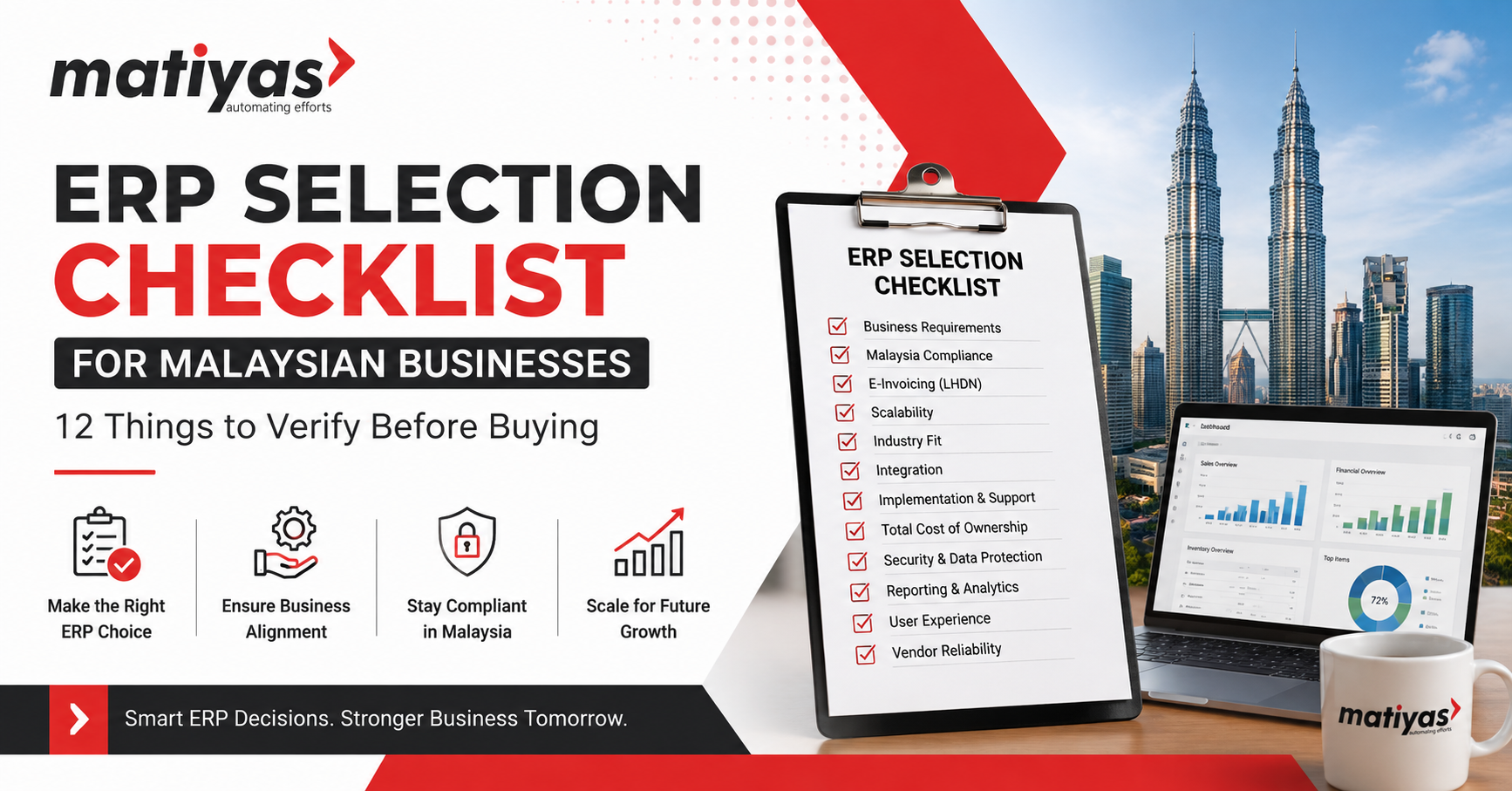
Before signing an ERP agreement, make sure you have verified:
Core business process coverage
Malaysian tax and compliance requirements
LHDN e-Invoicing readiness
Scalability
Industry-specific functionality
Integration capabilities
Customization and configuration
Implementation and support services
Total ERP cost
Security and data management
Reporting and analytics
Practical usability through a real-world demo
A carefully evaluated ERP system can become a strong foundation for business growth. By following this ERP selection checklist for Malaysian businesses, organizations can reduce selection risks, identify the right technology partner, and choose an ERP platform that supports both current operations and future expansion.