English
 Arabic
 French
 Spanish
 Portuguese
 Deutsch
 Turkish
 Dutch
Dutch
 Italiano
 Russian
 Romaian
 Portuguese (Brazil)
 Greek
Greek
How to Choose the Best Dental Hospital in Thrissur for Your Family
Health |
2026-07-30 12:06:13
 Social Networth OS
 Creator Commerce
 Launch Startup
 Global News
 Creator Award
 Talkfever App
Ver Todo
Talkfever App
Ver Todo

Upgrade to Pro
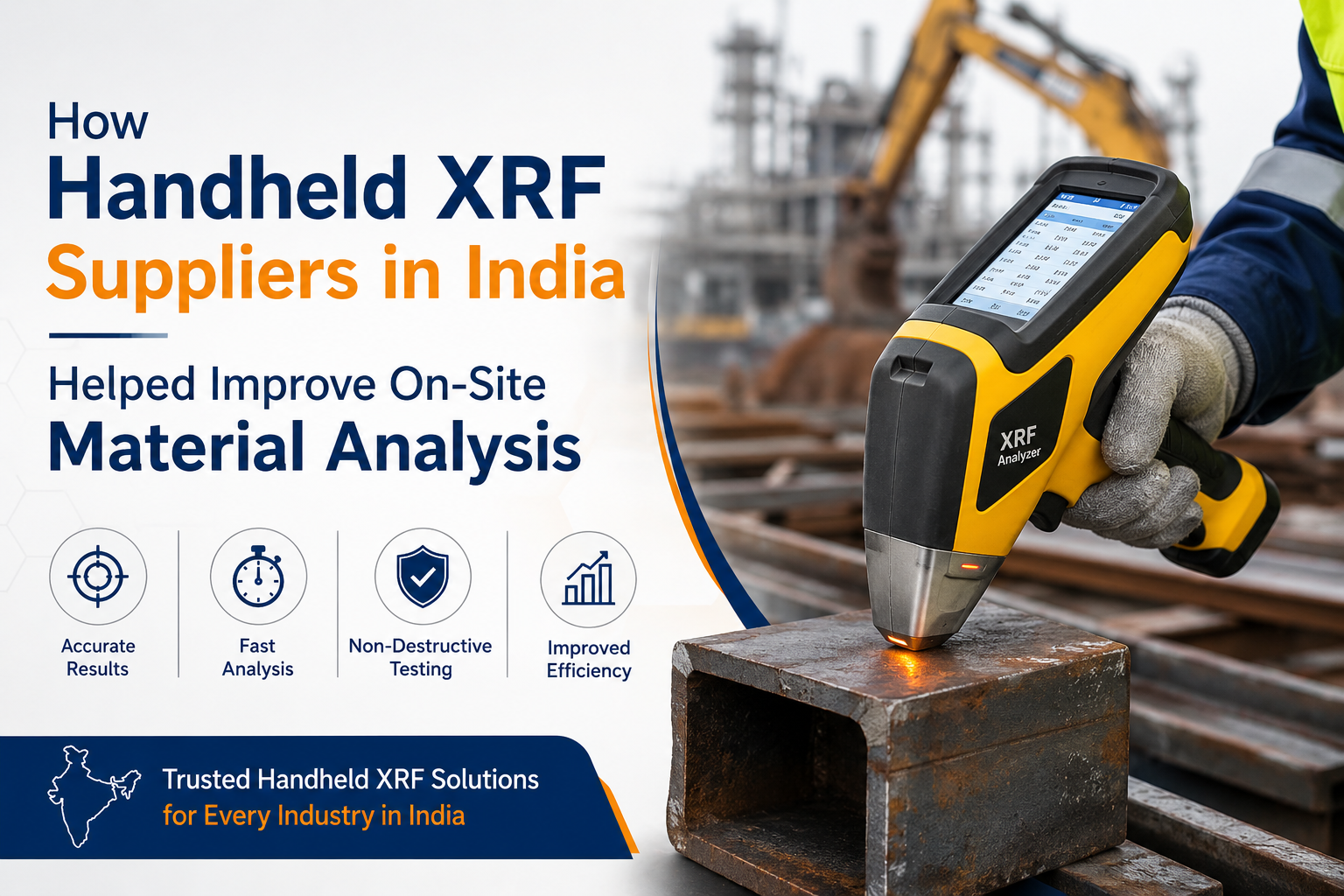
In industries where material composition directly affects quality, safety, and productivity, waiting for laboratory-based testing can slow down important decisions. Mining, metal processing, manufacturing, recycling, construction, and quality-control teams increasingly need faster ways to identify and analyze materials directly at the worksite.
This is where handheld X-ray fluorescence (XRF) analyzers have become valuable. By enabling rapid, non-destructive elemental analysis at the point of inspection, handheld XRF technology can help organizations make faster and more informed material-related decisions.
This case-study-style article explores how working with reliable handheld XRF suppliers in India can help industrial organizations improve on-site material analysis, streamline quality-control processes, and reduce dependence on conventional laboratory testing for routine applications.
Consider an industrial facility that regularly handles metals, alloys, raw materials, or recycled materials.
Previously, technicians may have had to:
Collect material samples.
Label and transport them to a laboratory.
Prepare the samples for analysis.
Wait for laboratory testing.
Review the results before making a production or purchasing decision.
Although laboratory instruments can provide highly detailed analysis, this workflow may not always be practical when hundreds of samples need to be screened or when immediate decisions are required.
For example, a quality-control team inspecting incoming metal components may need to verify whether the material matches the required alloy grade before accepting a shipment. Delays in identification can affect inventory management, production schedules, and quality assurance.
The organization therefore needed a faster method for preliminary material identification.
The company evaluated handheld XRF technology as a solution for rapid on-site elemental analysis.
A handheld XRF analyzer uses X-rays to excite atoms in a material. The excited atoms emit characteristic fluorescent X-rays, which the analyzer detects and processes to identify the elements present and estimate their concentrations.
Unlike many conventional testing workflows, handheld XRF analysis can often be performed directly at the inspection location with little or no sample preparation, depending on the application and material.
This made the technology particularly useful for:
Alloy identification
Metal sorting
Scrap inspection
Incoming material verification
PMI (Positive Material Identification)
Raw material screening
Coating and plating analysis
Environmental screening applications
Geological and mining exploration
Selecting the right analyzer is only one part of implementing an effective XRF testing solution. The supplier can also play an important role in helping organizations select suitable equipment for their specific application.
Reliable handheld XRF suppliers in India can help customers evaluate factors such as:
Different industries have different testing requirements.
A metal manufacturer may prioritize alloy identification and PMI, while a mining organization may require geological or ore analysis capabilities.
Suppliers can help organizations identify an analyzer configuration that matches their intended applications.
The elements that need to be detected can vary significantly between applications.
Before selecting an analyzer, users should determine which elements are important for their testing process and verify that the instrument's specifications and calibration options are appropriate for those requirements.
For high-volume inspection, testing speed can have a major impact on productivity.
A suitable handheld XRF analyzer can provide rapid screening, allowing technicians to assess multiple samples or components without moving every sample to a centralized laboratory.
One of the major advantages of handheld XRF is mobility.
Technicians can carry the instrument directly to:
Production lines
Warehouses
Scrap yards
Mining sites
Construction sites
Inspection areas
Material storage facilities
This reduces the need to transport every sample to a laboratory for initial screening.
Modern XRF analyzers can provide digital measurement results and instrument software designed to assist with material identification and reporting.
For organizations handling large volumes of measurements, data-management capabilities can make the testing workflow easier to organize and document.
Imagine a manufacturing company receiving different grades of metal components from multiple suppliers.
The quality-control team relied primarily on documentation and laboratory testing.
The process involved:
Material received → Sample collected → Laboratory testing → Results reviewed → Material approved/rejected
This approach created delays when immediate verification was required.
The organization introduced handheld XRF screening at the receiving area.
The revised process became:
Material received → Handheld XRF screening → Alloy identification → Quality decision → Detailed laboratory testing when required
The handheld analyzer became a first-line screening tool.
Materials that matched the required composition could move through the inspection process more efficiently, while questionable samples could be sent for additional laboratory analysis.
One of the biggest advantages of handheld XRF is the ability to obtain material-composition information quickly.
This can help inspectors make faster decisions regarding incoming materials, components, and scrap.
XRF is generally considered a non-destructive analytical technique for suitable applications. This means the inspected component can often remain intact after testing.
This is particularly valuable when analyzing expensive components, finished products, or materials that cannot easily be cut or damaged.
Because analysis can be performed at the inspection location, organizations may reduce the need to transport every sample to a central laboratory for preliminary screening.
Handheld XRF can help quality-control teams verify material identity and composition during different stages of the supply chain.
It can be used for incoming inspection, production verification, inventory checks, and final quality assessments, depending on the application.
Recycling facilities can use handheld XRF technology to distinguish between different metal and alloy grades.
More accurate sorting can help improve material segregation and reduce the risk of mixing incompatible materials.
Because the analyzer is portable, teams can perform testing in locations where transporting samples to a laboratory would be inconvenient or time-consuming.
Handheld XRF should not necessarily be viewed as a replacement for every laboratory analytical technique.
Instead, the technologies can complement each other.
|
Factor |
Handheld XRF |
Laboratory Analysis |
|
Portability |
High |
Generally low |
|
On-site testing |
Yes |
Usually limited |
|
Sample preparation |
Often minimal |
May be extensive |
|
Rapid screening |
Excellent for suitable applications |
Depends on technique |
|
Non-destructive testing |
Often possible |
Depends on technique |
|
Detailed laboratory characterization |
Limited compared with specialized techniques |
Strong |
|
High-volume field screening |
Highly suitable |
Less convenient |
The most effective approach may therefore be to use handheld XRF for rapid screening and identification, while sending selected samples to a laboratory when more comprehensive characterization is necessary.
Handheld XRF analyzers can support material analysis across several industries.
Manufacturers can use handheld XRF for alloy verification, PMI, incoming material inspection, and production quality control.
Geological teams can use portable XRF instruments for rapid elemental screening of rocks, ores, and soil-related samples in suitable applications.
Recycling companies can use XRF to help identify and segregate different metal and alloy grades.
Construction and infrastructure teams may use XRF technology for material screening and selected environmental or coating-related applications.
Where material traceability and alloy verification are important, handheld XRF can support inspection workflows.
PMI is an important consideration in many industrial environments where verifying alloy composition can help support material identification and quality assurance.
Choosing a supplier should involve more than comparing instrument prices.
Organizations should evaluate:
A supplier should understand the customer's application and be able to explain the capabilities and limitations of the proposed analyzer.
Check important specifications such as:
Elemental range
Detection capabilities
Measurement modes
Accuracy and repeatability
Measurement time
Detector technology
Battery performance
Display and user interface
Data storage and connectivity
Different applications may require different calibration methods or software configurations.
Discuss the intended application with the supplier before purchasing the instrument.
A practical demonstration can help users understand how the analyzer performs on their actual materials.
Training is also important because measurement technique, sample condition, instrument setup, and operating environment can influence results.
Instrument support does not end after purchase.
Organizations should consider the availability of:
Technical support
Operator training
Maintenance
Calibration services
Spare parts
Software support
Warranty services
A supplier with strong after-sales support can help maintain the long-term usability of the instrument.
The real value of handheld XRF is not simply the instrument itself. It is how the technology fits into an organization's broader testing workflow.
A well-planned process can combine:
Handheld XRF Screening → Material Identification → Quality Decision → Laboratory Confirmation Where Required → Documentation
This approach can help organizations reserve detailed laboratory testing for samples that genuinely require further investigation.
As a result, laboratories and industrial teams can potentially improve resource utilization while maintaining appropriate quality-control procedures.
The adoption of handheld XRF can provide several practical advantages for organizations that require rapid material identification:
Faster on-site elemental screening
Reduced dependence on laboratory testing for routine identification
Non-destructive analysis for suitable materials
Portable testing at different inspection locations
Improved alloy and material verification
More efficient scrap sorting
Better support for quality-control decisions
Greater flexibility for field-based testing
However, instrument selection should always be based on the specific material, elements of interest, required accuracy, testing environment, and intended application.
Handheld XRF technology is changing how many organizations approach on-site material analysis. Instead of sending every sample to a laboratory, industrial teams can use portable XRF analyzers for rapid preliminary screening and material identification directly where the inspection takes place.
For organizations evaluating this technology, partnering with experienced handheld XRF suppliers in India can make the selection and implementation process more effective. The right supplier can help identify suitable equipment, understand application requirements, provide training, and support the instrument throughout its operational life.
Ultimately, the goal is not simply to purchase an XRF analyzer—it is to build a faster, more practical, and reliable material-analysis workflow that supports better quality-control and operational decisions.