English
 Arabic
 French
 Spanish
 Portuguese
 Deutsch
 Turkish
 Dutch
Dutch
 Italiano
 Russian
 Romaian
 Portuguese (Brazil)
 Greek
Greek
MBBS Abroad Made Simple for Indian Students
Music |
2026-05-25 10:10:45
 Social Networth OS
 Creator Commerce
 Launch Startup
 Global News
 Creator Award
 Talkfever App
Смотреть все
Talkfever App
Смотреть все

Обновить до Про
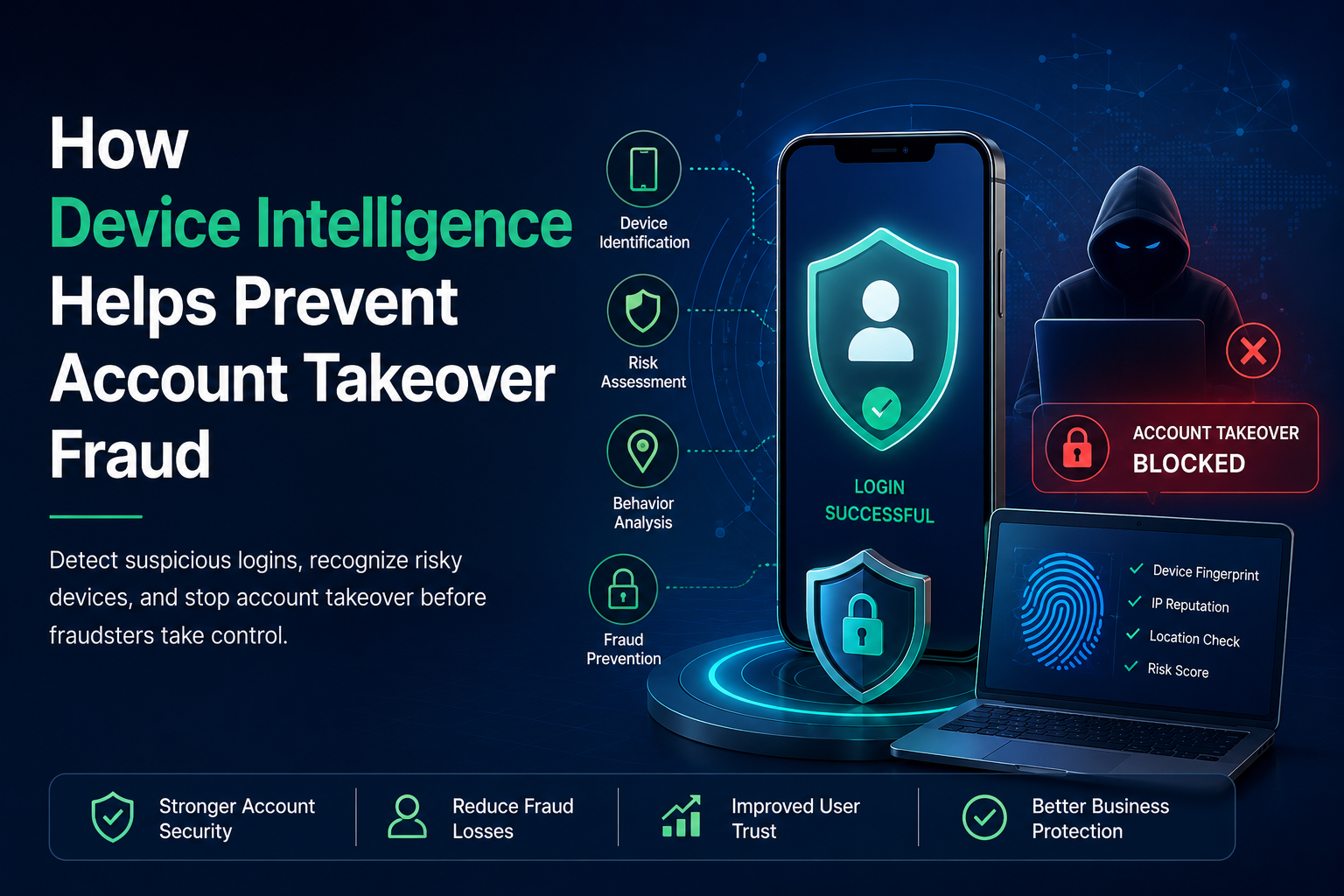
Imagine logging into your bank account and finding that someone else has already changed the password, updated the recovery details, or started a transaction.
For the business, the difficult part is that the attacker may not look suspicious at first. They could be using a legitimate username and password obtained through phishing, credential theft, or another form of compromise.
This is one of the reasons account takeover fraud has become an important security concern for digital businesses.
Traditional authentication remains essential, but credentials alone do not always tell the complete story. Businesses also need to understand the environment from which a login or account action is taking place.
This is where device intelligence can provide another layer of context.
Account takeover fraud occurs when an unauthorized person gains access to a legitimate user's online account.
The attacker may then attempt to:
Change account information
Access sensitive data
Make unauthorized transactions
Add new payment methods
Abuse account benefits
Take control of recovery options
Use the account for further fraudulent activity
The challenge is that the attacker may already possess valid credentials.
From a basic authentication perspective, everything can appear normal.
The device and surrounding activity, however, may tell a different story.
Passwords are still widely used, but they are no longer the only factor businesses should consider when assessing account security.
A password can be stolen, reused, shared, exposed through phishing, or obtained through compromised systems.
Multi-factor authentication adds another layer, but businesses may still benefit from understanding the context behind the authentication attempt.
For example, consider two login attempts using the correct credentials.
The first comes from a device that the customer has regularly used for months.
The second comes from an unfamiliar environment with unusual device characteristics and suspicious activity indicators.
The credentials are identical.
The risk context is not.
Device intelligence helps businesses incorporate that additional context into their security decisions.
Device intelligence is the process of collecting and analyzing signals associated with a device and its environment to help businesses understand digital interactions.
Depending on the technology being used, relevant signals may include:
Device characteristics
Operating system information
Browser or application environment
Network-related information
Emulator indicators
Root or jailbreak indicators
Device tampering signals
Automation indicators
Device changes
Historical device activity
The purpose is not simply to identify a device.
The broader objective is to understand whether the device and its current environment appear consistent with a legitimate interaction.
Device intelligence can become useful at several points in the account lifecycle.
When a user attempts to sign in, a business can evaluate device-level information alongside the authentication result.
A login from a familiar device may look different from a login from a completely unfamiliar environment.
If additional risk signals are present, the business can choose an appropriate response, such as requesting additional verification or sending the event for further review.
The important point is that the device signal does not replace authentication.
It adds context to it.
Attackers who take over an account may try to register their own device as a trusted device.
Device intelligence can help businesses evaluate the environment before allowing a new device to become associated with an account.
This can provide another opportunity to identify suspicious activity before the attacker establishes longer-term access.
Sensitive account changes deserve additional attention.
An attacker may attempt to change an email address, phone number, password, recovery method, or other account information after gaining access.
Device signals can become one of the inputs used to assess whether the activity appears consistent with the account's previous behavior.
Account takeover often becomes financially damaging when the attacker reaches a transaction stage.
Device intelligence can provide additional context before a payment, transfer, withdrawal, or other sensitive action is approved.
A business can combine device signals with transaction information, account history, identity signals, and behavioral information to make a more informed risk decision.
Consider an online financial service with an established customer.
For months, the customer has accessed the account from a familiar mobile device.
One day, a login occurs using the correct username and password.
At first glance, the authentication appears successful.
However, the device environment is unfamiliar. Additional signals suggest that the device may be running in an unusual environment, and the activity pattern differs from what has previously been observed.
The business now has more information.
Instead of immediately treating the interaction as legitimate or automatically blocking the user, it can apply a risk-based response.
For example, the system might request additional verification before allowing sensitive account changes.
This approach can help protect the account while avoiding unnecessary friction for users whose activity appears normal.
One of the biggest advantages of device intelligence is that it can support risk-based authentication.
Traditional authentication often follows a relatively simple pattern:
Credentials → Authentication → Access
A risk-based approach can introduce additional context:
Credentials + Device + Activity + Risk Signals → Risk Assessment → Appropriate Response
The response does not have to be the same for every user.
Low-risk interactions may continue normally.
Higher-risk interactions can receive additional verification or monitoring.
This can help businesses balance security with convenience.
Account takeover attempts do not always happen from ordinary devices.
Attackers may use emulators, automated environments, modified devices, or other setups designed to imitate legitimate users or bypass security controls.
Device intelligence can help identify signals associated with these environments.
For example, a mobile application may look for indicators associated with:
Rooted or jailbroken devices
Emulators
Application tampering
Automation
Unusual device configurations
Suspicious device changes
None of these indicators should automatically be treated as proof of fraud.
Instead, they can contribute to an overall risk assessment.
A familiar device can provide useful continuity.
If a customer consistently accesses an account from the same device environment, that history can become another signal when evaluating future activity.
Now imagine an attacker obtains the customer's credentials and attempts to log in from a completely different environment.
The difference between the familiar and unfamiliar environments may provide useful context.
This is especially valuable when combined with other signals rather than used as a standalone decision.
It is important to make one distinction clear.
Device intelligence is not a replacement for multi-factor authentication.
MFA remains an important security control because it can require users to provide additional proof of access.
Device intelligence serves a different purpose.
It helps businesses understand the device and environment surrounding an interaction.
These technologies can therefore work together.
For example, a business could use device intelligence to evaluate the risk of a login and then apply stronger authentication when the risk appears elevated.
This creates a more flexible security model than treating every login exactly the same way.
Security controls can sometimes create a difficult customer experience.
If every login triggers an additional verification step, legitimate users may become frustrated.
At the same time, reducing security checks for everyone can increase exposure to account takeover.
Device intelligence can support a middle ground.
When an interaction appears familiar and low risk, the customer may be able to continue without additional friction.
When the device or activity presents stronger risk indicators, the business can introduce additional checks.
The objective is not simply to increase the number of security controls.
It is to apply the right level of security based on the available context.
Account takeover prevention should not begin and end at the login screen.
A compromised account can involve several stages.
A business may need to evaluate device signals during:
Account registration
Login
Password changes
New device enrollment
Profile updates
Payment method changes
High-value transactions
Account recovery
Looking at device information across multiple stages can provide a more complete picture of account activity.
No single device signal can reliably determine whether an interaction is fraudulent.
A familiar device can potentially be compromised.
An unfamiliar device can belong to a legitimate customer who recently purchased a new phone.
An emulator may be used for legitimate testing.
A new network connection may simply mean that the customer is traveling.
This is why device intelligence works best as part of a broader risk strategy.
Businesses can combine device information with:
Identity verification
Authentication results
Transaction information
Behavioral patterns
Network intelligence
Account history
Fraud signals
The combination provides more context than any individual signal.
Device intelligence also needs to be implemented responsibly.
Businesses should consider what device information they actually need, why they need it, how it is protected, how long it is retained, and who can access it.
Privacy and data governance should be part of the implementation from the beginning.
There is also an important difference between a risk signal and a conclusion.
A device that appears unusual does not automatically belong to a fraudster.
Businesses should avoid treating individual signals as definitive proof and should consider multiple factors before taking significant action against a customer.
This can help reduce false positives and create a more balanced security experience.
Device intelligence is most effective when it works as one layer within a broader account security strategy.
A typical approach may combine:
Identity verification
Authentication
Device intelligence
Behavioral analysis
Network intelligence
Transaction monitoring
Risk-based decisioning
Each layer answers a different question.
Identity verification can help establish who the customer is.
Authentication can establish whether the user has the required credentials or authentication factors.
Device intelligence can provide context about the environment behind the interaction.
Transaction monitoring can evaluate what the user is attempting to do.
Together, these layers can provide a stronger foundation for account protection.
Organizations looking to add device-level context to their fraud prevention strategy can use device intelligence platforms such as Deep ID.
Deep ID focuses on device-level signals that can help businesses understand digital interactions across web and mobile environments.
These signals can be used alongside existing authentication, identity, and fraud controls to support risk-based decisions.
The important concept is broader than any single provider: understanding the device behind an interaction can give businesses another useful layer of information when protecting accounts and digital services.
Account takeover fraud is difficult to address because attackers may use legitimate credentials to access legitimate accounts.
That means businesses need to look beyond the authentication event itself.
Device intelligence can provide additional context about the device, its environment, and associated activity.
When combined with authentication, identity verification, behavioral analysis, transaction monitoring, and other security controls, this information can help businesses identify unusual interactions and apply stronger protection where it is needed.
The goal is not to treat every unfamiliar device as fraudulent.
It is to make better-informed, risk-based decisions.
As digital services continue to become part of everyday life, protecting accounts will require more than passwords and one-time verification. Understanding the devices behind digital interactions can become an important part of building secure, trusted, and user-friendly digital experiences.