English
 Arabic
 French
 Spanish
 Portuguese
 Deutsch
 Turkish
 Dutch
Dutch
 Italiano
 Russian
 Romaian
 Portuguese (Brazil)
 Greek
Greek
Skontaktuj sie z zespolem obsługi klienta Qatar Airways
Music |
2026-02-17 06:51:55
 Social Networth OS
 Creator Commerce
 Launch Startup
 Global News
 Creator Award
 Talkfever App
Alle anzeigen
Talkfever App
Alle anzeigen

Upgrade auf Pro
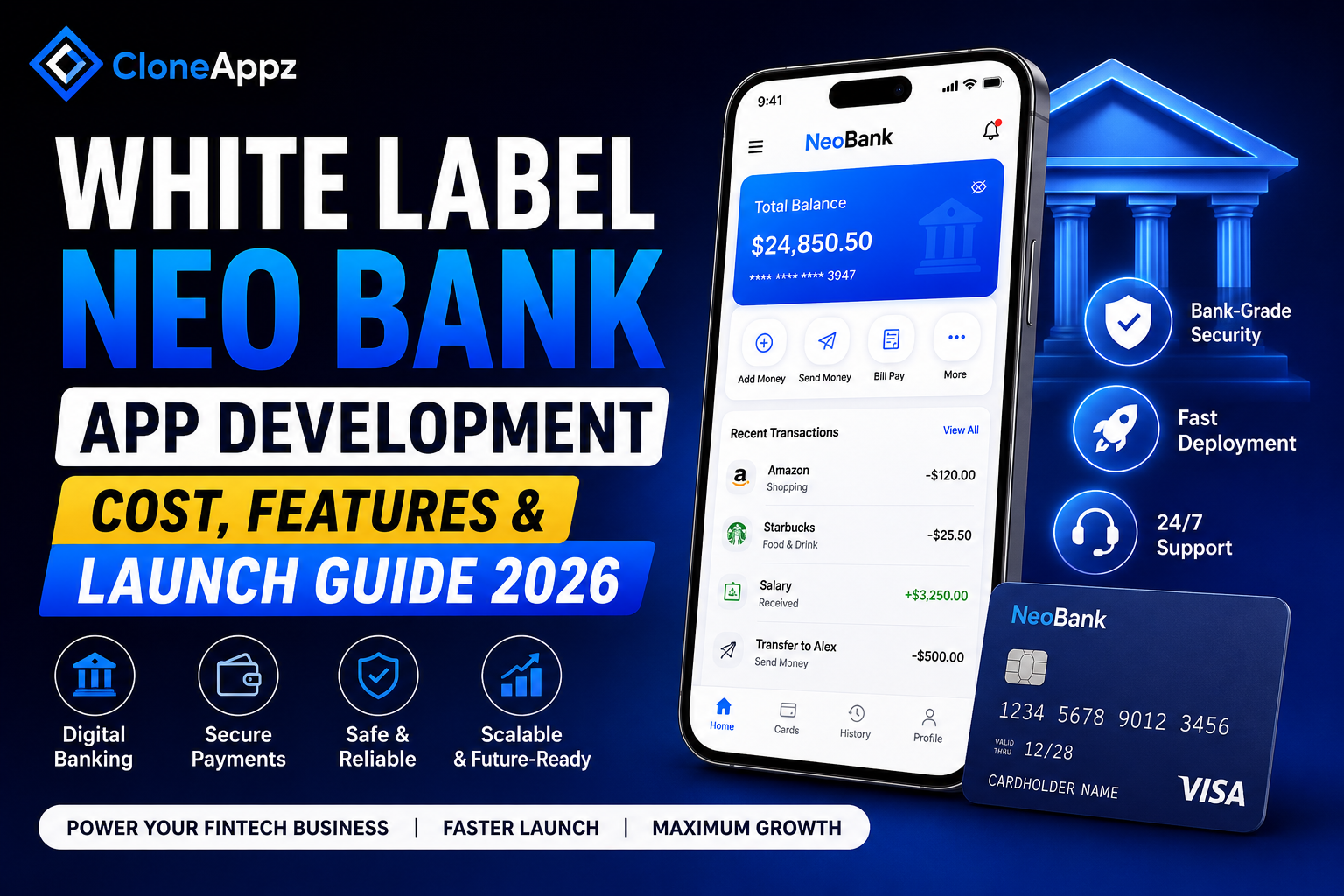
The way people manage money has changed. Customers now expect banking services to be available on their phones, with faster payments, simple account management, instant notifications, and secure digital transactions. This shift has created new opportunities for fintech startups and businesses looking to launch their own financial products.
White label neo bank app development offers a practical way to enter this market without building an entire digital banking platform from the ground up. A ready-made solution can be customized with your brand, user interface, features, integrations, and business requirements.
In 2026, white-label neobanking is increasingly being considered by startups and businesses that want faster market entry while keeping development manageable. Current industry guides highlight speed, integrations, compliance, security, and scalability as major factors when planning a neobank launch.
White label neo bank app development involves using a pre-built digital banking platform and customizing it for your business.
Instead of spending months or years developing every component from scratch, a business can start with an existing foundation and add its own branding and functionality.
A typical white-label neo bank may include:
Digital accounts and wallets
Money transfers
Payment processing
Debit or virtual cards
Transaction history
KYC verification
Notifications
Admin dashboard
Customer support
Security and fraud controls
Banking and payment API integrations
The exact features depend on the target market, business model, banking partners, and regulatory requirements.
The biggest advantage is speed to market. A pre-built platform can remove much of the repetitive development work involved in creating a digital banking product.
A recent 2026 industry comparison estimates that white-label platforms can have significantly shorter launch timelines than fully custom neobank development, although the actual timeline varies by integrations, customization, compliance, and jurisdiction.
Businesses can focus on their brand, customers, and financial products rather than creating every basic banking component from zero.
The platform can be customized with your company name, logo, colors, interface, and customer journey.
Because the core platform already exists, businesses may avoid some of the costs associated with developing a complete banking application from scratch.
A modern platform can be designed to support additional users, transactions, payment methods, and financial services as the business grows.
A successful banking app needs to combine convenience with security. The following features can form the foundation of a modern platform.
Users should be able to view their balance, manage accounts, review transactions, and access important financial information from one place.
Customers expect quick and convenient transfers. Depending on the market and financial partners, the application can support peer-to-peer transfers, bank transfers, and other payment methods.
Know Your Customer processes are essential for many financial products. A neobank can integrate third-party identity verification services to support customer onboarding and compliance.
Payment APIs allow the application to connect with external payment infrastructure. The right integrations depend on the countries, currencies, and services the business plans to support.
A digital banking platform can support virtual or physical card services through suitable issuing and processing partners.
Users should have a clear record of incoming and outgoing payments. Search, filtering, transaction status, and downloadable statements can make account management easier.
Real-time alerts can notify users about payments, transfers, login attempts, card activity, and other account events.
The admin panel gives operators control over users, transactions, verification requests, reports, support tickets, notifications, and platform settings.
Security should be part of the platform architecture from the beginning. Depending on the product, this may include multi-factor authentication, encryption, device verification, transaction monitoring, access controls, and fraud detection.
There is no single development price for every project. The final cost depends on the product scope, integrations, customization, security requirements, development team, and target market.
Current 2026 estimates vary considerably. For example, some industry guides place white-label platforms around $60,000–$150,000 plus licensing fees, while broader neobank projects can range from approximately $40,000 to $250,000+ depending on complexity.
The major cost factors include:
UI/UX customization
Mobile app development
Backend development
Banking APIs
Payment integrations
KYC/AML services
Card issuing integrations
Security testing
Cloud infrastructure
Admin dashboard
Compliance requirements
Maintenance and support
A simple MVP will normally require less investment than a full platform with multi-currency accounts, advanced analytics, cards, investments, open banking, and AI-powered financial tools.
More features mean more development and testing. Start with the functions customers actually need instead of adding unnecessary features.
Banking, payment, KYC, card, fraud prevention, and communication APIs can increase both development effort and ongoing operating expenses.
A standard white-label product is generally less expensive than a heavily customized platform with unique workflows and proprietary functionality.
Financial applications cannot treat compliance as an afterthought. KYC, AML, data protection, card security, and local regulatory requirements should be considered before development begins.
A platform designed for a few thousand users will have different infrastructure requirements from one expected to handle millions of accounts and transactions.
Launching a digital bank requires more than installing an application and adding a logo. A clear roadmap helps avoid expensive changes later.
Decide whether your product will serve consumers, freelancers, businesses, eCommerce sellers, international customers, or another niche.
Choose the initial services you want to provide. These could include accounts, transfers, cards, payments, savings tools, or other financial products.
Identify the banking, BaaS, payment, card, KYC, and compliance partners required for your target jurisdiction.
Add your branding, UI/UX, workflows, notifications, payment methods, and other business-specific features.
Payment flows, account creation, authentication, KYC, transactions, notifications, security, and administrative controls should be thoroughly tested before launch.
Start with a controlled launch, collect customer feedback, monitor performance, and gradually introduce new features.
Businesses interested in fintech can also explore a cashapp clone app based around peer-to-peer payments and digital wallet functionality.
A Cash App-style solution can include user accounts, wallet management, money transfers, transaction history, payment notifications, and other financial features. However, the goal should be to create an original product rather than copying another company's branding, proprietary design, or protected assets.
For some businesses, a payment-focused application can be a starting point before expanding into a broader digital banking ecosystem.
Banking is not only about transactions. Customer support and communication are also important parts of the user experience.
A white label chat app can provide in-app messaging between customers and support teams. It can help users ask questions, report payment issues, receive updates, or communicate with service representatives without switching to another application.
For fintech businesses, combining financial services with convenient communication can make customer support faster and more accessible.
The white-label approach also works outside financial technology.
An amazon clone app can provide the foundation for launching an eCommerce marketplace with features such as product catalogs, customer accounts, shopping carts, payments, order management, seller panels, reviews, and notifications.
Although eCommerce and digital banking have different requirements, both demonstrate the value of starting with a ready-made technology foundation and customizing it for a specific business model.
Choosing the right development company is an important step because financial applications require more than standard mobile development.
Look for a partner with experience in:
Fintech application development
Banking API integration
KYC and AML workflows
Payment systems
Secure backend architecture
Mobile application security
Cloud infrastructure
Scalable systems
Admin dashboards
Long-term maintenance
Also check whether you receive source code ownership, documentation, customization rights, deployment support, and post-launch maintenance.
White label neo bank app development can help businesses enter the digital finance market with a ready-made technology foundation and a faster path toward launching their own branded product.
The right solution should not focus only on appearance. Security, compliance, integrations, scalability, user experience, and reliable financial infrastructure should all be considered from the beginning.
Whether you are planning a digital bank, a cashapp clone app, a white label chat app, or an amazon clone app, the most effective strategy is to build around a clear audience and genuine customer need.
For 2026, businesses that combine a simple user experience with secure technology, strong integrations, compliance planning, and continuous product improvement will be better positioned to build trust and compete in the growing digital financial services market.