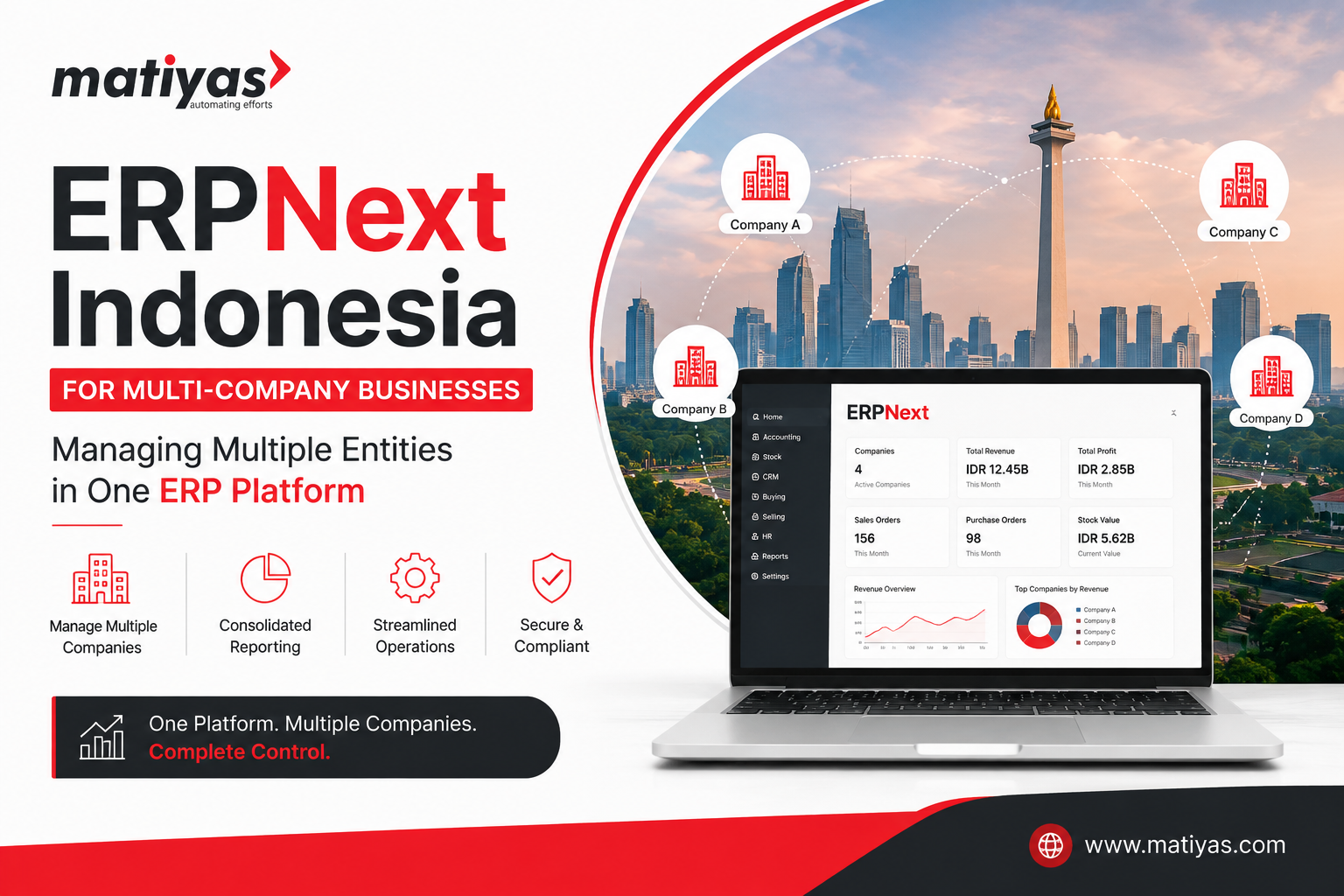
Managing multiple companies under one business group can become increasingly complex as operations expand across Indonesia. Each entity may have its own customers, suppliers, bank accounts, employees, warehouses, transactions, and financial reporting requirements. When these activities are managed through disconnected systems or spreadsheets, maintaining accurate data and consolidated visibility becomes difficult.
ERPNext Indonesia provides a practical way for multi-company businesses to manage multiple entities within one ERP platform while keeping each company's transactions, accounting records, and operational workflows properly separated. With centralized management and company-specific configurations, businesses can improve financial control, reporting, and operational visibility without maintaining completely separate ERP systems for every entity.
For Indonesian businesses operating multiple legal entities, subsidiaries, branches, or business units, understanding how ERPNext for multi-company management works can help determine whether a unified ERP approach is suitable for their organization.
What Is Multi-Company Management in ERPNext?
Multi-company management allows businesses to manage multiple independent companies or legal entities from a single ERP system. Instead of deploying separate software for each organization, a business group can configure multiple companies within one ERPNext environment.
Each company can maintain its own:
- Chart of accounts
- Financial transactions
- Customers and suppliers
- Bank accounts
- Warehouses
- Cost centers
- Sales and purchase transactions
- Tax settings
- Accounting reports
- Employees and organizational structures
At the same time, authorized users can access consolidated information across companies when required.
This approach is particularly useful for Indonesian groups that operate several subsidiaries, manufacturing entities, trading companies, distribution businesses, or related organizations.
Why Indonesian Multi-Company Businesses Need an Integrated ERP System
Managing multiple entities becomes challenging when every company uses separate accounting software, spreadsheets, or disconnected business applications. Finance teams may spend significant time collecting information from different entities before management can understand overall performance.
An integrated ERP software Indonesia solution can centralize business processes while maintaining appropriate separation between companies.
For example, a business group may have one company responsible for manufacturing, another for distribution, and another for retail operations. Each entity needs independent financial records, but management may still require a consolidated view of revenue, expenses, inventory, receivables, and profitability.
ERPNext can support this structure by allowing multiple companies to operate within the same ERP environment.
How ERPNext Indonesia Supports Multiple Companies
ERPNext provides a company structure that allows organizations to configure multiple entities while maintaining separate transactional data.
For each company, administrators can configure company-specific accounting and operational settings. Users can then work with the appropriate company based on their responsibilities.
This creates a balance between centralized ERP management and company-level operational control.
For example, the finance team of Company A can process its own sales invoices and payments without mixing transactions with Company B. At the management level, authorized users can review information across the business group.
This is one of the reasons ERPNext Indonesia can be considered for organizations that have outgrown single-company accounting systems.
Centralized Accounting With Separate Company Records
One of the biggest advantages of using ERPNext for multiple entities is the ability to manage accounting operations through a common platform.
Each company can maintain its own accounting structure, transactions, receivables, payables, expenses, and financial reports.
This allows businesses to maintain financial separation while reducing the complexity of operating several unrelated ERP systems.
For Indonesian businesses, this can be especially useful when different entities have different operational requirements but management still needs standardized processes and consistent reporting.
Finance teams can also reduce the need to manually combine information from separate spreadsheets or systems.
Consolidated Financial Reporting Across Companies
Multi-company businesses often need two levels of reporting.
The first is individual company reporting, which helps management understand the performance of a particular entity.
The second is group-level reporting, which provides an overall view of the business.
With a properly configured ERPNext environment, businesses can organize their company structures and reporting processes to support both requirements.
Management can analyze information such as revenue, expenses, receivables, payables, inventory, and profitability at the individual-company level while also working toward consolidated group reporting.
This can make financial analysis more efficient compared with manually collecting reports from different systems.
Managing Intercompany Transactions
Intercompany transactions are another important consideration for multi-company organizations.
For example, Company A may manufacture products and sell them to Company B, which distributes those products to customers. If these transactions are handled manually, finance teams need to maintain accurate records on both sides of the transaction.
A centralized ERP system Indonesia approach can help businesses structure these workflows more consistently.
ERPNext can be configured to support intercompany transactions between companies, helping organizations maintain appropriate records for transactions between related entities.
This can reduce manual duplication and make it easier for finance teams to trace transactions between companies.
Inventory Management Across Multiple Companies
Inventory becomes more complicated when several companies share warehouses, transfer materials, or operate different supply chains.
A multi-company ERP setup can provide greater visibility into inventory-related transactions while maintaining the appropriate company structure.
For example, a manufacturing company may transfer finished goods to a distribution company within the same business group. Instead of managing these activities through spreadsheets and separate inventory applications, the organization can structure the process through its ERP environment.
This provides better visibility into stock movements, warehouses, purchasing, sales, and inventory valuation.
For Indonesian businesses with manufacturing and distribution operations, this can be particularly valuable when business growth creates more complex supply chain requirements.
Standardizing Business Processes Across Companies
A major benefit of implementing an ERP platform across multiple entities is process standardization.
Different companies within the same group may gradually develop different ways of handling:
- Sales orders
- Purchase orders
- Inventory transactions
- Supplier management
- Customer invoicing
- Expense management
- Approval workflows
- Financial reporting
This makes it difficult for management to compare performance and enforce consistent processes.
With ERPNext Indonesia, organizations can establish standardized workflows and operating procedures while still allowing company-specific configurations where necessary.
This can create greater consistency without requiring every entity to operate exactly the same way.
Managing Users and Company-Level Access
Multi-company ERP environments also require appropriate user access controls.
Not every employee should have access to every company's financial or operational information.
A properly configured ERPNext implementation can define user permissions and roles according to responsibilities.
For example, an accountant responsible for one company may need access to that company's transactions but not the financial records of another entity. Senior management may require broader access for group-level reporting and decision-making.
This approach helps businesses maintain operational control while supporting collaboration across the organization.
ERPNext Indonesia and Local Business Requirements
For Indonesian businesses, choosing an ERP platform is not only about managing accounting and operations. Local tax and compliance requirements also need to be considered.
An ERP solution used in Indonesia may need to support business processes related to Indonesian taxation, invoicing, payroll, and financial reporting.
When evaluating ERP software Indonesia, businesses should therefore consider whether the platform can be configured or integrated to support their local requirements.
ERPNext can provide the underlying ERP framework, while an experienced implementation partner can configure workflows, reports, integrations, and localization requirements based on the organization's business structure.
This is particularly important for multi-company businesses because each entity may have different operational, tax, or reporting requirements.
When Should a Business Consider ERPNext for Multi-Company Operations?
ERPNext may become particularly relevant when a business experiences several of the following challenges:
The organization operates multiple legal entities and needs centralized visibility.
Finance teams spend excessive time combining reports from different systems.
Management lacks real-time visibility across companies.
Intercompany transactions are difficult to track.
Inventory is distributed across multiple entities or locations.
Different companies use different software and business processes.
Management wants standardized workflows across the group.
The business expects to add more subsidiaries or entities in the future.
In these situations, implementing a centralized ERP system Indonesia can provide a more scalable foundation for business growth.
ERPNext Indonesia vs Separate ERP Systems for Each Company
A multi-company organization generally has two approaches.
The first is deploying separate ERP systems for each entity. This can provide complete independence but may increase implementation, maintenance, integration, and reporting complexity.
The second approach is managing multiple entities within one ERP environment.
The second model can be more efficient when companies share common processes, management structures, supply chains, or reporting requirements.
However, the right approach depends on the organization's legal structure, operational complexity, data requirements, localization needs, and future growth plans.
A proper ERP assessment should therefore be completed before deciding how the system should be structured.
How Matiyas Solutions Can Help With ERPNext in Indonesia
Implementing ERPNext for multi-company businesses requires more than simply creating multiple company records in the system. The ERP architecture needs to reflect the organization's actual business structure, accounting requirements, workflows, permissions, reporting needs, and integrations.
Matiyas Solutions can help businesses evaluate their requirements and implement a suitable ERPNext Indonesia solution for multi-company operations. From company structure and accounting configuration to inventory, sales, purchasing, reporting, workflows, and integrations, the implementation can be aligned with the organization's operational requirements.
If your business operates multiple companies in Indonesia and you are looking for a centralized ERP software Indonesia solution, contact Matiyas Solutions to discuss your ERPNext requirements and explore an approach suited to your business structure.
Conclusion
Managing multiple companies through disconnected systems can create unnecessary complexity in accounting, inventory, reporting, intercompany transactions, and daily operations. A centralized ERP approach can provide businesses with greater visibility while allowing each entity to maintain its own operational and financial records.
ERPNext Indonesia can support multi-company organizations by bringing different entities into a unified ERP environment. Businesses can manage company-specific transactions, accounting, inventory, users, and workflows while creating a foundation for standardized processes and broader management reporting.
For Indonesian business groups planning expansion or looking to replace fragmented systems, ERPNext for multi-company management can be a practical option to consider. With the right implementation strategy and localization approach, businesses can create an ERP environment that supports both individual company operations and long-term group-level growth.
 English
 Arabic
 French
 Spanish
 Portuguese
 Deutsch
 Turkish
 Dutch
Dutch
 Italiano
 Russian
 Romaian
 Portuguese (Brazil)
 Greek
Greek
 Social Networth OS
 Creator Commerce
 Launch Startup
 Global News
 Creator Award
 Talkfever App
Afiseaza-i pe toti
Talkfever App
Afiseaza-i pe toti