English
 Arabic
 French
 Spanish
 Portuguese
 Deutsch
 Turkish
 Dutch
Dutch
 Italiano
 Russian
 Romaian
 Portuguese (Brazil)
 Greek
Greek
How to Communicate with BellSouth Email Customer Support
Other |
2025-04-21 05:58:45
 Social Networth OS
 Creator Commerce
 Launch Startup
 Global News
 Creator Award
 Talkfever App
عرض كل النتائج
Talkfever App
عرض كل النتائج

ترقية الحساب
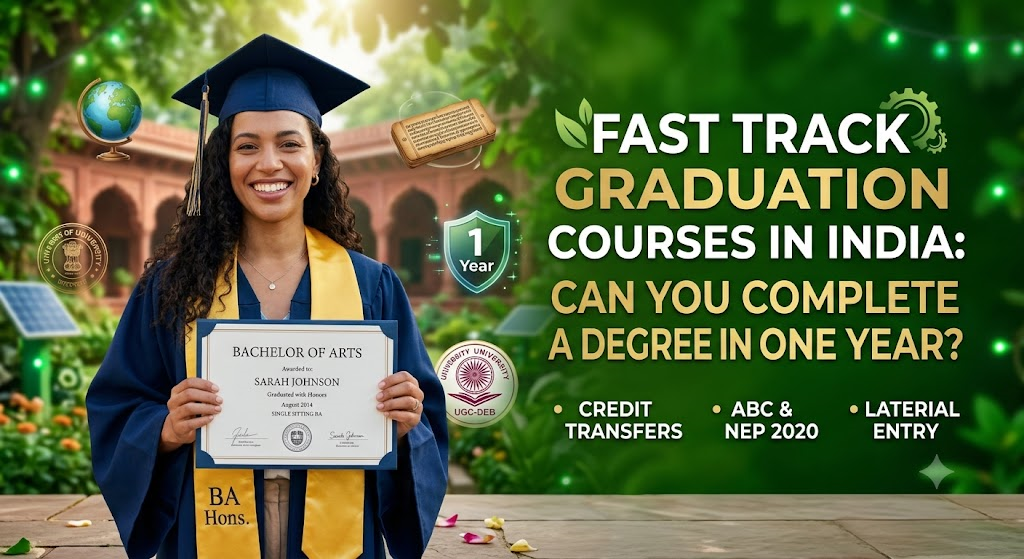
For students and working professionals who have an education gap, completing graduation quickly can seem like an attractive option. This is why searches for fast track graduation courses in India, graduation degree in one year, and accelerated degree programmes are increasingly common.
A shorter study route can be appealing to someone who discontinued college, started working after Class 12, or needs a bachelor's degree for career advancement. However, students should understand that a programme advertised as a one year graduation degree is not automatically a recognised or valid bachelor's degree.
The key is to distinguish between legitimate flexible education options and programmes that use terms such as “fast track,” “one sitting,” or “one year degree” purely as marketing claims.
This guide explains what fast-track graduation means, whether graduation can be completed in one year, what alternatives students can explore, and how to verify a programme before taking admission.
Fast track graduation courses generally refer to programmes marketed as allowing students to complete a bachelor's qualification more quickly or through a more flexible academic route.
However, “fast track” is not itself a standard category that makes a degree valid. The actual recognition of a programme depends on the university, degree, academic structure, mode of education, and applicable regulations.
A legitimate flexible programme still has academic requirements. Students may need to complete prescribed coursework, credits, assignments, examinations, and other assessments.
Therefore, if an advertisement promises a graduation degree simply by appearing for one examination, students should investigate the offer carefully.
This is the most important question for anyone searching for a graduation degree in one year.
Students should not assume that a conventional bachelor's degree can simply be compressed into twelve months. Undergraduate programmes generally have prescribed academic structures and requirements.
The UGC has also historically addressed the issue of one-sitting degrees. Its official regulations database includes a notification concerning the validity of one-sitting degrees.
This means that the phrase “one year degree” should not be treated as proof of recognition.
If an institution claims that a standard BA, B.Com, B.Sc., or another bachelor's degree can be completed in one year, ask for clear official documentation explaining the programme's duration, academic framework, and regulatory basis.
These terms are often used together in online advertisements, but they should not automatically be considered the same.
A fast-track programme may refer to a flexible or accelerated academic pathway, depending on the institution and applicable rules.
A one sitting degree is generally marketed as a qualification that can be completed through examinations or academic formalities in a single sitting.
The distinction is important because a recognised flexible programme cannot simply be assumed to be equivalent to an advertised one sitting qualification.
Students should focus on the actual university programme, not the promotional terminology.
There are several reasons why students search for one year graduation courses in India.
Students may discontinue college because of financial problems, family responsibilities, employment, relocation, or other circumstances. Later, they may want to complete graduation.
Some jobs require a bachelor's degree as a minimum educational qualification. Working professionals may therefore look for flexible graduation options.
A bachelor's degree may be required for admission to postgraduate courses, depending on the programme.
Someone who started working immediately after school may later decide to change career direction and obtain a formal graduation qualification.
Working professionals may not have the flexibility to attend a conventional college every day. Online or distance education can provide a more manageable study format.
Yes, an education gap does not automatically prevent someone from pursuing graduation.
A student who completed Class 12 several years ago can explore eligible bachelor's programmes offered by recognised universities.
Depending on eligibility and personal circumstances, possible options may include:
Regular bachelor's degree programmes
Online bachelor's degree programmes
Open and Distance Learning programmes
University-specific re-entry options
Applicable credit-based pathways
The best option depends on your previous academic qualifications and career objectives.
Students should not feel pressured into a questionable one sitting programme simply because they have been away from education for several years.
For many working professionals, an online graduation degree may be a practical alternative to a traditional campus programme.
Online education can provide access to digital course material, lectures, assessments, and academic resources without requiring daily physical attendance.
However, students should verify the institution and programme before admission.
A university's website or an advertisement claiming “online degree” does not automatically establish that the programme has the necessary recognition. Students should check current official information regarding the institution and the programme.
Open and Distance Learning is another route for students who need flexibility.
A distance bachelor's programme can allow students to study while managing employment or family responsibilities. However, distance education is still a structured academic programme.
Students should expect to meet the applicable requirements relating to:
Admission
Curriculum
Credits
Assignments or coursework
Assessments
Examinations
Programme completion
The UGC maintains a regulatory framework covering Open and Distance Learning and online programmes.
Therefore, students should verify the current status of the university and programme rather than choosing a course solely because it is advertised as “fast.”
When researching fast track graduation courses in India, students commonly look at bachelor's programmes such as:
A BA can include subjects such as English, History, Political Science, Sociology, Economics, and other humanities and social science subjects, depending on the university.
B.Com programmes are often considered by students interested in commerce, accounting, business, banking, and related areas.
B.Sc programmes cover various science and related disciplines. Eligibility and subject requirements vary by university and specialisation.
BBA can be suitable for students interested in management, business, marketing, entrepreneurship, and related fields.
Universities may offer additional undergraduate programmes in areas such as computer applications, social sciences, humanities, and specialised disciplines.
The availability of these courses through online or distance modes varies, so students should check the specific university and programme.
If you find an advertisement promising a one year graduation degree, follow these verification steps before paying any fees.
Check whether the university is legally authorised to award the relevant degree.
Do not rely exclusively on a private education consultant's statement that an institution is “UGC approved.”
University recognition alone is not enough.
Confirm that the specific bachelor's programme is offered by the institution and that the programme follows the applicable academic and regulatory requirements.
Determine whether the programme is:
Regular
Online
Open and Distance Learning
For online or distance programmes, check the university's current status under the relevant regulatory framework.
Request the official programme duration in writing.
If an agent says that you can complete a standard bachelor's degree in one year while the university's official information lists a longer duration, ask for an explanation and supporting documentation.
Ask how examinations are conducted and what academic requirements you must complete.
Be cautious if the provider says that you can obtain the degree without studying, completing assessments, or meeting normal academic requirements.
Students searching for fast track graduation in India should be aware of common warning signs.
A bachelor's degree is an academic qualification, not simply an examination certificate. Such claims should be investigated carefully.
Flexible education can reduce the need for classroom attendance, but it does not necessarily eliminate academic requirements.
Any offer involving a backdated qualification should be treated with extreme caution.
Recruitment authorities determine their own eligibility criteria. No private institute should be assumed to have universal authority to guarantee acceptance.
A claim that a degree certificate can be issued immediately without completing an appropriate programme is a significant warning sign.
Ask for the exact university and programme information. A generic UGC claim is not sufficient evidence.
If you previously studied at a college but did not complete your degree, you may have additional options.
Contact your previous university and ask whether it offers any re-entry, credit transfer, migration, or other applicable academic pathway.
You can also contact another recognised university and ask whether previous academic work can be considered.
However, never assume that old credits will automatically be accepted. Credit transfer policies depend on the university and programme.
Keep copies of:
Previous mark sheets
Transfer certificates
Migration documents
Registration details
Course records
Other academic documents
These may help the university assess your previous education.
Working professionals often search for fast track graduation courses because they want to continue working while completing their education.
If you are employed, compare programmes based on flexibility rather than speed alone.
Consider:
Study schedule
Online learning facilities
Examination requirements
Programme duration
Total fees
Academic support
University recognition
Career relevance
Further-study eligibility
An appropriately recognised online or distance programme may be more practical than leaving your job for a conventional full-time programme.
Before enrolling, ask yourself five questions.
What is my goal?
Do you need graduation for a job, promotion, higher education, career change, or personal development?
What qualification do I already have?
Your Class 12 subjects and previous college education may affect your eligibility.
Which degree suits my career?
Choose a programme that supports your long-term professional plans.
What learning mode works for me?
Decide whether regular, online, or distance learning is practical.
Will the qualification meet my intended requirement?
If you need the degree for a specific job, government examination, postgraduate programme, or professional purpose, check the relevant eligibility rules before admission.
Not necessarily.
The attraction of completing graduation in one year is understandable, but the value of a degree depends on its recognition and suitability.
Suppose two programmes are available. One promises a certificate very quickly but provides unclear information about recognition. Another takes the standard academic duration but is offered by a properly recognised university and clearly meets your career requirements.
The second option may be far more valuable in the long term.
Education is an investment. Saving time at the beginning is not beneficial if the qualification later creates problems with employment or higher education.
Fast track graduation courses in India can be appealing to anyone who wants to complete a bachelor's qualification quickly. However, students should be careful with claims about a graduation degree in one year or single sitting graduation.
The most important factors are not the speed promised by an advertisement but the university, programme recognition, academic duration, learning mode, examination requirements, and future acceptance of the qualification.
If you have an education gap or work full-time, explore recognised online, distance, or other flexible education options that fit your circumstances.
Before making any payment, verify the programme through official sources and obtain clear information about the degree you will receive.
Ultimately, the goal should not simply be to get a degree as quickly as possible. The goal should be to earn a recognised graduation qualification that supports your future career and education plans.