English
 Arabic
 French
 Spanish
 Portuguese
 Deutsch
 Turkish
 Dutch
Dutch
 Italiano
 Russian
 Romaian
 Portuguese (Brazil)
 Greek
Greek
Sneakers Industry Market Size, Forecast and Outlook 2026–2036
Other |
2026-07-13 09:54:31
 Social Networth OS
 Creator Commerce
 Launch Startup
 Global News
 Creator Award
 Talkfever App
δες τα όλα
Talkfever App
δες τα όλα

Upgrade to Pro

Learning Physics is more convenient when you go beyond memorising formulas and grasp the connections between key concepts. From revision for school tests to exams, good study skills can help make tough subjects easier.
Students are supported by experienced tutors to further develop their conceptual understanding, establish regular practice, and become confident in solving multi-step problems. Ongoing guidance helps learners recognise gaps, use formulas correctly, understand the questions, and develop their exam technique.
Through planned revision and targeted practice, students will be able to tackle more difficult topics of Physics with clarity and achieve better learning outcomes.
Physics is an additive subject. An understanding of basic concepts is essential for advanced concepts. Always make sure that basic concepts and ideas underlying a topic are clear before taking on a complex, multi-mark question.
Forces & Motion: Before doing multi-step calculations of acceleration, momentum or resultant forces, see what a force actually does to an object.
Electricity: Learn how current, potential difference and resistance are related in a simple circuit before moving on to more complex series and parallel circuits.
Mindset Shift: Question what is happening physically in this situation instead of which equation should I use? This move assists you in discovering the rules that govern any problem.
Key equations should be learned by heart, but if you learn a key equation but don't understand it, you will make errors on new test questions. Pay attention to the meaning of each variable, the units of measurement that are used as SI units, and the effect that changing one variable has on the system.
Active Recall: Take brief notes that capture the meaning of the text, not necessarily the exact words.
Visual Aids: Annotated diagrams, clear definitions for variables, and unit breakdowns will support complex ideas.
Feynman Technique: Teach a new concept verbally as if to a beginner. If you get stuck on a concept or use jargon, go back to your notes and fill in that part of your lesson plan.
Passive familiarity is provided by reading revision guides; active problem-solving is provided by working on problems. Set aside specific time weekly to solve specific Physics problems.
Progressive Difficulty: Begin by asking questions for retrieval to test understanding, then progress to multistep problems and problems with unknown context.
Structured Problem-Solving: Record all values, identify the unknown, write the equation, rearrange it neatly, and solve for the unknown.
SI unit and SF: Ensure that your answer contains the correct SI unit and appropriate SF.
Errors are an essential ingredient to learning Physics. Don't just look at the mark scheme and then go on; discuss why your first answer was wrong.
Identify Patterns: Determine whether the error is due to misreading command words, incorrect equation rearrangement, unit conversion error or conceptual error.
Practice: Review the error log prior to tests. Looking back at one's errors will help in preventing repeat errors more effectively than going through questions that one has already solved.
The key in Physics is to visualise what is happening. When appropriate, draw force diagrams, circuit diagrams, ray diagrams or simple sketches to aid interpretation of a problem. Physics tutors can also use real-life examples to help students understand concepts and make them more memorable.
Consider friction as a bicycle slows down, energy as it is passed on when using a household appliance or pressure when inflating a tyre. Relating concepts in the classroom to real-life situations will help you gain a better understanding of Physics beyond the textbook.
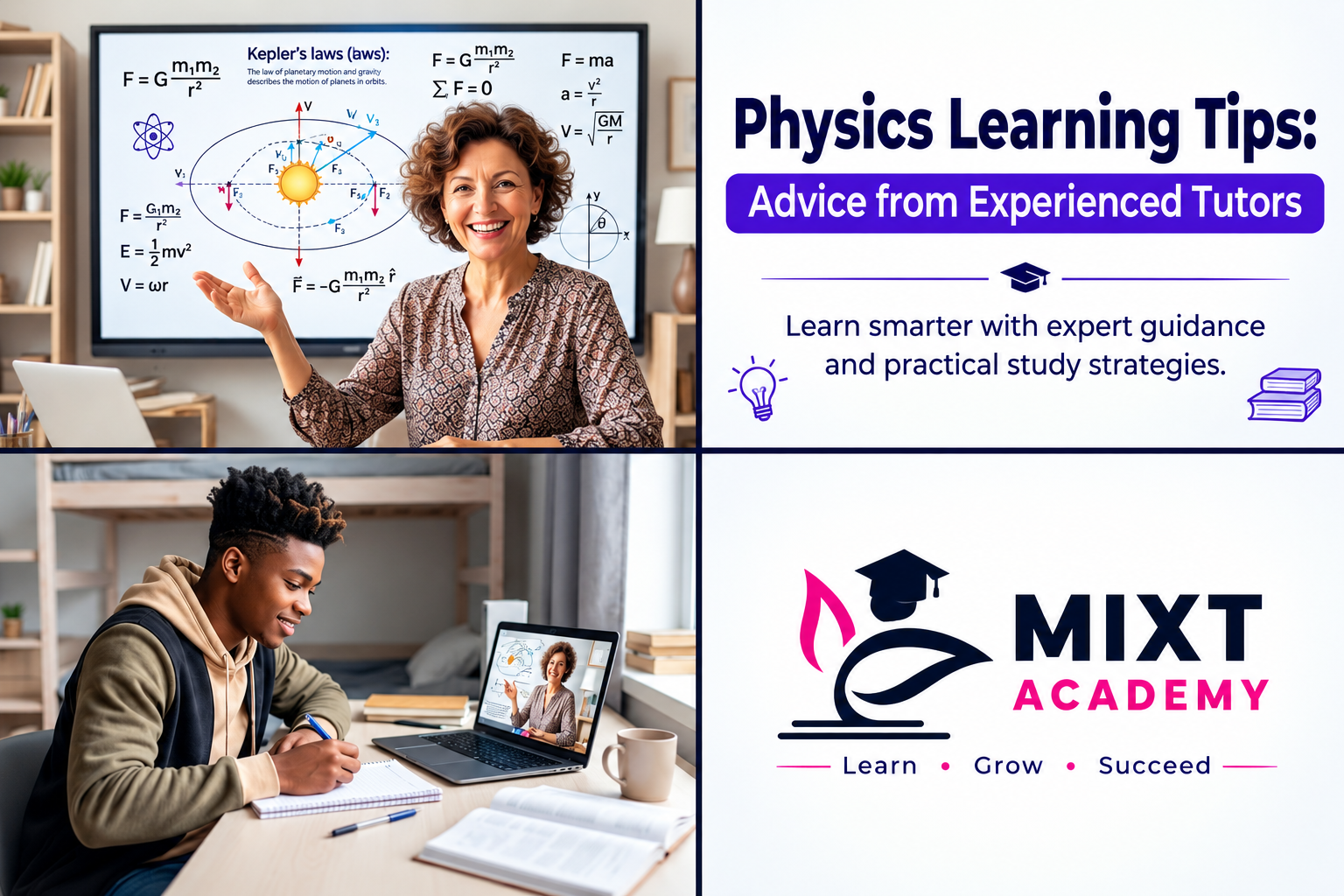
Knowledge of the subject matters is only 50% of the final grade, the other 50% being how clearly the knowledge is executed within the time limits.
|
Command Word |
What the Examiner Expects |
|
Describe |
Describe the facts, process or pattern, but not necessarily how or why it occurs. |
|
Explain |
Give reasons for or how a phenomenon happens, based on scientific principles. |
|
Calculate |
Present clear mathematical working, indicate the equation used and give units. |
|
Evaluate |
Weigh evidence or arguments, considering both pros and cons before concluding. |
If a student is not able to get through a concept within a few hours, he/she becomes frustrated. If self-study has stalled, then targeted guidance works to quickly clear up misunderstandings.
Having a qualified tutor with physics helps you get suggestions and feedback that are structured to your learning pace. If you are a student in the UK, then a physics tutor in the UK guarantees your study will be tailored to the requirements of any exam board: AQA, Pearson Edexcel, or OCR.
GCSE Focus: A specialist GCSE tutor in physics guides students to see how key concepts relate to the exam and how to produce high marks.
Flexible Learning: For flexible learning, you can seek the best Liverpool online tutors or UK tutors for the best instruction from home.
Platforms like Mixt Academy simplify this search by connecting students with DBS-checked, experienced tutors who provide personalised, syllabus-aligned support to boost confidence and performance.
Consistency beats cramming. Short, regular revision sessions retain information far better than late-night study marathons.
Set Weekly Targets: Focus on mastering one specific sub-topic, reviewing key formulas, and completing 10–15 past-paper questions each week.
Spaced Repetition: Revisit past topics every few weeks to move concepts into long-term memory. Seeing past-paper questions become easier over time validates your effort and builds genuine exam confidence.
Struggling through complex concepts alone often leads to unnecessary frustration and knowledge gaps. Working alongside a qualified physics tutor provides structured feedback to clear up misconceptions quickly. Partnering with an experienced physics tutor in the UK at Mixt Academy UK ensures your preparation aligns directly with exam board standards.
A specialised GCSE physics tutor helps convert core theory into high-scoring answers, while flexible online tutors offer accessible support tailored to your schedule. Establishing a consistent revision routine prevents cramming and improves long-term retention. Setting clear weekly goals, like mastering one topic and practising past papers, keeps progress steady. Ultimately, focusing on core principles and seeking targeted help when stuck builds the confidence needed to excel.