 English
 Arabic
 French
 Spanish
 Portuguese
 Deutsch
 Turkish
 Dutch
Dutch
 Italiano
 Russian
 Romaian
 Portuguese (Brazil)
 Greek
Greek
One way Cab Ranchi | One way Taxi Ranchi
Non classé |
2026-05-27 15:59:16
 Social Networth OS
 Creator Commerce
 Launch Startup
 Global News
 Creator Award
 Talkfever App
Tout voir
Talkfever App
Tout voir

Mise à niveau vers Pro
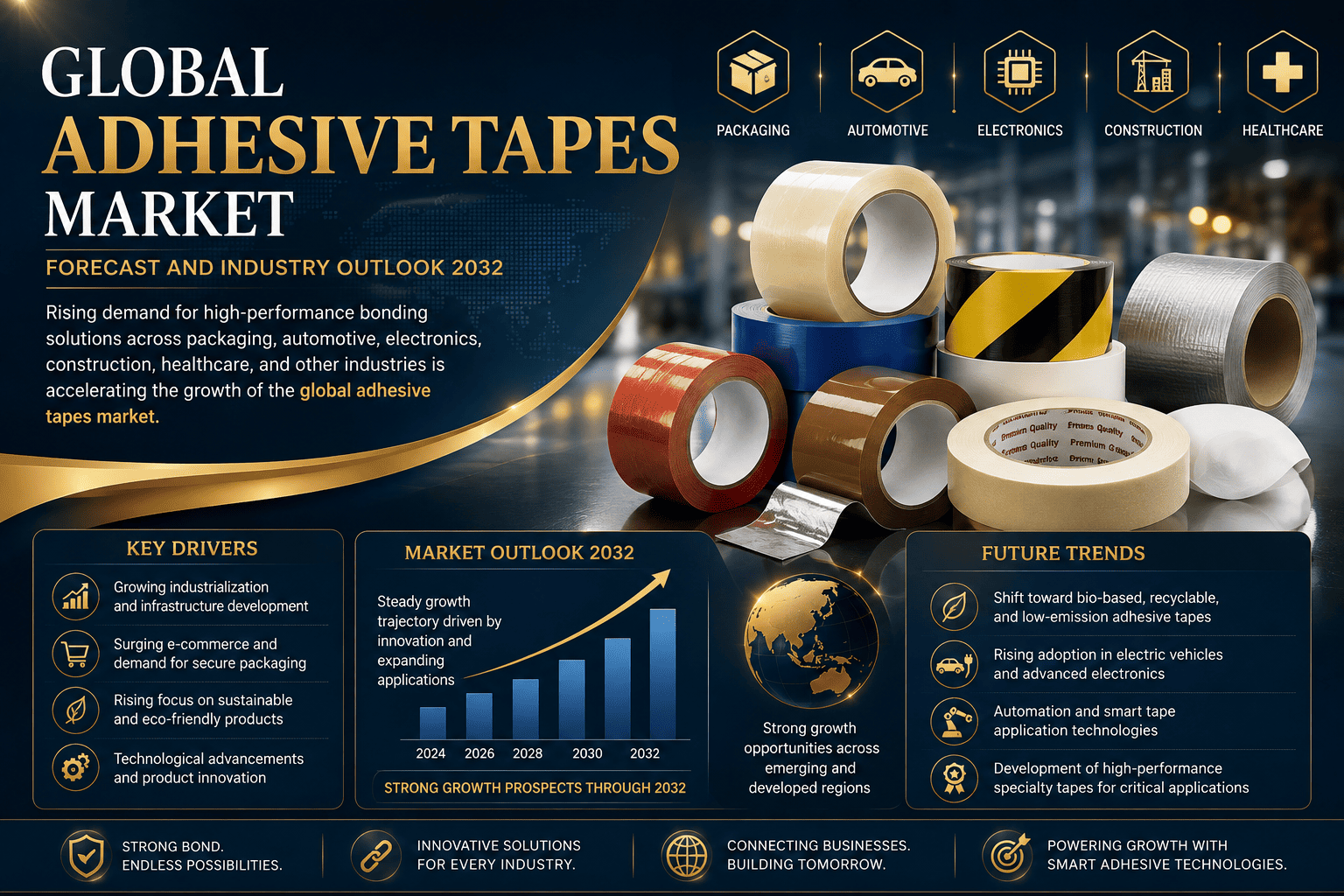
The Global adhesive tapes market is entering a sustained expansion phase as industries increasingly adopt flexible, lightweight, and high-performance bonding solutions. According to 6Wresearch, the market was valued at USD 75 billion in 2025 and is projected to reach USD 105 billion by 2032, registering a CAGR of 4.90% from 2026 to 2032. The expansion is being supported by diversified applications across automotive, healthcare, construction, packaging, appliances, electronics, and other industries.
Adhesive tapes have developed beyond conventional fastening and packaging uses. Manufacturers are increasingly relying on advanced tape technologies for component attachment, insulation, surface protection, sealing, lightweight assembly, and specialized industrial processes. At the same time, sustainability concerns are encouraging the development of bio-based, recyclable, and biodegradable adhesive products. These developments are reshaping the competitive environment and creating new opportunities for manufacturers and investors.
The global adhesive tapes market presents attractive investment potential because demand is distributed across a wide range of end-use industries. Automotive manufacturers require tapes for lightweight assembly and component applications, while healthcare organizations use specialized adhesive solutions for medical, sterilization, and packaging requirements. Construction, appliances, electronics, and consumer products add further sources of demand.
The diversified nature of the industry provides companies with opportunities to participate in established applications while developing products for emerging sectors. The automotive industry alone contributes approximately 21% of market demand, while healthcare is projected to grow at a CAGR of 5.2% between 2026 and 2032.
Investment opportunities are also emerging from specialized products. Advanced adhesive formulations designed for high-stress, high-temperature, electronic, medical, automotive, and sustainable applications can help manufacturers move toward higher-value market segments. Companies investing in research and development can differentiate themselves through performance, durability, application flexibility, and environmental characteristics.
The growing preference for adhesive tapes is closely connected with modern manufacturing requirements. Industries are looking for solutions that can simplify assembly while reducing weight and maintaining product performance. Adhesive tapes can replace or complement mechanical fastening methods in suitable applications, reducing the need for screws, bolts, drilling, or other assembly processes.
Lightweight construction is particularly important in automotive manufacturing. As vehicle manufacturers seek greater efficiency and electric vehicles continue to expand, specialized adhesive solutions are becoming increasingly relevant. 6Wresearch identifies lightweight adhesives for EV components as a potential revenue opportunity of up to USD 2 billion.
Automation is another factor supporting future demand. Modern factories require consistent, reliable materials that can integrate with standardized and automated production processes. Adhesive tapes can support efficient assembly and component placement, making them increasingly relevant as manufacturers modernize production facilities.
The expansion of the global adhesive tapes market is also creating greater opportunities for companies to strengthen their digital presence. Industrial buyers increasingly research technical specifications, application suitability, material compatibility, and performance characteristics before contacting suppliers.
The industry includes several resin categories, such as acrylic, epoxy, rubber-based, silicone, and polyurethane. Acrylic held the largest resin share at approximately 42% in 2025, while rubber-based adhesive tapes are projected to be the fastest-growing resin segment, with a CAGR of 6.3% from 2026 to 2032.
This segmentation gives manufacturers opportunities to communicate specialized solutions around specific applications. Businesses that provide informative technical content about adhesion strength, temperature resistance, surface compatibility, durability, and sustainability can improve their ability to reach industrial customers researching these solutions online.
As digital procurement becomes more common, strong search visibility can help manufacturers, distributors, and technology providers connect with customers across different geographic markets.
Demand across the global adhesive tapes market continues to expand because adhesive solutions offer multiple functional benefits. Automotive manufacturers use tapes to support lightweight construction and component attachment. Healthcare companies require specialized products for medical applications and packaging. Construction companies use adhesive tapes for mounting, sealing, insulation, and protection.
Packaging is becoming another important area of expansion. The growth of e-commerce is increasing the need for convenient and dependable packaging solutions. According to 6Wresearch, adhesive tape applications in packaging could increase by approximately 25% through 2030 as online retail expands.
Appliances and electronics also provide opportunities because manufacturers increasingly seek compact designs and efficient assembly methods. Adhesive tapes can support component attachment, insulation, protection, and finishing without necessarily adding significant weight or bulk.
This combination of applications gives the industry a strong foundation for expansion and reduces reliance on one specific demand source.
Performance and ease of use are becoming important factors in adhesive tape selection. Industrial users require products that provide reliable adhesion, consistent application, durability, and compatibility with different surfaces and environmental conditions.
Technology development is helping manufacturers meet these requirements. Solvent-based adhesive tapes are projected to remain the leading technology segment, accounting for approximately 47% of market share in 2025. Meanwhile, hot-melt technology is expected to grow faster, with a projected CAGR of 5.5% between 2026 and 2032, supported by its quick-curing characteristics and versatility in packaging and electronics.
Better-performing adhesive tapes can help manufacturers simplify assembly processes and improve operational consistency. In high-volume production environments, these advantages can contribute to productivity and reduce complications associated with traditional fastening techniques.
Although adhesive tapes are primarily industrial products, their benefits extend into everyday consumer products. They are widely used in packaging, appliances, electronics, automobiles, furniture, healthcare products, and household applications.
In consumer electronics, specialized tapes can support component attachment and insulation while helping manufacturers create compact designs. In appliances and furniture, adhesive solutions can assist with mounting, assembly, finishing, and protection. These applications contribute to products that are lighter, more streamlined, and easier to manufacture.
Packaging also demonstrates the lifestyle relevance of adhesive tape innovation. Secure and efficient packaging helps products withstand transportation and delivery, which has become particularly important with the expansion of online shopping.
Sustainability is adding another dimension to these benefits. Polypropylene is expected to remain the dominant backing material, with approximately 40% market share in 2025, while eco-friendly backing materials are forecast to grow at a CAGR of 7.2% through 2032.
Infrastructure development is an important contributor to the global adhesive tapes market because construction projects require materials for sealing, mounting, insulation, protection, and finishing. Growing urbanization and industrialization are increasing construction activity in several developing markets.
Asia-Pacific remains the largest regional market, representing approximately 48% of market share in 2025. Its strong manufacturing ecosystem, automotive production, electronics industry, infrastructure development, and consumer-goods sector provide substantial demand for adhesive tape solutions.
Latin America is expected to be the fastest-growing region, with a projected CAGR of 6.8% from 2026 to 2032. Expanding industrial activity and rising demand from automotive and consumer-goods industries are contributing to its growth prospects.
Infrastructure investment can also generate indirect demand by encouraging the construction of factories, warehouses, commercial facilities, transportation infrastructure, and healthcare facilities. These developments create additional applications for adhesive products.
Sustainability is becoming a central theme in the global adhesive tapes market. Environmental regulations and changing purchasing preferences are encouraging manufacturers to rethink materials, formulations, and production processes.
Bio-based adhesives, recyclable backings, biodegradable materials, and environmentally responsible manufacturing methods are gaining attention. Sustainable adhesive tapes are expected to capture nearly 30% of market share by 2030 as environmental regulations and customer expectations become stronger.
This transition presents both challenges and opportunities. Manufacturers may need to invest more heavily in research and compliance, but companies capable of delivering environmentally responsible products without compromising performance can potentially gain a competitive advantage.
Sustainability can therefore become more than a regulatory requirement; it can serve as a product differentiation strategy in a market where industrial buyers increasingly evaluate environmental performance alongside cost and functionality.
Future expansion will depend heavily on technology, automation, and supply-chain resilience. Smart manufacturing can help producers improve quality, optimize material usage, and reduce waste. Digital production systems can also enable greater customization for niche industrial applications.
At the same time, manufacturers face pressure from raw-material volatility. Petroleum-based inputs can represent more than 60% of production costs, making fluctuations in feedstock prices an important challenge for manufacturers. Stricter environmental standards can also increase compliance costs and place pressure on smaller producers.
Supply-chain resilience is therefore expected to become increasingly important. Companies may seek to localize production, diversify suppliers, and establish regional manufacturing capabilities to reduce exposure to disruptions. These strategies can support more stable product availability and help companies respond faster to regional demand.
The global adhesive tapes market is positioned for continued expansion as industries increasingly prioritize efficient assembly, lightweight materials, specialized performance, and sustainable manufacturing. With market value projected to rise from USD 75 billion in 2025 to USD 105 billion by 2032, the sector offers substantial opportunities across automotive, healthcare, packaging, construction, electronics, appliances, and emerging applications.
The strongest opportunities are likely to emerge where adhesive technology intersects with major industrial trends. Electric vehicles are creating demand for lightweight and specialized solutions, e-commerce is increasing packaging requirements, healthcare is expanding its use of advanced adhesive products, and sustainability is encouraging new materials and technologies.
For investors and industry participants, entering the market or expanding existing capabilities now can be strategically valuable. Companies that focus on specialized products, sustainable technologies, regional expansion, supply-chain resilience, and innovation can position themselves to benefit from long-term market expansion. As adhesive tapes become increasingly integrated into modern manufacturing and everyday products, the industry presents a compelling opportunity for future-oriented investment.
1. What is the forecast for the global adhesive tapes market?
The global adhesive tapes market is projected to grow from USD 75 billion in 2025 to USD 105 billion by 2032. According to 6Wresearch, the industry is expected to expand at a CAGR of 4.90% during 2026–2032, supported by diverse industrial applications and technological developments.
2. What factors are driving adhesive tapes market expansion?
Several factors are driving the global adhesive tapes market, including automotive lightweighting, healthcare applications, e-commerce packaging, construction activity, electronics manufacturing, automation, and sustainability. The growing need for flexible and efficient assembly solutions is also encouraging industries to adopt advanced adhesive technologies.
3. Which region dominates the global adhesive tapes market?
Asia-Pacific currently dominates the global adhesive tapes market, accounting for approximately 48% of market share in 2025. Strong manufacturing capabilities, automotive production, electronics, infrastructure development, and expanding consumer industries support the region's leading position.
4. Why are adhesive tapes important for electric vehicles?
Adhesive tapes can support lightweight assembly, component attachment, insulation, and other EV manufacturing requirements. The growing emphasis on vehicle weight reduction and advanced materials is creating new opportunities. 6Wresearch estimates that lightweight adhesives for EV components could represent a cumulative revenue opportunity of up to USD 2 billion.
5. Which resin segment leads the adhesive tapes market?
Acrylic is the leading resin segment in the global adhesive tapes market, representing approximately 42% of market share in 2025. Rubber-based adhesive tapes are projected to grow faster, supported by strong bonding capabilities and increasing adoption in high-stress automotive and industrial applications.
6. How is sustainability affecting the adhesive tapes market?
Sustainability is encouraging manufacturers to develop bio-based formulations, recyclable products, and biodegradable backing materials. Sustainable adhesive tapes are expected to gain significant market share as regulations and customer preferences increasingly favor environmentally responsible products without sacrificing performance.
7. How does e-commerce support adhesive tape demand?
E-commerce is increasing the need for secure, flexible, and efficient packaging materials. Adhesive tapes are widely used for sealing and protecting shipments throughout distribution networks. The global adhesive tapes market could see packaging applications rise by approximately 25% through 2030 as online retail continues expanding.
8. What technology is expected to grow rapidly in the adhesive tapes market?
Hot-melt technology is expected to record strong growth in the global adhesive tapes market, with a projected CAGR of 5.5% between 2026 and 2032. Its quick-curing characteristics and versatility make it suitable for packaging, electronics, and several other industrial applications.
9. What are the major challenges facing the global adhesive tapes market?
Raw-material price volatility is a major challenge because petroleum-based inputs can account for more than 60% of production costs. Environmental regulations, compliance requirements, supply-chain disruptions, and competitive pressure can also influence manufacturing expenses and profitability.
10. Why is the global adhesive tapes market attractive for investment?
The global adhesive tapes market offers attractive investment potential because it serves multiple industries and is benefiting from long-term trends such as electric vehicles, automation, e-commerce, healthcare expansion, infrastructure development, and sustainability. Investing in specialized technologies and emerging applications can provide opportunities for future growth.
Read More..
Global activated carbon market

