English
 Arabic
 French
 Spanish
 Portuguese
 Deutsch
 Turkish
 Dutch
Dutch
 Italiano
 Russian
 Romaian
 Portuguese (Brazil)
 Greek
Greek
Global Trade Excellence: How Dubai’s Shipping Sector Leads the Future of Logistics
Networking |
2025-08-11 12:07:42
 Social Networth OS
 Creator Commerce
 Launch Startup
 Global News
 Creator Award
 Talkfever App
Afiseaza-i pe toti
Talkfever App
Afiseaza-i pe toti

Upgrade to Pro
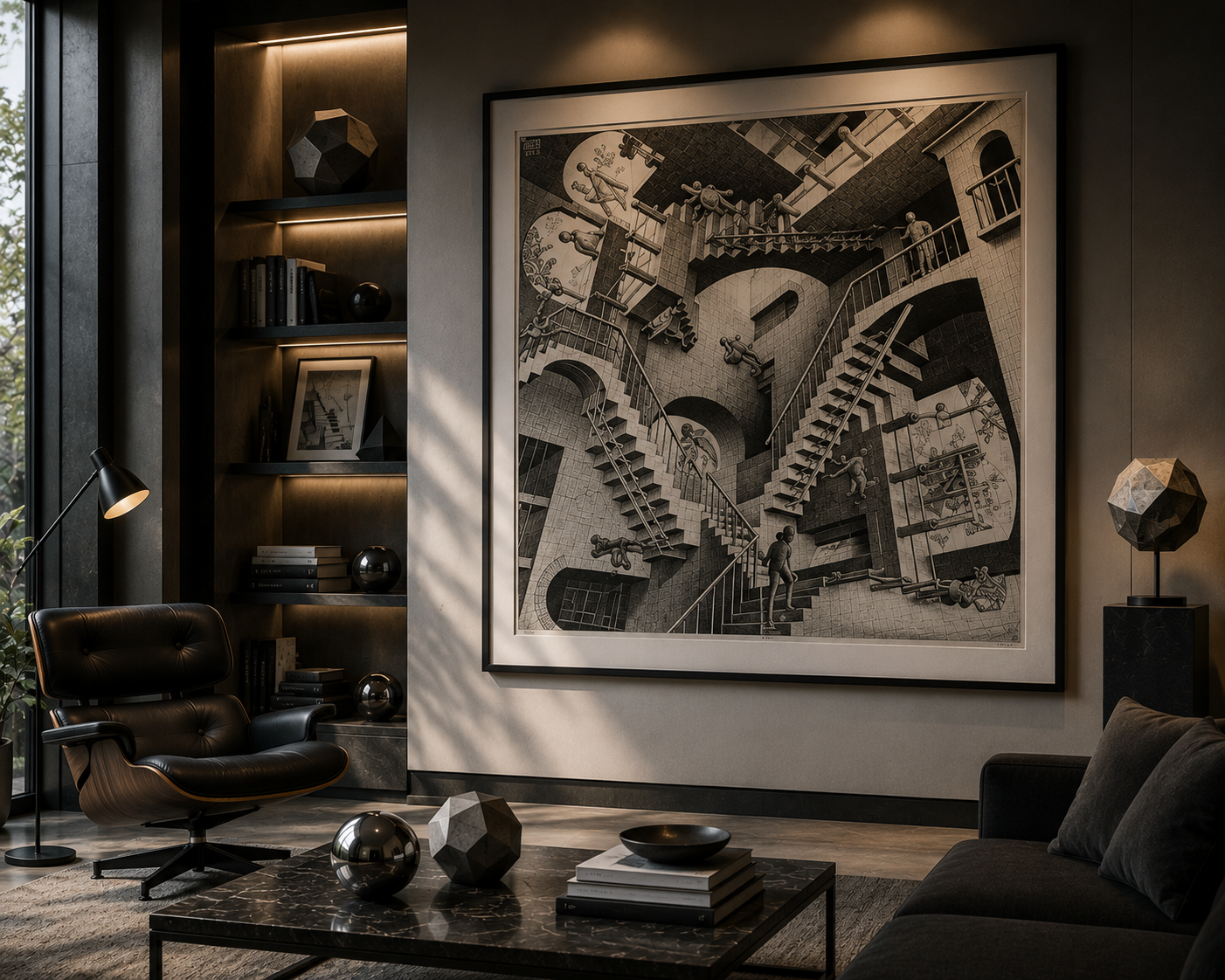
Some artworks are admired for their beauty, while others invite viewers to question what they see. M.C. Escher achieved both through an artistic language built around intricate detail, mathematical structure, optical illusion, and impossible spaces. His compositions often appear realistic at first glance, only to reveal contradictions when examined more carefully.
For collectors and enthusiasts exploring Escher artist images, this quality is one of the reasons his work remains so compelling. Escher did not simply create pictures; he created visual experiences that encourage the eye and mind to work together. Among his most celebrated examples, Waterfall demonstrates this approach with remarkable clarity.
M.C. Escher developed a distinctive style by combining traditional printmaking techniques with ideas drawn from geometry, mathematics, architecture, and nature. He was fascinated by the way people interpret depth and spatial relationships.
A staircase could appear to ascend forever. A reflection could create another world within an image. Repeated figures could transform into completely different shapes. These concepts became recurring elements throughout his artistic career.
The enduring appeal of Escher artist images comes partly from this ability to combine technical precision with intellectual curiosity. Viewers can appreciate the craftsmanship immediately, while the underlying visual puzzle may take considerably longer to understand.
Created in 1961, Waterfall is one of Escher’s most recognizable explorations of impossible architecture. The composition presents a large architectural structure containing a channel through which water appears to flow.
At first, the scene seems straightforward. Water moves through the channel, travels toward a waterfall, and falls downward. However, following the water's path carefully reveals an extraordinary contradiction: the water appears to return to the same elevated point from which it began.
The M.C. Escher Waterfall therefore creates the impression of a perpetual cycle. The water seems to flow continuously without losing elevation, something that cannot happen naturally in the physical world.
The success of Waterfall depends on Escher's careful manipulation of perspective. Individual sections of the structure look believable, but their arrangement creates an impossible overall environment.
The architectural columns and geometric lines guide the viewer's eye through the composition. Because these elements appear consistent, the brain initially accepts the structure as realistic.
Only after following the watercourse does the contradiction become obvious.
This is one of Escher's greatest artistic achievements. Rather than presenting an obviously fantastical environment, he constructed an image in which the impossible emerges from apparently logical parts.
Architecture was an important source of inspiration for Escher because buildings provide strong visual cues for depth, scale, and direction. Stairs, bridges, towers, arches, and channels can be arranged to create convincing illusions.
In Waterfall, architecture is essential to the visual puzzle. The structure creates the framework that makes the impossible water cycle appear believable.
This approach can also be found in other Escher compositions involving stairways and interconnected spaces. His architectural environments encourage viewers to question whether different parts of the scene actually occupy the same physical space.
One of the most appealing characteristics of Escher’s art is its ability to reward repeated viewing. A first glance may reveal the overall composition, while a second or third examination can uncover details that were previously overlooked.
Looking at Escher artist images as a collection can make this even more apparent. Themes such as infinity, tessellation, reflection, symmetry, transformation, and impossible perspective recur throughout his work.
The Broader Appeal of Waterfall
The M.C. Escher Waterfall is particularly accessible because its central subject is familiar. Most people understand how water behaves, so the contradiction is immediately intriguing once it becomes apparent.
The work also raises an interesting question about perception: if every individual part of a scene appears believable, does that make the entire scene believable? Escher demonstrates that the answer is not necessarily. Our brains assemble visual information into a coherent whole, and his art cleverly exploits that process.
For collectors and art enthusiasts interested in examining Escher’s work more closely, Walker Fine Art offers a specialized collection dedicated to the artist’s remarkable legacy.
Viewing original works provides an opportunity to appreciate the fine details that contribute to Escher’s illusions. His precise lines, intricate patterns, and carefully constructed compositions demonstrate the extraordinary technical skill behind the visual effects.
Exploring a collection of his work can also provide valuable context. A piece such as Waterfall becomes even more interesting when viewed alongside Escher’s other experiments with perspective, symmetry, and impossible spaces.
M.C. Escher demonstrated that art could be both visually beautiful and intellectually challenging. His impossible worlds encourage viewers to question their assumptions and look beyond the obvious.
The M.C. Escher Waterfall remains one of the clearest examples of this philosophy. By creating a watercourse that seems to flow endlessly through an impossible architectural structure, Escher transformed an ordinary natural process into a fascinating visual paradox.
For collectors, the continued interest in Escher artist images reflects the timeless strength of his artistic ideas. Through Walker Fine Art, enthusiasts can explore the precision, imagination, and visual intelligence that continue to make Escher’s work extraordinary.