English
 Arabic
 French
 Spanish
 Portuguese
 Deutsch
 Turkish
 Dutch
Dutch
 Italiano
 Russian
 Romaian
 Portuguese (Brazil)
 Greek
Greek
Latest News: Smart Pianos And Guitars Market Witness Huge Growth by 2034
Networking |
2025-02-28 05:00:17
 Social Networth OS
 Creator Commerce
 Launch Startup
 Global News
 Creator Award
 Talkfever App
Ver todos
Talkfever App
Ver todos

Atualizar para Plus
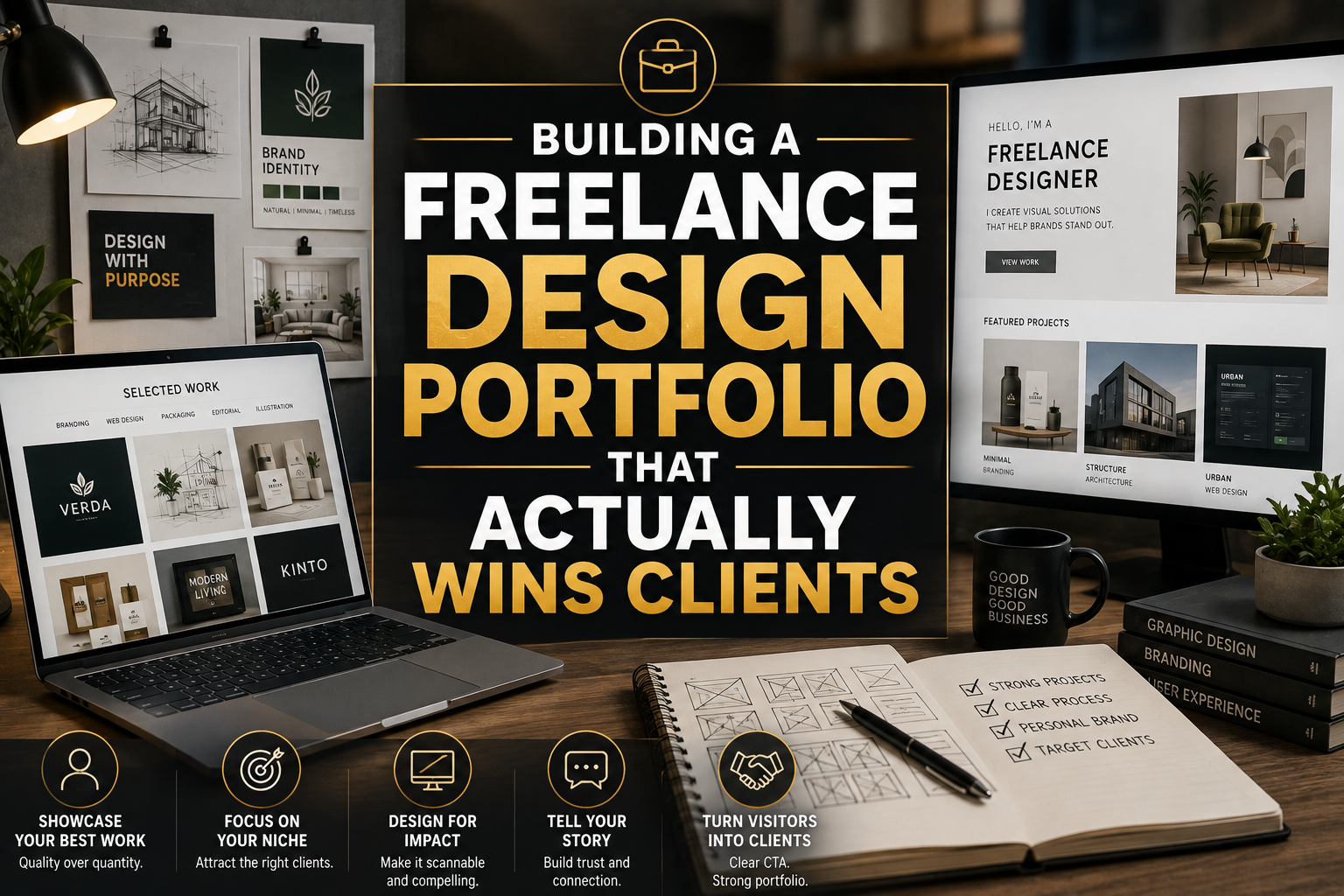
Most freelance designers make the same mistake early on: they treat their portfolio as a dumping ground for every project they've ever finished, instead of a curated pitch built to win the next one. The difference between a portfolio that sits ignored and one that consistently converts visitors into paying clients usually has less to do with talent and everything to do with how deliberately it's organized. Here's what actually separates the two.
There's a hard truth in freelance creative work: being good at the craft and being good at getting hired are two different skills, and the second one is learnable even if it doesn't come naturally. A brilliant designer with a cluttered, unfocused portfolio will consistently lose work to a merely competent one who presents their work with clarity and intention. Clients aren't just evaluating skills, they're evaluating whether they can trust you to solve their specific problem, and a portfolio is the primary evidence they use to decide.
When a potential client lands on a portfolio site and can't quickly tell what you specialize in, they don't dig deeper; they bounce. Attention online is scarce, and a portfolio that requires effort to understand is a portfolio that loses business before a single email is ever sent. Every unnecessary click, every unclear category, and every irrelevant project sitting between the client and your best work is a small leak in your pipeline.
New freelancers often feel pressure to show quantity proof that they've done a lot of work. But clients don't hire based on volume; they hire based on relevance and quality. A portfolio with eight exceptional, carefully chosen pieces will consistently outperform one stuffed with thirty mediocre ones. If a project isn't your best work or doesn't represent the kind of job you want more of, it shouldn't be taking up space.
The way a portfolio is organized tells a client almost as much as the work itself. A disorganized grid of unrelated projects looks like a hobbyist's blog. A portfolio broken into clear categories, with a logical flow and a consistent presentation style, signals someone who runs their business with intention which is exactly the impression a client wants before committing a budget to a project.
This principle holds true across creative disciplines, and it's worth studying how other visually driven fields solve the same problem. This guide on how to organize a 3D rendering portfolio lays out a genuinely transferable framework specialization, presentation, versatility, and process that applies just as well to a graphic designer, illustrator, or UX portfolio as it does to architectural visualization work.
Whatever sits at the very top of your portfolio should be the single best example of the kind of work you want to be hired to do again. Don't lead with your most technically impressive piece if it's not representative of your day-to-day services lead with what you want more of.
Sorting projects by date tells a visitor nothing useful. Grouping by service type, industry, or style lets a potential client find relevant proof quickly, especially if they're comparing you against other freelancers with a specific project in mind.
A project title and a pretty image aren't enough. A short note on the client's problem, your approach, and the outcome turns a static image into a case study and case studies are what actually build trust with a hesitant client.
It's fine to demonstrate versatility, but it should live in clearly separated sections rather than blended together. A client searching for a brand identity designer shouldn't have to wade through unrelated packaging work to find what they're looking for.
Old work that no longer reflects your current skill level should be retired. A portfolio is not an archive, it's a living pitch, and it should always represent your best current capability, not a history of everything you've ever made.
The freelancers who consistently win better clients over time aren't the ones who built a great portfolio once and left it alone. They're the ones who revisit it regularly, swap in stronger recent work, remove anything that's started to feel dated, and adjust the framing as their focus shifts. A portfolio that hasn't changed in two years is quietly telling potential clients that your work hasn't either.
A freelance portfolio isn't a gallery, it's a sales tool, and it should be built with the same intentionality as any other part of a business. Curating ruthlessly, organizing by category, adding context to every project, and revisiting it regularly will do more for your client pipeline than adding one more finished piece ever will. The goal isn't to show everything you've made. It's to show exactly what you want to be hired to make next.