English
 Arabic
 French
 Spanish
 Portuguese
 Deutsch
 Turkish
 Dutch
Dutch
 Italiano
 Russian
 Romaian
 Portuguese (Brazil)
 Greek
Greek
Press Release: Global Epoxy composite Market Expectation Surges with Rising Demand With Top Companies (2024-2030) | +5.55% CAGR | Exactitude Consultancy
Other |
2024-02-20 03:53:59
 Social Networth OS
 Creator Commerce
 Launch Startup
 Global News
 Creator Award
 Talkfever App
Tout voir
Talkfever App
Tout voir

Mise à niveau vers Pro
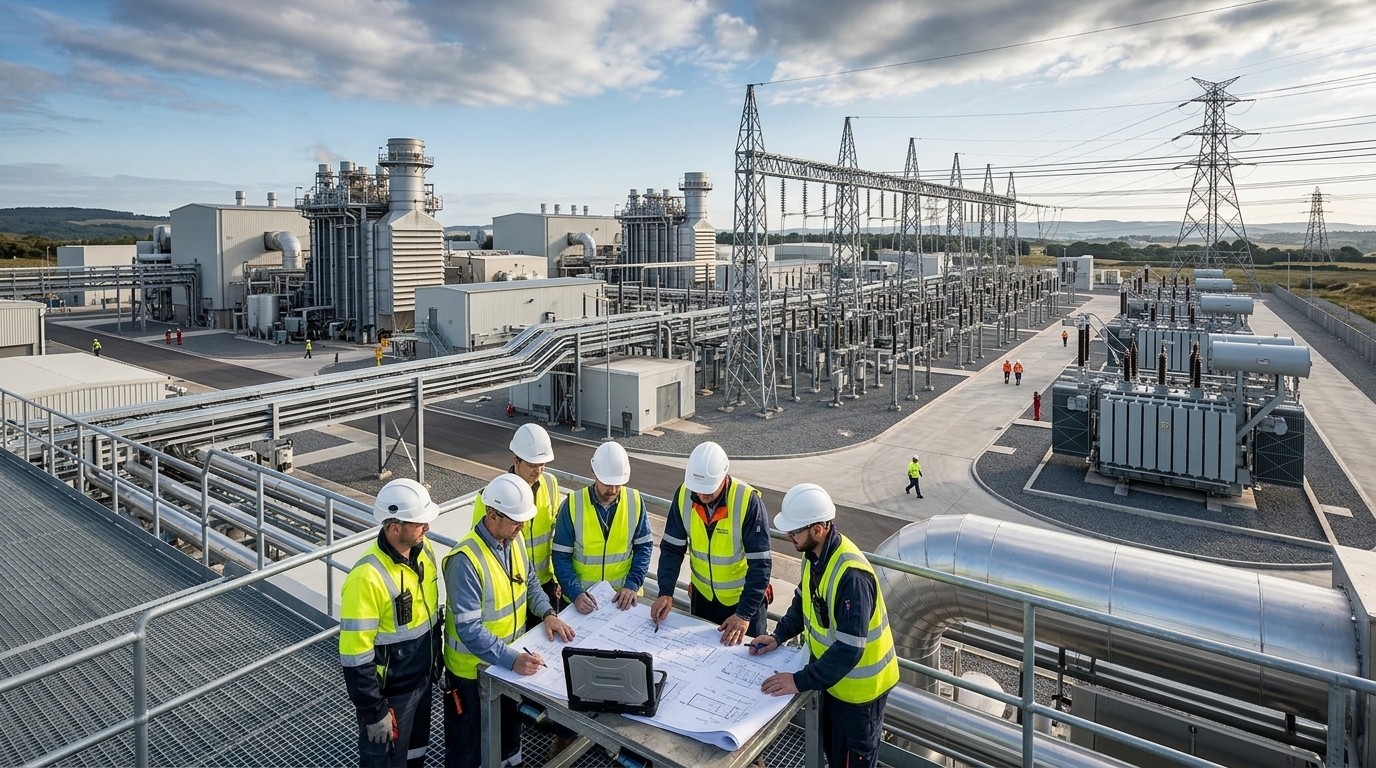
Designing a large power plant is a complex engineering challenge that requires careful coordination between electrical, mechanical, civil, structural, control, and safety disciplines. A successful project is not simply about selecting equipment and connecting it to the grid. It involves developing an integrated system that can operate safely, efficiently, reliably, and economically throughout its service life.
Modern energy projects also face growing demands for higher efficiency, grid stability, environmental performance, and regulatory compliance. This makes professional power plant design essential from the earliest planning stages through detailed engineering and commissioning.
For large-scale projects, every engineering decision can influence construction costs, operational reliability, maintenance requirements, and long-term plant performance. Understanding the major considerations helps project owners and developers make informed decisions and reduce avoidable risks.
The first step in power plant design is establishing clear project requirements. Engineers need to understand the expected generation capacity, operating profile, fuel characteristics, grid connection requirements, site conditions, and future expansion plans.
A plant designed for continuous baseload operation will have different engineering requirements from a facility intended to provide peak power or support renewable generation. The expected load profile directly influences equipment sizing, operating philosophy, redundancy, and control strategies.
Site selection is equally important. Factors such as available land, access roads, water supply, fuel transportation, climate, geology, environmental conditions, and proximity to transmission infrastructure can significantly affect the final design.
Early feasibility studies can identify technical constraints before detailed engineering begins. This helps prevent expensive modifications later in the project lifecycle.
A strong electrical plant design is fundamental to reliable power generation. The electrical system must safely collect generated power, supply auxiliary loads, provide protection, and transfer electricity to the transmission or distribution network.
Key electrical systems may include generators, transformers, medium- and high-voltage switchgear, busbars, cables, protection systems, grounding networks, station service systems, and emergency power supplies.
Engineers also need to determine the appropriate voltage levels and equipment ratings based on the plant's generation capacity and grid requirements. Short-circuit studies, load-flow analysis, transient stability studies, motor-starting studies, and protection coordination studies can help verify that the electrical network will perform correctly under normal and abnormal conditions.
Grid interconnection requirements must be considered early. A plant that performs well internally may still create problems if its electrical characteristics are not compatible with the wider power system. Proper integration therefore requires coordination between plant equipment and the utility or transmission network.
Equipment selection is one of the most important decisions in power plant design engineering. Generators, transformers, switchgear, turbines, boilers, cooling systems, pumps, compressors, and auxiliary equipment must be selected according to the plant's operating requirements.
Engineers should consider more than initial purchase cost. Equipment efficiency, availability, maintainability, spare-parts requirements, expected service life, manufacturer support, and operating conditions can have a major impact on total project economics.
Reliability is particularly important for large generating facilities. Critical equipment may require redundancy or alternative supply arrangements so that a single equipment failure does not result in a complete plant shutdown.
Thermal performance and energy efficiency should also be evaluated. Even small improvements in efficiency can produce significant savings over decades of operation, especially in high-capacity plants.
Modern power plants rely heavily on sophisticated control and protection systems. These systems monitor equipment, regulate plant operation, detect abnormal conditions, and initiate protective actions when necessary.
Protection systems should be carefully coordinated so that faults are isolated quickly without unnecessarily disconnecting healthy equipment. Generator protection, transformer protection, busbar protection, feeder protection, and backup protection all form part of the overall electrical protection philosophy.
Plant control systems also play an important role in operational efficiency. Supervisory control, distributed control systems, automatic voltage regulation, excitation systems, turbine controls, and synchronization systems must work together effectively.
Automation can reduce response times and improve operational visibility, but it also requires careful engineering of communication networks, cybersecurity, redundancy, and fail-safe functions.
Safety must be integrated into the design rather than treated as a final project requirement. Large power facilities contain high voltages, rotating machinery, combustible materials, pressurized systems, heat sources, and other potential hazards.
A comprehensive engineering approach considers electrical safety, fire protection, emergency shutdown systems, grounding, arc-flash risks, equipment access, ventilation, hazardous areas, and emergency response requirements.
Environmental considerations are also increasingly important. Depending on the type of plant, engineers may need to address emissions, wastewater, cooling-water consumption, noise, fuel handling, waste management, and other environmental impacts.
Regulatory and grid-code requirements should be incorporated during the design phase. Early compliance reviews can help identify gaps before equipment procurement and construction, reducing the likelihood of costly redesigns or project delays.
A technically excellent design must also be practical to construct and maintain. Constructability should therefore be considered during engineering, including equipment transportation, lifting requirements, construction sequencing, access routes, temporary facilities, and site logistics.
Maintenance planning is equally important. Equipment should be positioned to allow safe inspection, repair, replacement, and testing. Adequate clearance around transformers, switchgear, generators, and other critical equipment can significantly improve maintenance efficiency.
A lifecycle approach also helps project owners evaluate long-term operating costs rather than focusing solely on capital expenditure. Reliability, energy efficiency, maintenance requirements, equipment replacement intervals, and future upgrades should all be considered.
Digital engineering tools, detailed electrical studies, 3D coordination, and multidisciplinary design reviews can improve project accuracy and reduce clashes between engineering disciplines.
Large-scale power projects require much more than basic equipment specifications. Effective power plant design engineering combines electrical studies, equipment selection, protection and automation, safety, environmental planning, constructability, and lifecycle considerations into one coordinated engineering strategy.
A well-designed plant can provide dependable generation, efficient operation, safer working conditions, and improved long-term value. By addressing technical and operational requirements from the beginning, project developers can reduce engineering risks and create infrastructure capable of supporting changing energy demands.
For organizations planning complex generation projects, working with experienced power engineering professionals can make a significant difference. A disciplined design process ensures that electrical systems, plant equipment, grid requirements, and operational objectives work together as one reliable power-generation solution.