English
 Arabic
 French
 Spanish
 Portuguese
 Deutsch
 Turkish
 Dutch
Dutch
 Italiano
 Russian
 Romaian
 Portuguese (Brazil)
 Greek
Greek
Top 3 Global Importer of Record Solutions for 2026
Networking |
2026-06-16 17:43:21
 Social Networth OS
 Creator Commerce
 Launch Startup
 Global News
 Creator Award
 Talkfever App
Tout voir
Talkfever App
Tout voir

Mise à niveau vers Pro
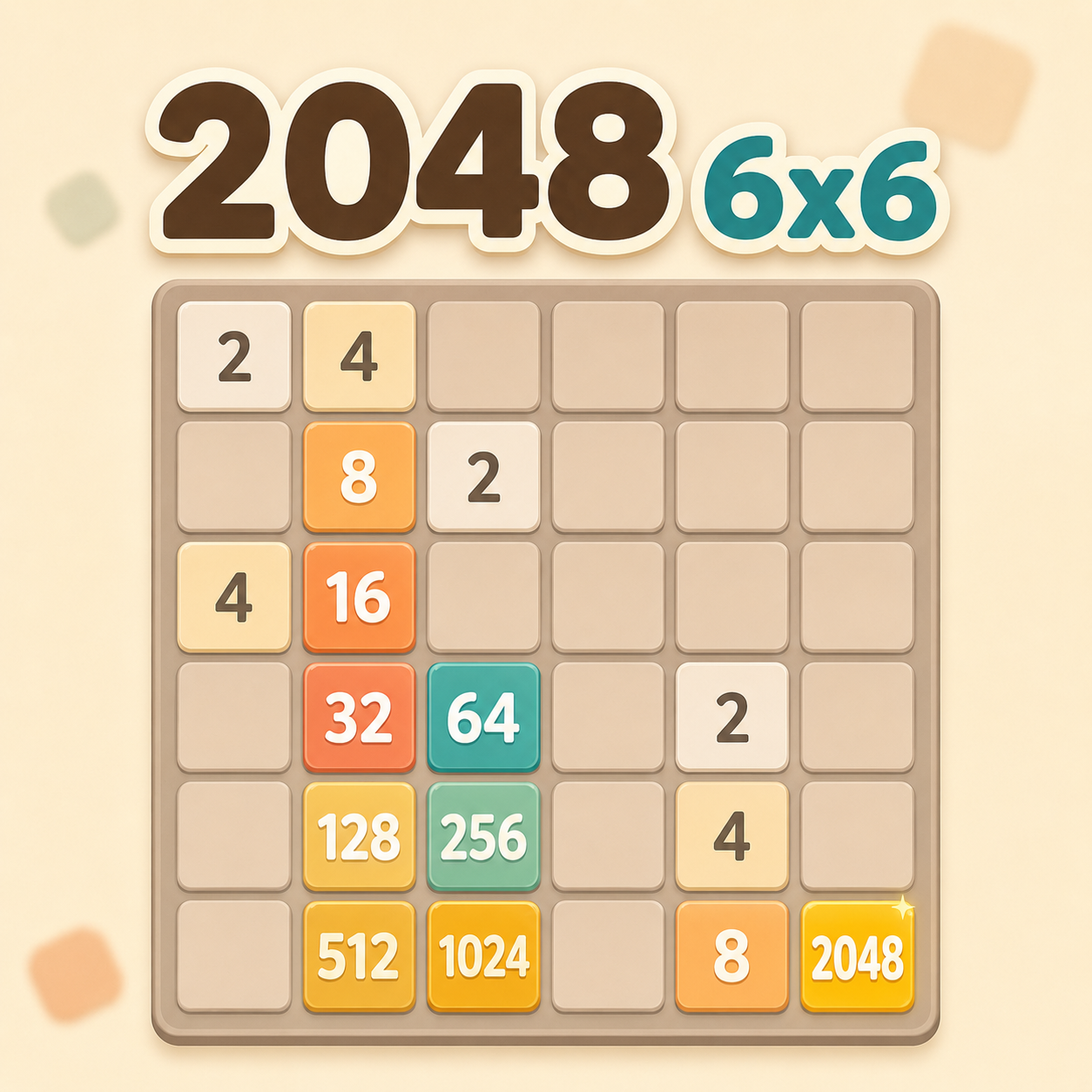
2048 6x6 expands the famous number-merging puzzle onto a larger board, giving players more room to build combinations and pursue extremely valuable tiles. The rules remain easy to understand: slide all tiles in one direction, combine matching numbers, and keep the board open for future moves. However, the additional space changes the rhythm of the game. Early progress feels forgiving, but long-term success depends on organization, patience, and the ability to plan beyond the next obvious merge.
What Is 2048 6x6?
The standard version of 2048 uses a four-by-four grid, while 2048 6x6 offers thirty-six cells. Players move every tile at once by swiping or pressing an arrow key. When two tiles with the same value meet, they merge into one tile worth twice as much. Two 2 tiles become 4, two 4 tiles become 8, and the sequence continues through 16, 32, 64, 128, 256, 512, 1024, 2048, and beyond.
After a valid move, a new low-value tile usually appears in an empty cell. This means every action changes both the current arrangement and the amount of free space available. The game ends when the grid is full and no neighboring tiles can merge. Creating the 2048 tile is a major milestone, but the larger board encourages ambitious players to continue toward even higher values and larger scores.
How the Larger Board Changes the Experience
The 6x6 grid initially appears much easier because it offers twenty more cells than the classic board. There is room to separate awkward tiles, recover from small errors, and develop several merging chains at the same time. Beginners can experiment without losing immediately, while experienced players have space to create more advanced structures.
More space does not remove the challenge; it delays and reshapes it. A disorganized board can survive for a long time before its weaknesses become obvious. By the time the grid begins to fill, misplaced high-value tiles may be too far apart to combine. The player must therefore treat empty cells as a strategic resource rather than an invitation to swipe carelessly. The goal is not simply to use the available space, but to control it.
The Foundation of a Strong Strategy
Choose and protect a corner
A reliable strategy is to keep the largest tile in one corner and build descending values beside it. The chosen corner becomes the anchor of the board. Most moves should support that structure, allowing smaller tiles to travel toward the high-value chain instead of pulling the largest tile into the center. A stable corner reduces confusion and makes future merges easier to predict.
Limit unnecessary directions
Although the game allows movement in four directions, strong play usually favors three. If the main tile is kept in the lower-right corner, for example, repeated downward and rightward moves help preserve its position. Left moves may be used carefully when needed, while upward moves should be rare because they can break the ordered row and allow a new tile to appear beneath the anchor.
Build smooth value chains
The most useful arrangement is not a collection of isolated large numbers. It is a sequence in which values decrease gradually away from the main corner. A row such as 1024, 512, 256, 128, 64, and 32 can absorb new tiles efficiently. Smaller values should circulate through the open area until they are ready to join this chain.
Managing Empty Space and Small Tiles
Empty cells create flexibility. They allow tiles to move, give matching numbers a route toward each other, and provide room for new pieces. A player who preserves several open spaces can often recover from an imperfect move. Once only one or two cells remain, every swipe becomes dangerous because a poorly placed new tile may block an essential merge.
Small tiles deserve equal attention. A single 2 trapped between large numbers can interrupt an otherwise perfect sequence. Whenever possible, merge low values early and keep them in the active part of the board rather than near the protected corner. The larger grid makes it tempting to ignore clutter, but delayed cleanup is one of the main reasons promising games eventually collapse.
Thinking Beyond the Immediate Merge
Not every available merge is beneficial. Combining two tiles may create a satisfying result while shifting the rest of the board into a weaker arrangement. Before moving, consider where every row and column will land, whether the anchor remains protected, and where the next tile could appear. A move is strongest when it completes a merge and improves the board's overall shape.
It also helps to prepare merges in pairs. If two 32 tiles can become 64, try to have another 64 nearby so the result can continue into 128. These chain reactions free several cells in one move and move valuable tiles toward the main sequence. Planning two or three stages ahead is more important than chasing the largest possible number immediately.
Common Mistakes to Avoid
Swiping too quickly
Fast play feels exciting, but the 6x6 board contains many interacting tiles. Pause long enough to inspect the full grid, especially after a large chain reaction. One careless swipe can separate important values or move the corner tile out of position.
Filling every corner
High tiles scattered across several corners are difficult to reunite. Choose one main destination and direct the board toward it. Other corners should remain flexible enough to support movement and temporary combinations.
Chasing points without structure
A high score grows naturally when the board is organized. Random merges may produce quick points, but they often leave gaps in the value sequence. Prioritize position and mobility; the score will follow as larger combinations become possible.
Why 2048 6x6 Remains So Enjoyable
2048 6x6 balances relaxation with meaningful decision-making. Its simple controls make it accessible within seconds, yet the spacious grid supports long sessions filled with planning and recovery. Each game develops differently because new tiles appear in changing positions, so players must adapt rather than repeat a fixed solution.
The game is also satisfying because progress is visible. Small numbers gradually become impressive tiles, an untidy board can transform into an orderly chain, and a single thoughtful move can open several new possibilities. Whether someone plays for a short break or pursues a personal record, the puzzle offers a clear challenge without complicated instructions or time pressure.
Conclusion
2048 6x6 takes a familiar puzzle and gives it greater strategic depth. The larger grid provides freedom, but that freedom must be managed through a protected corner, controlled movement, smooth value chains, and careful use of empty space. Success comes from looking beyond individual merges and shaping the board for future turns. With patience and consistent organization, players can create enormous tiles, achieve higher scores, and enjoy the rewarding feeling of turning a crowded grid into a carefully planned number system.