 English
 Arabic
 French
 Spanish
 Portuguese
 Deutsch
 Turkish
 Dutch
Dutch
 Italiano
 Russian
 Romaian
 Portuguese (Brazil)
 Greek
Greek
Agra to Ayodhya Taxi | Agra to Ayodhya Cab
Other |
2026-06-30 11:56:12
 Social Networth OS
 Creator Commerce
 Launch Startup
 Global News
 Creator Award
 Talkfever App
δες τα όλα
Talkfever App
δες τα όλα

Upgrade to Pro
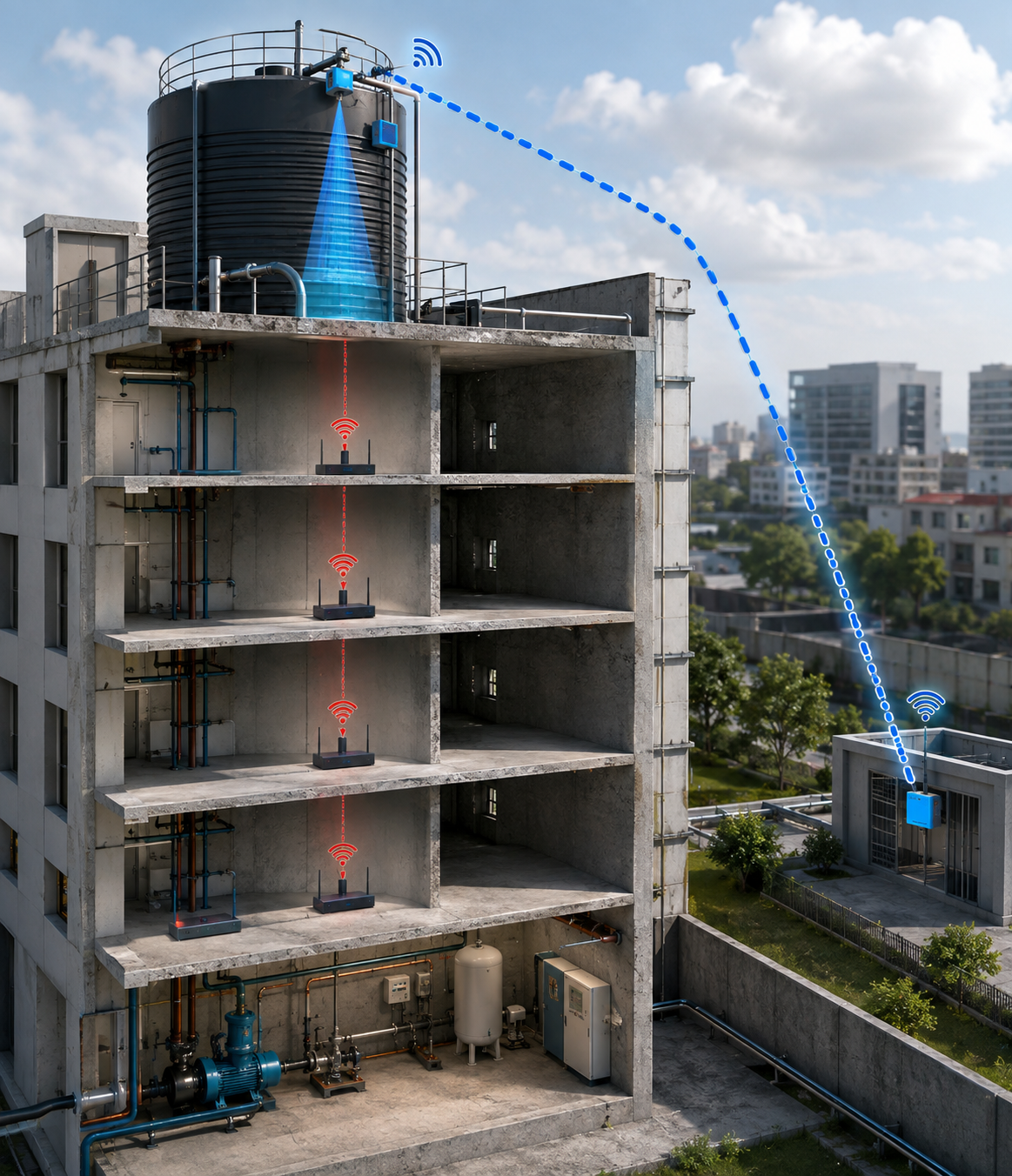
Monitoring water tanks located far from buildings, rooftops, pump rooms, or control centers can be challenging. Wired connections may require extensive cabling, while Wi-Fi may not provide reliable coverage across long distances or multiple floors.
This is where a water level sensor with LoRa can offer a practical alternative. LoRa technology combines long-range wireless communication with low power consumption, making it suitable for remote water-level monitoring applications.
A Water Tank Level Sensor with LoRa can measure the tank level and wirelessly transmit the information to a gateway, allowing facility teams to monitor tanks without requiring a separate Wi-Fi connection at every location.
Water tanks are often installed in locations that aren't easy to access or connect to a conventional network.
For example:
Rooftop tanks may be several floors above the control room.
Underground tanks may be located far from network equipment.
Industrial facilities may have tanks spread across a large area.
Apartment complexes may have multiple tanks in different buildings.
Remote utility tanks may not have convenient wired connectivity.
In these situations, communication range becomes an important factor when selecting a water-level monitoring solution.
A water level sensor with LoRa combines level measurement with long-range wireless communication.
The sensor first measures the distance between the sensor and the water surface. It then transmits the measured data through a LoRa wireless connection to a gateway.
A typical system works like this:
Water Tank → Level Sensor → LoRa Wireless Signal → Gateway → Monitoring Platform
The gateway can then forward the information to a dashboard or application where users can view the tank's current level.
Wi-Fi is excellent for many connected applications, but it isn't always ideal for remote water tanks.
A Water Tank Level Sensor with LoRa can be advantageous when the tank is located far from the network infrastructure.
LoRa is designed for long-range, low-power communication, making it suitable for sensors located far from a central gateway.
This can reduce the need to install Wi-Fi access points near every tank.
Water-level sensors may need to operate for long periods without frequent maintenance.
LoRa's low-power characteristics make it suitable for battery-powered monitoring devices, depending on the sensor's configuration and reporting frequency.
Traditional wired monitoring systems can require communication cables running between tanks and control equipment.
With a water level sensor with LoRa, level data can be transmitted wirelessly, potentially simplifying installation.
A single LoRa gateway can potentially communicate with multiple sensors within its coverage area, depending on the environment and network design.
This makes the technology useful for facilities that need to monitor several tanks from one centralized platform.
Communication technology is only one part of the solution. Buyers should also consider how the water level itself is measured.
A non-contact radar sensor can be particularly useful because it can be installed above the tank and measure the water surface without being submerged.
Combining radar measurement with LoRa communication provides two key capabilities:
Radar → Accurate non-contact level measurement
LoRa → Long-range wireless data transmission
This combination can be useful for rooftop, commercial, industrial, and remote water tanks.
Before selecting a sensor, consider the following factors:
Check whether the sensor can measure the full height of your tank and the expected operating water levels.
Don't rely only on the maximum range mentioned in product specifications. Building structures, walls, terrain, gateway placement, and other environmental factors can influence actual communication performance.
For remote tanks, battery operation may be preferable. Check expected battery life based on the sensor's reporting frequency.
Make sure the sensor can communicate with the selected LoRa gateway and monitoring platform.
Consider whether the sensor can be installed easily above the tank and whether the installation location provides a suitable measurement path.
A good system should make the collected data useful. Look for features such as:
Real-time level monitoring
Low-level alerts
High-level alerts
Historical data
Multiple-tank monitoring
Remote access
Pump status information
A Water Tank Level Sensor with LoRa can do more than provide information.
When integrated with a suitable control system, the water-level data can be used to automate pump operation.
For example:
Water level drops → Sensor detects low level → LoRa sends data → Controller receives information → Pump starts → Tank fills → High level detected → Pump stops
This can reduce manual tank inspections and help facility teams manage water more efficiently.
A water level sensor with LoRa can be considered for a variety of applications, including:
Commercial buildings
Apartment complexes
Hotels
Hospitals
Schools and institutions
Industrial facilities
Warehouses
Large residential communities
Remote water storage facilities
The suitability will depend on the required measurement range, communication environment, installation conditions, and system architecture.
If your water tank is located far from your monitoring point, choosing the right communication technology is just as important as choosing the right level sensor.
A Water Tank Level Sensor with LoRa offers a combination of long-range wireless connectivity and low-power operation, making it a strong option for remote and distributed tank monitoring.
When paired with non-contact radar measurement, a water level sensor with LoRa can provide a practical solution for monitoring rooftop, commercial, industrial, and hard-to-reach tanks while also creating a foundation for automated pump control and smarter water management.

