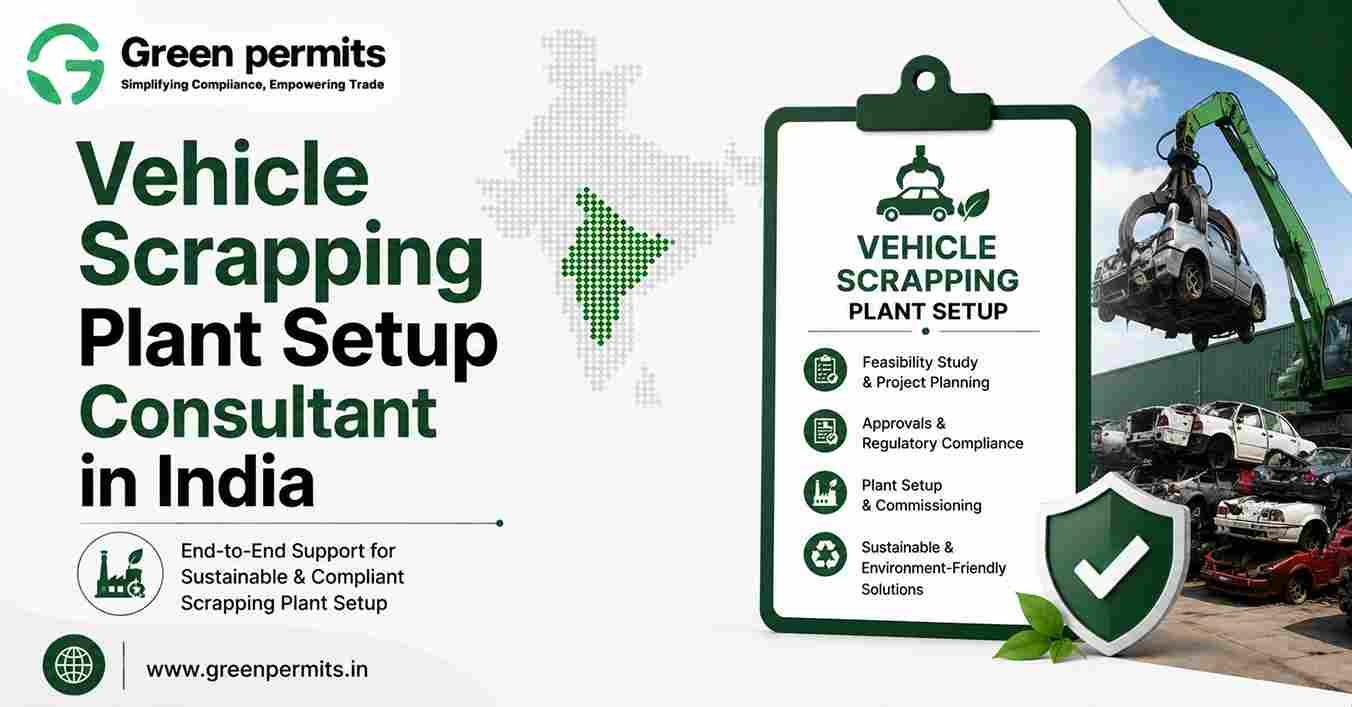
Vehicle Scrapping Plant Setup Consultant in India

Vehicle Scrapping Plant Setup Consultant in India plays an important role for businesses planning to enter the organized vehicle recycling and end-of-life vehicle management sector. With rising vehicle ownership, old vehicle replacement, pollution control requirements, and the formal scrapping policy framework, vehicle scrapping has become a growing business opportunity in India.

A vehicle scrapping plant is generally known as a Registered Vehicle Scrapping Facility, or RVSF. It is a facility where old, unfit, damaged, seized, abandoned, or end-of-life vehicles are scientifically dismantled, depolluted, segregated, recycled, and disposed of in an environmentally sound manner.

End-of-life vehicles contain useful materials such as steel, aluminium, copper, plastic, rubber, glass, tyres, batteries, and other recyclable components. At the same time, they may also contain hazardous materials such as engine oil, brake fluid, coolant, fuel residue, batteries, airbags, and other components that require safe handling.

A Vehicle Scrapping Plant Setup Consultant helps businesses plan the project, select suitable land, prepare the DPR, obtain approvals, register as RVSF, comply with pollution control requirements, and manage ongoing ELV EPR compliance.

What is a Vehicle Scrapping Plant?

A vehicle scrapping plant is a facility where end-of-life vehicles are received and processed through a formal dismantling and recycling system.

The plant generally performs activities such as:

  • Vehicle receiving and documentation
  • Vehicle identity verification
  • Depollution of vehicles
  • Removal of fluids and hazardous components
  • Dismantling of reusable parts
  • Segregation of metals, plastics, rubber, glass, and tyres
  • Cutting or shredding of vehicle body
  • Storage of recovered materials
  • Transfer of recyclable materials to authorized recyclers
  • Safe disposal of non-recyclable waste

The purpose of a vehicle scrapping plant is to replace informal dismantling with organized, traceable, and environmentally compliant vehicle recycling.

Why Vehicle Scrapping Plant Setup is Important

Vehicle scrapping is important because old and unfit vehicles may cause higher emissions, road safety risks, poor fuel efficiency, and environmental problems. Scientific scrapping helps recover valuable resources and reduce pollution from informal dismantling.

A vehicle scrapping plant helps in:

  • Reducing old and unfit vehicles from roads
  • Supporting organized recycling
  • Recovering valuable metals and materials
  • Reducing informal scrap market practices
  • Managing hazardous vehicle components safely
  • Supporting circular economy
  • Creating employment opportunities
  • Supporting ELV EPR compliance
  • Reducing environmental pollution
  • Improving vehicle lifecycle management

With ELV EPR compliance becoming active, RVSFs will play an important role in the vehicle recycling ecosystem.

Who Can Set Up a Vehicle Scrapping Plant?

Any eligible business entity can set up a vehicle scrapping plant after obtaining required approvals and registrations.

The following entities may set up a vehicle scrapping facility:

  • Private limited companies
  • Limited liability partnerships
  • Partnership firms
  • Existing recycling companies
  • Automobile sector businesses
  • Waste management companies
  • Steel recycling businesses
  • Scrap processing companies
  • Industrial investors
  • Logistics and fleet management companies
  • Entrepreneurs entering vehicle recycling
  • Joint ventures with automobile or recycling companies

Before starting the project, the business must check land suitability, investment requirement, machinery, pollution control needs, registration process, and market potential.

What is RVSF Registration?

RVSF Registration means registration as a Registered Vehicle Scrapping Facility under the applicable vehicle scrapping framework.

An RVSF is authorized to receive and scrap eligible vehicles through a defined process. The facility must follow technical, environmental, safety, recordkeeping, and digital compliance requirements.

RVSF registration helps ensure:

  • Legal vehicle scrapping operations
  • Traceable vehicle disposal
  • Proper depollution and dismantling
  • Safe handling of hazardous components
  • Digital records of scrapped vehicles
  • Certificate-related compliance
  • Support for ELV EPR obligations
  • Environmentally sound recycling practices

A vehicle scrapping plant should not operate informally without required registration and pollution control approvals.

Role of Vehicle Scrapping Plant Setup Consultant

A Vehicle Scrapping Plant Setup Consultant helps businesses manage the complete project setup and approval process.

Consulting support generally includes:

  • Project feasibility assessment
  • Land and site suitability review
  • DPR preparation
  • Approval checklist preparation
  • RVSF registration support
  • Consent to Establish filing
  • Consent to Operate filing
  • CPCB ELV portal support
  • Pollution control compliance planning
  • Machinery planning support
  • Process flow and layout support
  • Document preparation
  • Query response support
  • Inspection coordination
  • Ongoing compliance advisory

A consultant helps businesses avoid wrong planning, incomplete documentation, unsuitable land selection, and approval delays.

Approvals Required for Vehicle Scrapping Plant Setup

Setting up a vehicle scrapping plant requires multiple approvals depending on the state, facility size, process, land location, and waste handling activities.

Common approvals may include:

  • Company registration
  • GST registration
  • Land use approval
  • Factory licence, if applicable
  • Consent to Establish from SPCB
  • Consent to Operate from SPCB
  • RVSF registration
  • CPCB ELV portal registration, where applicable
  • Hazardous waste authorization, where applicable
  • Fire NOC, where required
  • Building plan approval
  • Trade licence, where applicable
  • Electricity connection approval
  • Weighbridge approval, where applicable
  • Labour and safety compliance approvals

The exact approval requirement should be checked before land purchase or project investment.

Documents Required for Vehicle Scrapping Plant Setup

Proper documentation is essential for approval and registration.

Common documents may include:

  • Company Incorporation Certificate
  • PAN Card
  • GST Registration Certificate
  • Land ownership or lease agreement
  • Site layout plan
  • Factory layout plan
  • Project report
  • Detailed project report
  • Process flow chart
  • Machinery details
  • Installed capacity details
  • Pollution control system details
  • Fire safety plan
  • Waste storage area details
  • Hazardous waste handling plan
  • Vehicle depollution process details
  • Material recovery plan
  • Manpower details
  • Consent to Establish
  • Consent to Operate
  • Authorization letter
  • Authorized signatory documents
  • Undertaking or declaration

Additional documents may be required depending on state policy, RVSF registration requirements, and the type of vehicles proposed to be scrapped.

Machinery Required for Vehicle Scrapping Plant

The machinery requirement depends on the capacity and process design of the facility.

Common machinery and equipment may include:

  • Vehicle lifting equipment
  • Depollution station
  • Fluid draining system
  • Oil collection system
  • Fuel recovery system
  • Battery removal tools
  • Tyre removal equipment
  • Dismantling tools
  • Gas cutting equipment, where permitted
  • Hydraulic shearing machine
  • Baling press
  • Weighbridge
  • Material handling equipment
  • Forklift or crane
  • Storage bins
  • Fire safety equipment
  • Air pollution control system
  • Wastewater treatment system, where required

Machinery should be selected after reviewing safety, capacity, environmental compliance, and material recovery goals.

Vehicle Scrapping Plant Setup Process

The setup process includes feasibility study, site selection, DPR preparation, approval filing, machinery installation, RVSF registration, and operational compliance.

Step 1: Feasibility Study

The first step is preparing a feasibility study for the project.

This includes checking:

  • Vehicle availability
  • Target vehicle categories
  • Land requirement
  • Investment requirement
  • Machinery requirement
  • Labour requirement
  • Recovered material market
  • Approval requirement
  • Pollution control requirement
  • Project profitability

A feasibility study helps determine whether the project is technically and commercially viable.

Step 2: Site Selection

The site should be suitable for industrial and recycling activity.

Important points include:

  • Industrial land use
  • Road access for vehicle movement
  • Sufficient storage space
  • Space for dismantling area
  • Space for depollution area
  • Space for recovered material storage
  • Fire safety suitability
  • Distance from sensitive locations
  • Availability of power
  • Pollution control feasibility

Wrong site selection can lead to approval delays, rejection, or future operational problems.

Step 3: DPR Preparation

A detailed project report is required for planning, approvals, and investment.

The DPR generally includes:

  • Promoter details
  • Plant capacity
  • Land and building details
  • Process description
  • Machinery list
  • Investment details
  • Pollution control measures
  • Waste handling method
  • Safety measures
  • Manpower requirement
  • Revenue model
  • Compliance roadmap

A clear DPR helps authorities and investors understand the project properly.

Before installing machinery or starting construction, the unit may need Consent to Establish from the State Pollution Control Board.

The application generally includes:

  • Unit details
  • Site details
  • Process information
  • Capacity details
  • Pollution control proposal
  • Waste handling details
  • Storage details
  • Supporting documents

CTE approval allows the unit to proceed with setup as per approved conditions.

Step 5: Install Machinery and Infrastructure

After setup approval, the business can install machinery and prepare the facility.

This stage may include:

  • Civil work
  • Machinery installation
  • Depollution bay setup
  • Vehicle storage area preparation
  • Hazardous waste storage area
  • Material segregation area
  • Fire safety system installation
  • Pollution control system installation
  • Worker safety arrangement
  • Digital recordkeeping system

The facility should be developed as per approved layout and compliance conditions.

After completing setup, the business must obtain Consent to Operate before starting commercial operations.

The authority may verify:

  • Installed machinery
  • Depollution system
  • Waste storage arrangement
  • Pollution control systems
  • Fire safety measures
  • Vehicle handling process
  • Compliance with CTE conditions
  • Site readiness

CTO is required before regular scrapping operations begin.

Step 7: Apply for RVSF Registration

After preparing the facility and documents, the applicant can proceed with RVSF registration as per applicable requirements.

The application may include:

  • Business details
  • Site details
  • Facility layout
  • Machinery details
  • Process flow
  • Capacity details
  • Consent documents
  • Safety documents
  • Pollution control documents
  • Supporting declarations

The authority may review the application and conduct verification before granting registration.

Step 8: CPCB ELV Portal Compliance

Under the ELV EPR framework, registered entities may also need to manage compliance through the CPCB ELV portal.

This may include:

  • RVSF portal registration
  • Vehicle scrapping data upload
  • Certificate generation support
  • Certificate transfer records
  • Return filing
  • Compliance record management
  • Query response
  • Annual reporting support

Digital compliance will become increasingly important for RVSFs working with vehicle producers and EPR obligations.

Step 9: Start Operations and Maintain Compliance

After approvals and registration, the vehicle scrapping plant can begin operations.

Ongoing compliance may include:

  • Maintaining vehicle receipt records
  • Maintaining owner documents
  • Maintaining depollution records
  • Maintaining scrapping records
  • Filing portal returns
  • Managing recovered material records
  • Handling hazardous waste safely
  • Renewing approvals on time
  • Keeping inspection records ready
  • Following consent and registration conditions

Compliance must be maintained continuously after plant setup.

Cost of Vehicle Scrapping Plant Setup

The cost of setting up a vehicle scrapping plant depends on several factors.

These include:

  • Plant capacity
  • Land cost
  • Building cost
  • Machinery cost
  • Depollution system cost
  • Pollution control system cost
  • Fire safety system cost
  • Digital system cost
  • Approval and registration cost
  • Labour and manpower cost
  • Working capital requirement
  • Consultant professional charges

A small dismantling facility may require lower investment, while an integrated vehicle scrapping and material recovery plant may require higher investment.

Timeline for Vehicle Scrapping Plant Setup

The timeline depends on project size, land readiness, approval processing, machinery procurement, installation, and registration review.

The general timeline may include:

  • Feasibility study: 3 to 7 working days
  • DPR preparation: 5 to 15 working days
  • Consent to Establish: depends on SPCB processing
  • Machinery procurement: depends on supplier
  • Machinery installation: depends on plant capacity
  • Consent to Operate: depends on inspection and approval
  • RVSF registration: depends on authority review
  • CPCB ELV portal registration: depends on document review and query response

Businesses should plan timelines carefully because approvals and setup can take several months.

Common Mistakes During Vehicle Scrapping Plant Setup

Many projects face delays because of poor planning or incomplete compliance.

Common mistakes include:

  • Selecting unsuitable land
  • Starting setup without CTE
  • Preparing weak DPR
  • Not planning depollution systems
  • Ignoring hazardous waste handling
  • Installing wrong machinery
  • Missing fire safety planning
  • Submitting incomplete documents
  • Starting operations without CTO
  • Not applying for RVSF registration
  • Not maintaining digital records

Professional guidance helps avoid these mistakes and improves approval efficiency.

Benefits of Setting Up Vehicle Scrapping Plant

A vehicle scrapping plant provides business, environmental, and compliance benefits.

It helps in:

  • Recovering valuable metals and materials
  • Supporting ELV EPR compliance
  • Reducing old and polluting vehicles
  • Creating formal recycling infrastructure
  • Reducing informal dismantling
  • Supporting circular economy
  • Generating employment
  • Improving road and environmental safety
  • Supporting automobile sector sustainability
  • Creating long-term business opportunity

With the growth of organized vehicle scrapping, compliant RVSFs can become important partners for producers, fleet owners, and recycling industries.

Why Work with Vehicle Scrapping Plant Setup Consultant?

Vehicle scrapping plant setup involves technical planning, environmental approvals, RVSF registration, machinery selection, pollution control systems, documentation, and ongoing portal compliance.

An experienced consultant can assist with:

  • Feasibility assessment
  • Site suitability review
  • DPR preparation
  • Approval checklist preparation
  • Consent to Establish filing
  • Consent to Operate filing
  • RVSF registration support
  • CPCB ELV portal support
  • Document preparation
  • Query response
  • Inspection coordination
  • Compliance advisory

Professional support helps businesses reduce delays and complete the setup process correctly.

Learn More About Vehicle Scrapping Plant Setup

If you are planning to start a vehicle scrapping business in India, understanding approvals, plant setup requirements, machinery, investment, RVSF registration, and ELV compliance is essential before starting.

Read the complete guide here:

👉 https://www.greenpermits.in/07/vehicle-scrapping-plant-setup-consultant-in-india/

📞 Get Expert Assistance for Vehicle Scrapping Plant Setup

If you need help with Vehicle Scrapping Plant Setup or RVSF compliance, Green Permits Consulting can guide you efficiently.

🌐 Website: https://www.greenpermits.in/

📞 Phone: +91 78350 06182

📧 Email: wecare@greenpermits.in

Book a consultation with Green Permits Consulting today for expert assistance with Vehicle Scrapping Plant Setup Consultant services in India and complete ELV compliance support.

Talkfever - Growing worldwide https://talkfever.com