English
 Arabic
 French
 Spanish
 Portuguese
 Deutsch
 Turkish
 Dutch
Dutch
 Italiano
 Russian
 Romaian
 Portuguese (Brazil)
 Greek
Greek
The Future of Gambling Site Verification Services
Sports |
2026-03-14 11:09:02
 Social Networth OS
 Creator Commerce
 Launch Startup
 Global News
 Creator Award
 Talkfever App
See All
Talkfever App
See All

Upgrade to Pro
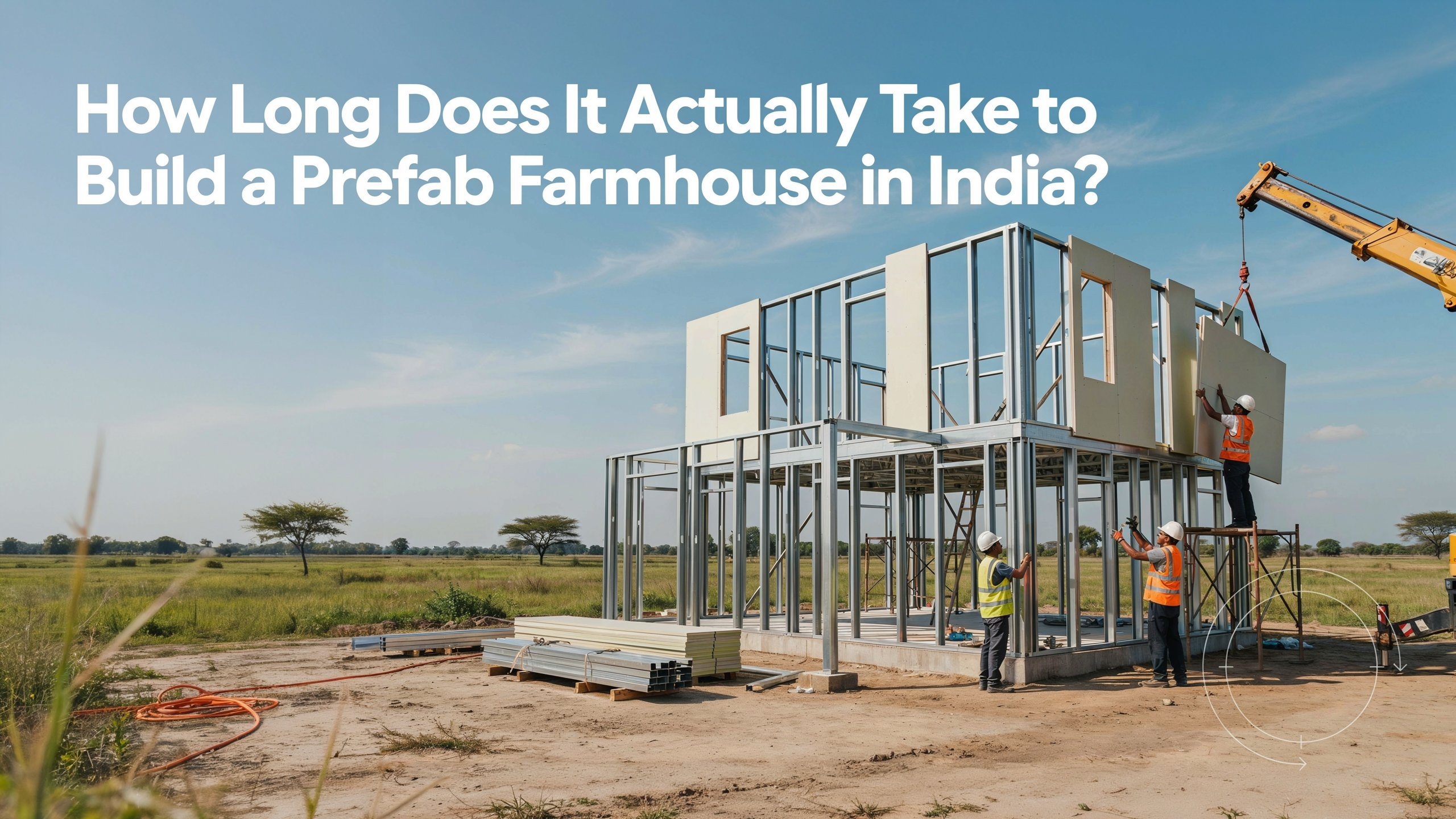
I get this question in almost every first meeting with a client. Someone walks in with a piece of agricultural land, a rough idea in their head, and an assumption that building a farmhouse is going to eat up a year or more of their life. I understand why. Most people have seen a relative's traditional house construction drag on for eighteen months because of labour shortages, monsoon delays, or a mason who disappeared halfway through the job.
Prefabricated construction has changed that expectation, and for good reason. When you build a prefab farmhouse in India, a large part of the structure is manufactured in a controlled factory environment while your site is being prepared in parallel. That single shift, building off-site while the ground is still being leveled, is what compresses timelines from months into weeks in many cases.
In this article, I want to walk you through what actually determines how long your project will take, what a realistic stage-by-stage timeline looks like, where delays usually creep in, and how to keep your own project on track based on what I have seen across hundreds of farmhouse builds over the years.
Timeline isn't just a curiosity question. It affects your budgeting, because labour and material costs shift the longer a project runs. It affects how you plan approvals, since some permissions have validity windows. It affects your own personal planning too, whether that's a family event you want to host at the farmhouse or simply wanting to stop paying rent somewhere else.
Clients who go in with a realistic timeline make better decisions at every stage. Clients who go in expecting magic tend to get frustrated over things that are actually completely normal.
No two farmhouse projects take exactly the same amount of time, and anyone who tells you otherwise without seeing your site is guessing. The real timeline depends on a combination of factors.
Size is the obvious one. A compact 1,200 square foot weekend farmhouse moves faster than a sprawling 4,000 square foot family home. Design complexity matters just as much. A simple rectangular layout with standard rooflines will always be quicker than a design with multiple wings, curved elements, or double-height spaces.
Site location plays a bigger role than most people expect. A plot that's easy to reach with trucks and cranes moves faster than land tucked behind narrow village roads where every delivery needs careful planning. Foundation work depends on your soil type, and this is something I always recommend testing early rather than assuming.
Weather is a genuine factor, particularly if your build window overlaps with monsoon season in your region. Local approvals, which vary quite a bit from state to state and even panchayat to panchayat, can add unpredictable time if they aren't sorted out early. And utility connections, water, electricity, sometimes borewell work, often run on a schedule that has nothing to do with your construction team.
Let me break this down into the stages I walk every client through, since seeing the process laid out this way usually removes a lot of the anxiety.
This is where we sit with you and actually understand what you need. How many rooms, what kind of layout suits your land, what materials you're drawn to. Once we have a clear picture, our team moves into layout planning and material selection. Design approval from you is the final gate before anything moves to engineering. This stage typically takes one to three weeks depending on how quickly decisions get finalized on your end.
Once the design is locked, our engineering team prepares detailed drawings and structural components get fabricated at the factory. Every panel and frame goes through quality inspection before it leaves. The real advantage here is that this manufacturing happens while your site is still being worked on. You're not waiting for one to finish before the other starts.
While manufacturing is underway, your site needs foundation work, land leveling, and utility planning. I always tell clients this stage needs to be fully complete before delivery trucks arrive. A site that isn't ready when components show up causes real delays, and it's one of the most avoidable ones.
Once components are ready and your site is prepared, logistics kick in. We schedule deliveries carefully and take precautions to protect fabricated panels and frames during transport, especially over longer distances or rougher roads.
This is the part clients find most satisfying to watch. Structural assembly happens fast because components arrive ready to fit together. Roofing, wall panels, doors, and windows go up in a matter of days rather than weeks, which is a stark contrast to conventional brick and mortar timelines.
Electrical work, plumbing, flooring, painting, bathroom fittings, and kitchen installation happen in this final stretch. This stage takes real care, since rushing finishing work is where quality issues tend to show up later. I never recommend cutting corners here just to save a few days.
In my experience, delays rarely come from the prefab process itself. They come from late design changes requested after manufacturing has started, delayed approvals from local authorities, unexpected weather during transport or installation, poor site accessibility discovered too late, utility connection delays that are entirely out of the builder's hands, and changes requested mid-construction that require rework.
Almost every serious delay I have seen over the years traces back to one of these, and almost every one of them was avoidable with better planning upfront.
Factory-controlled manufacturing means your components are built in a consistent, weatherproof environment rather than being at the mercy of site conditions. Parallel site preparation means two workstreams move at once instead of one after another. There's less dependency on large labour crews, which means fewer delays tied to labour availability. Quality control in a factory setting also means fewer on-site corrections later, and material wastage drops significantly compared to conventional construction, where offcuts and errors are far more common.
Finalize your drawings early and resist the urge to keep tweaking them once manufacturing begins. Complete your local approvals before manufacturing starts rather than treating it as a parallel task. Prepare your site well in advance so it's genuinely ready when components arrive. Choose a prefab builder with real farmhouse experience, not just general industrial or commercial background. Avoid mid-project changes wherever possible. And stay in regular contact with your project team so small issues get caught before they become big ones.
Speed is a real advantage of prefab construction, but I want to be honest with you here. Faster isn't automatically better if it comes at the cost of planning or quality. I have seen builders promise unrealistic timelines just to win a contract, and the corners cut to hit those dates usually show up in the finished structure within a year or two.
What actually matters is a timeline built on solid planning, careful engineering, and proper execution at every stage. A well-built prefab farmhouse that takes a few extra weeks will always serve you better than a rushed one that needs repairs down the line.
If there's one thing twenty years in this industry has taught me, it's that the builders who give you an honest, detailed timeline upfront are usually the ones who deliver a structure you'll be happy with for decades. When you're evaluating who to build your farmhouse with, look past the shortest promised completion date and focus on whether the company values planning, transparency, and quality at every stage of the process. That's what actually determines whether your farmhouse experience is a good one.