 English
 Arabic
 French
 Spanish
 Portuguese
 Deutsch
 Turkish
 Dutch
Dutch
 Italiano
 Russian
 Romaian
 Portuguese (Brazil)
 Greek
Greek
 Creator, Content & Commerce (3C)
 IMS for Investors
 Global News
 Vdo Junction
 Talkfever App
A Comprehensive Guide to Easily Get in Touch with SBCGlobal Customer Service?
Home |
2025-04-16 07:57:11
India's merchandise exports crossed USD 437 billion in FY 2023–24 (Ministry of Commerce and Industry), with DGFT's Foreign Trade Policy 2023 targeting USD 2 trillion by 2030. Yet across every major export corridor EU, US, UK, GCC, Australia Indian manufacturers are losing shipments, markets, and revenue to one avoidable problem: absence of structured export compliance planning before product launch.
A factory approval in India does not translate into market access abroad. The WTO TBT Committee received 3,800+ notifications of new or amended technical regulations in a single recent year. Export compliance advisory for manufacturers entering new markets is the discipline that resolves this before the first shipment moves, not after it is detained.
What makes it more complex than most manufacturers anticipate:
• Not a single approval. CE Marking, FDA clearance, G-Mark, UKCA none recognise BIS or domestic Indian certifications. Each market requires individual compliance.
• Compliance failures are public. FDA Import Alerts and EU Safety Gate recall notices are searchable by manufacturer name and persist for years, flagging every subsequent shipment.
• Non-tariff barriers dominate. OECD analysis confirms technical regulations not tariffs are now the primary obstacle to manufactured goods trade globally.
Global regulatory enforcement has intensified across every major trade corridor. Filing a Shipping Bill and Certificate of Origin is no longer sufficient.
• EU Market Surveillance Regulation (EU) 2019/1020 mandates an EU-based Responsible Person for every product placed on the EU market by an offshore manufacturer. Without this designation, customs blocks the shipment regardless of actual product compliance.
• US FDA PREDICT system scores every import shipment for compliance risk before it reaches a US port. High-risk shipments face automatic detention with no advance notice to the exporter.
• US CBP enforcement reported over USD 1.5 billion in unpaid duties and penalties recovered in a single fiscal year. Customs enforcement is an active revenue mechanism, not a passive documentation check.
• DGFT eBRC and CBIC Shipping Bill regulations impose pre- and post-shipment compliance obligations on Indian exporters. Errors in these filings trigger FEMA scrutiny through RBI.
• BIS CRS ≠ CE Marking. BIS Compulsory Registration Scheme governs electronics for domestic sale. CE Marking under the Low Voltage Directive (2014/35/EU) and Radio Equipment Directive governs the same product in Europe. These are entirely separate frameworks. Satisfying one does not satisfy the other.
Non-compliance is documented, recurring, and expensive. These figures come from official regulatory enforcement data.
• EUR 200–400 per container per day demurrage rate at major EU ports (Rotterdam, Hamburg) beyond the free period.
• EUR 4,000–8,000 per container cost of a 2–3 week compliance review hold, before any penalties or corrective action.
• CBIC data confirms documentation errors are among the leading causes of export shipment delays from Indian ports, particularly for multi-clearance consignments.
• EU Safety Gate (Regulation EU 2023/988) publishes weekly recall alerts. Electronics, machinery, PPE, textiles, and children's products consistently appear.
• EUR 100,000 to several million euros documented cost range per recall incident, covering product withdrawal, destruction, regulatory communications, and consumer remedies.
• Up to 4× unpaid duties penalty exposure under the US Tariff Act of 1930 for incorrect customs declarations, including HS code errors.
• FDA Import Alert listing publicly searchable, persists by manufacturer name, flags every subsequent shipment for automatic examination. Recovery takes 12–36 months on average.
• UNCTAD 2023 World Investment Report confirms regulatory compliance capability is formally assessed by foreign distributors during supplier qualification. Non-compliance incidents directly affect supplier scorecards and long-term procurement relationships.
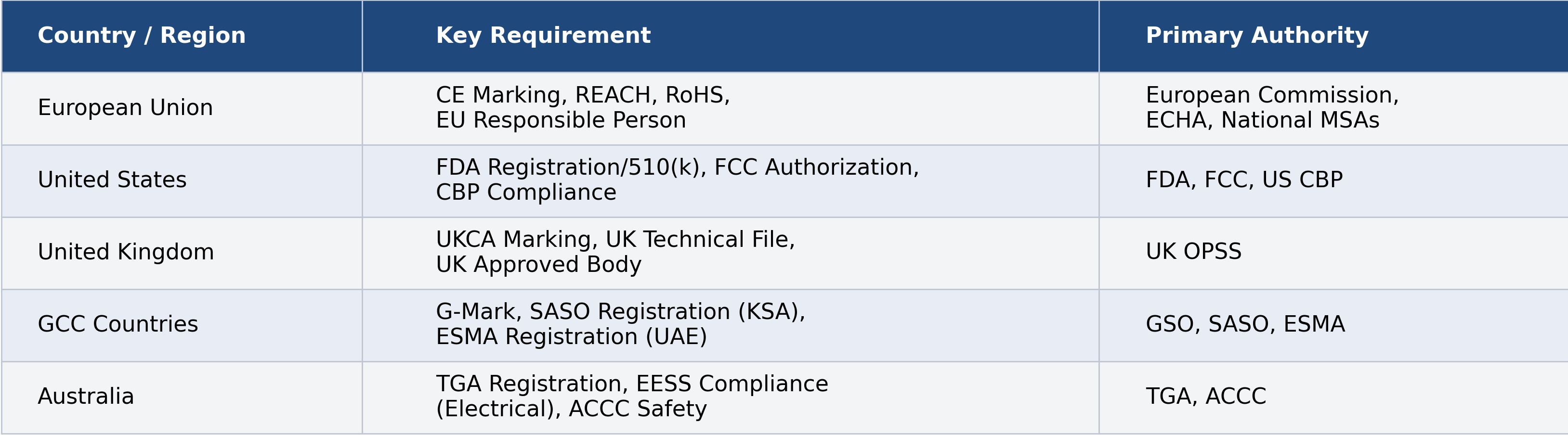
International market entry compliance requires assessment across multiple product and regulatory dimensions. There is no single certification that satisfies all markets.
• CE Marking (EU) mandatory for 26 product categories under EU Directives (Machinery 2006/42/EC, LVD 2014/35/EU, RED, MDR, PPE Regulation). A manufacturer's self-declaration supported by technical documentation and, where required, Notified Body assessment.
• UKCA Marking (UK) post-Brexit mandatory marking for Great Britain. CE Marking does not automatically satisfy UKCA. Separate UK-registered Approved Bodies and UK-specific technical documentation required.
• FDA Clearance (USA) 510(k) or PMA mandatory for medical devices. FDA Prior Notice mandatory for all food shipments. FSSAI registration does not substitute for FDA requirements under any mutual recognition arrangement.
• G-Mark (GCC) GSO certification covering Saudi Arabia, UAE, Kuwait, Bahrain, Oman, Qatar. Testing at GSO-recognized labs plus ESMA (UAE) or SASO (Saudi Arabia) registration. Non-registered products are returned or destroyed at the exporter's cost.
• EU REACH (EC 1907/2006) and RoHS (2011/65/EU) REACH restricts hazardous substances in chemicals and manufactured articles. ECHA registration mandatory above 1 tonne/year. RoHS mandatory for all EEE sold in the EU. MoEFCC domestic clearance does not satisfy either.
• TGA (Australia) mandatory pre-market registration for medical devices, pharmaceuticals, and complementary medicines before any Australian commercial activity.
UNCTAD's 2023 Trade Facilitation Report confirms documentation-related delays add 2–3 days per shipment on average significantly longer when destination-country compliance documentation is incomplete.
• IEC (Import Export Code) issued by DGFT; mandatory for every export shipment. Discrepancies in IEC details cause customs filing rejections.
• Shipping Bill via CBIC ICEGATE HS code errors, declared value mismatches, or product description inconsistencies trigger automatic examination holds.
• Certificate of Origin preferential CoOs required under India-UAE CEPA, India-ASEAN FTA, and applicable bilateral agreements to avail reduced duty rates.
• eBRC via RBI-designated channels discrepancies between eBRC and shipping documentation attract FEMA scrutiny.
• Sector-specific: APEDA (agricultural exports), MPEDA (marine exports), CDSCO (pharma/medical devices) mandatory before Shipping Bill is filed.
• Incorrect HS code disqualifies from FTA preferential duty, triggers anti-dumping investigation, affects DGFT duty drawback eligibility under CBIC Drawback Scheme.
• Inconsistent commercial documents US CBP's ACE system and EU's ICS2 flag mismatches automatically. Both trigger examination holds with no advance warning.
• Expired or variant-mismatched certifications certifications covering a product variant different from the one shipped are treated as non-compliance. Each occurrence resets the clearance timeline.
Manufacturers entering international markets consistently repeat the same compliance mistakes. Each carries quantifiable business consequences.
• Assuming one certification works globally. CE Marking is not recognised in the US. FDA clearance is not recognised in the EU. BIS is not recognised anywhere abroad. Every market requires independent compliance under export regulatory requirements specific to that jurisdiction.
• Ignoring labelling rules. Labelling non-compliance is the most frequently cited reason for food product holds at US FDA ports. EU Safety Gate listings regularly cite absent safety warnings and incorrect unit declarations as the primary failure.
• Missing product registration. Manufacturers entering GCC or Australian pharmaceutical, medical device, or pesticide markets frequently discover post-shipment that pre-market registration mandatory before any commercial sale was never initiated. Product is returned at the exporter's cost.
• Incorrect HS code classification. A wrong HS code disqualifies preferential FTA duty, triggers anti-dumping investigation, and affects duty drawback eligibility compounding across multiple shipments before detection.
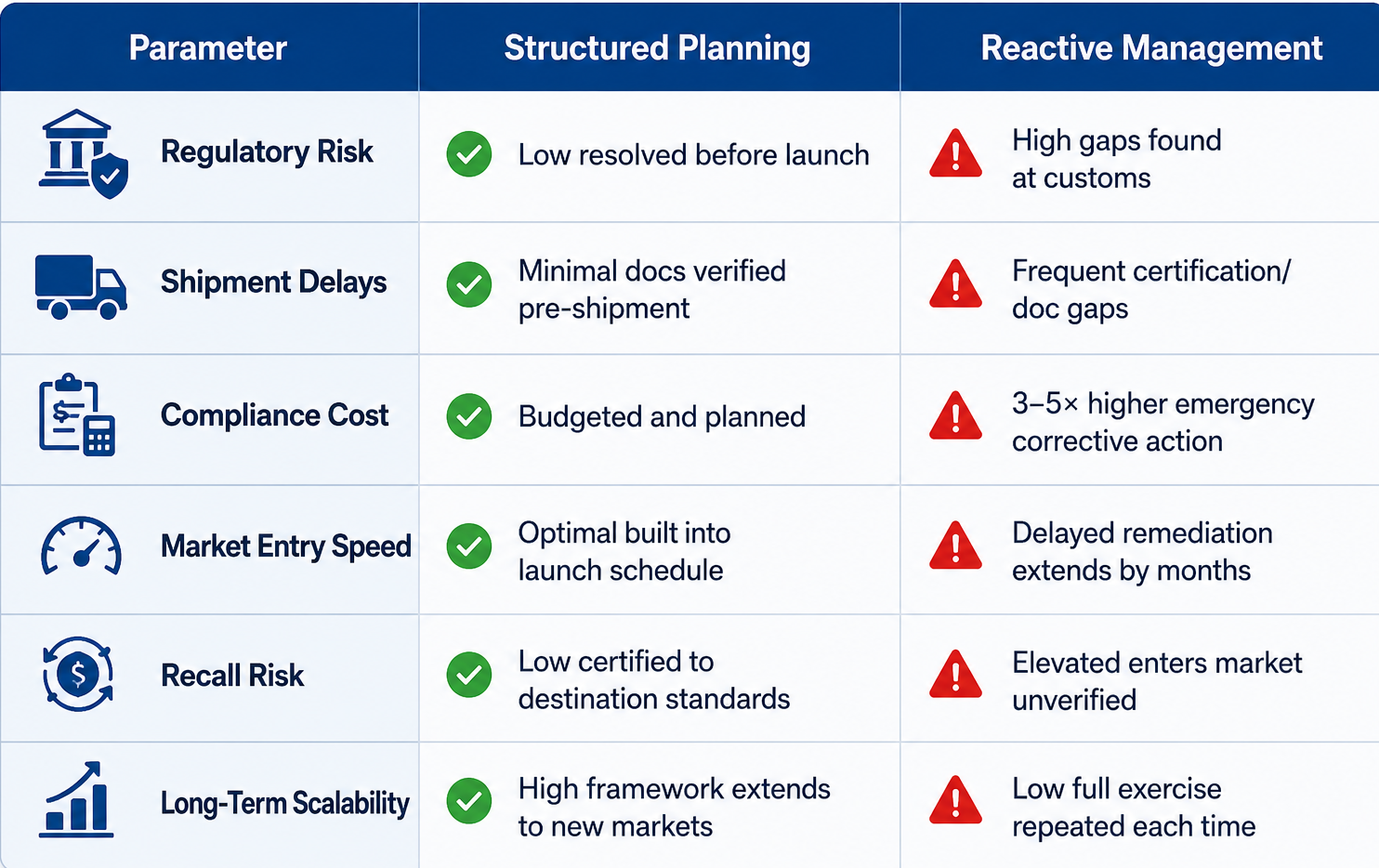
• Late compliance planning. Per OECD regulatory compliance cost analysis, post-development remediation costs 3–5× more than compliance integration at the design stage. Late planning forces rushed testing, emergency label changes, and delayed launches directly hitting PLI-linked commissioning milestones.
IMARC Engineering provides end-to-end export compliance advisory for manufacturers entering new markets covering EU, US, UK, GCC, and Australian corridors across industrial, engineering, consumer goods, and regulated product sectors.
• Regulatory Applicability Assessment determine whether CE, UKCA, FDA, G-Mark, TGA, or sector-specific Indian frameworks (APEDA, MPEDA, CDSCO, BIS) apply before filing anything. Wrong-framework submissions cause rejections before the process begins.
• Compliance Gap Assessment structured product-specific gap analysis against all applicable directives, standards, and registration requirements for each target market. Output: prioritised action plan with timelines, costs, and risk ratings.
• Product Registration Support dossier preparation, authority liaison, and status tracking for regulated categories (medical devices, pharmaceuticals, controlled chemicals). Registration timelines managed proactively not reactively.
• Documentation Review pre-shipment review of commercial documentation, labelling artwork, Safety Data Sheets, and technical files for completeness and internal consistency.
• Export Readiness Assessment pre-launch verification of certification status, documentation completeness, and registration currency. Evidence-based launch approval basis for management.
|
For manufacturers with PLI-linked commissioning deadlines, multi-state expansion plans, or regulated product categories requiring pre-market registration, IMARC Engineering's global market compliance strategy services are structured to reduce timeline risk at every stage of market entry. |
Talk to Our Export Compliance Team https://www.imarcengineering.com/contact?service=contract-manufacturer-identification
India's export ambitions are well-founded — FTP 2023, PLI schemes across 14 sectors, NICDP industrial corridors, and NSWS digital approvals collectively support substantially higher export volumes. What remains the critical gap is translating that ambition into compliant, cleared, commercially available product in foreign markets.
Compliance failures documented across RAPEX recall databases, FDA Import Alert records, CBP enforcement statistics, and UNCTAD trade facilitation assessments are expensive, reputation-damaging, and frequently avoidable. The cost of a structured export compliance planning programme is invariably lower than the cost of reactive remediation after a shipment is detained, a product is recalled, or a distributor relationship is lost.
Manufacturers who integrate export compliance advisory for manufacturers entering new markets into their market entry strategy from the outset gain a structural advantage: faster market entry, fewer disruptions, lower long-term compliance cost, and regulatory standing that scales to additional markets. The question is not whether product compliance for exports is worth the investment it is whether a manufacturer can afford to enter international markets without it.


