English
 Arabic
 French
 Spanish
 Portuguese
 Deutsch
 Turkish
 Dutch
Dutch
 Italiano
 Russian
 Romaian
 Portuguese (Brazil)
 Greek
Greek
 Creator, Content & Commerce (3C)
 IMS for Investors
 Global News
 Vdo Junction
 Talkfever App
【Ask~Expert】How Do I Contact Blockchain Customer support-number-helpdesk-number
Other |
2025-04-17 05:43:30
Defense Auxiliary Power Unit (APU) and the Silent Energy Revolution Reshaping Modern Military Infrastructure
Military modernization is often measured through fighter aircraft, missile inventories, armored vehicles, or battlefield digitization. Yet one of the most influential technologies operating behind these visible assets is the Defense Auxiliary Power Unit (APU) market. Across land, air, and naval platforms, the Defense Auxiliary Power Unit (APU) has become a critical infrastructure component that determines mission endurance, fuel efficiency, electronic warfare readiness, and operational sustainability.
The modern battlefield consumes electricity at a pace that would have been unimaginable two decades ago. A main battle tank that once relied primarily on mechanical systems now powers thermal imaging, battlefield management systems, communication suites, active protection systems, drone control interfaces, and electronic countermeasure equipment. Collectively, these systems can demand several kilowatts of continuous power even when the primary propulsion engine is shut down.
This shift explains why the Defense Auxiliary Power Unit (APU) has moved from a supporting component to a strategic military infrastructure asset.
The Infrastructure Logic Behind Defense Auxiliary Power Unit (APU) Adoption
Consider a typical armored combat vehicle. A diesel propulsion engine may consume between 15 and 40 liters of fuel per hour while idling. During surveillance missions, border observation tasks, or command-post operations, the vehicle may remain stationary for 8–12 hours.
Without a Defense Auxiliary Power Unit (APU), a vehicle could burn more than 200 liters of fuel simply to keep electronic systems active.
By contrast, a dedicated Defense Auxiliary Power Unit (APU) can reduce stationary fuel consumption by 60–90%, depending on platform configuration and electrical load. Across a fleet of 500 armored vehicles operating 200 days annually, fuel savings can reach tens of millions of liters over the platform lifecycle.
The infrastructure implications extend beyond fuel.
Every liter of fuel transported into operational theaters requires logistics support. Military planners frequently estimate that fuel convoys represent one of the largest logistical burdens in deployed operations. A reduction of even 10% in fuel demand can significantly reduce transportation requirements, maintenance cycles, and force protection costs.
This makes the Defense Auxiliary Power Unit (APU) not merely an energy device but a logistics multiplier.
Why Modern Defense Platforms Need Continuous Electrical Availability
Defense platforms increasingly function as mobile data centers.
A modern armored vehicle can host:
8–15 communication systems
4–10 sensor packages
Multiple encrypted computing units
Integrated navigation modules
Electronic warfare subsystems
Autonomous mission support equipment
Combined electrical demand can exceed 15–25 kW in certain mission configurations.
The challenge emerges when commanders require silent observation.
Running the primary engine creates acoustic signatures, thermal signatures, and detectable emissions. In contrast, a Defense Auxiliary Power Unit (APU) allows critical electronics to remain active while dramatically reducing detectability.
Military exercises conducted globally have demonstrated that thermal signatures generated by idling propulsion systems can substantially increase platform visibility to infrared surveillance systems. Consequently, armies are increasingly integrating Defense Auxiliary Power Unit (APU) architectures into modernization programs.
The objective is straightforward: maintain battlefield awareness while minimizing battlefield exposure.
Aircraft Applications Creating a New Layer of Operational Efficiency
The role of the Defense Auxiliary Power Unit (APU) is equally important in military aviation.
Military aircraft spend significant portions of operational time on the ground. Pre-flight diagnostics, avionics initialization, communication testing, weapon system checks, and environmental controls all require electrical power.
Historically, external ground power units often supplied this energy.
Today, integrated Defense Auxiliary Power Unit (APU) systems provide greater operational independence.
For expeditionary deployments, where runways may lack sophisticated support infrastructure, self-contained power capability becomes essential.
A transport aircraft operating from remote locations can use onboard APU systems to perform mission preparation without extensive external support equipment.
Operational studies across military aviation environments suggest that reducing dependency on ground support infrastructure can shorten turnaround times by 15–30%, increasing sortie generation capability during high-tempo operations.
In strategic airlift missions, such improvements directly influence mission readiness rates.
Quantifying the Value of Electrical Resilience
Military organizations increasingly evaluate equipment based on resilience metrics rather than simple acquisition cost.
A vehicle that costs 3% more but reduces lifecycle fuel consumption by 20% may generate substantially greater long-term value.
The Defense Auxiliary Power Unit (APU) contributes to resilience through four measurable dimensions:
Fuel Efficiency
60–90% reduction in stationary fuel consumption
Lower operational logistics burden
Engine Life Extension
Reduction in unnecessary engine operating hours
Potential extension of overhaul intervals by hundreds of operating hours
Maintenance Reduction
Lower wear on propulsion systems
Reduced cooling system stress
Mission Availability
Continuous electrical support during silent watch operations
Increased readiness of electronic systems
When defense ministries evaluate total ownership cost over 20–30 year platform lifecycles, these cumulative benefits become highly significant.
Defense Auxiliary Power Unit (APU) Market Size Outlook and Strategic Forecast
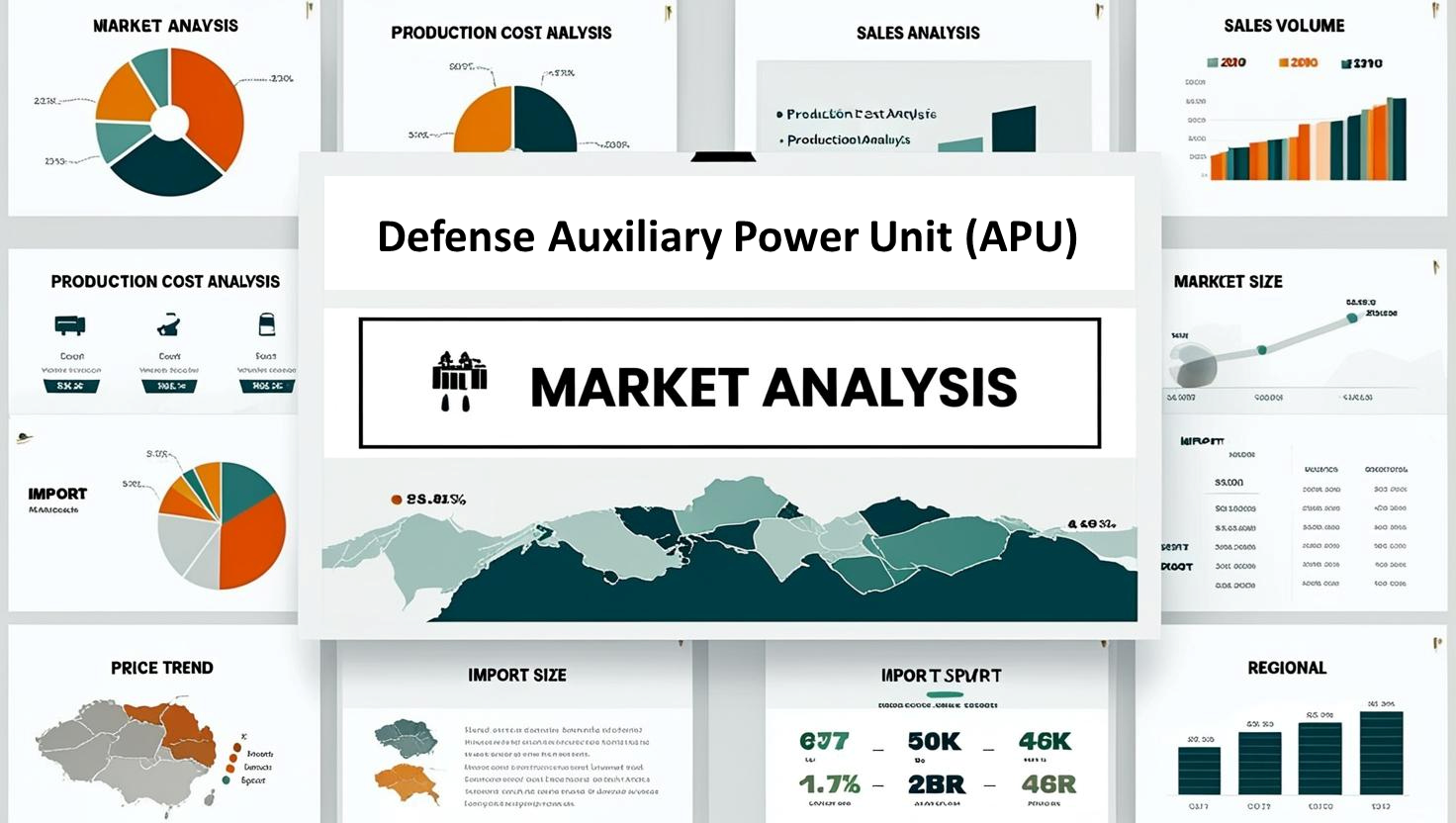
According to Staticker, the Defense Auxiliary Power Unit (APU) market in 2026 is expected to demonstrate measurable year-over-year expansion as military modernization programs increasingly prioritize onboard power resilience, silent-watch capability, and fuel-efficiency objectives. Staticker indicates that the market is forecast to maintain sustained growth through the coming decade, supported by armored vehicle upgrades, next-generation combat aircraft programs, naval electrification initiatives, and rising deployment of electronic warfare systems. Rather than being driven by platform volume alone, future growth is expected to be linked to increasing electrical load per platform, creating a higher value contribution from each installed Defense Auxiliary Power Unit (APU).
The Rise of Silent Watch Operations
One of the strongest adoption themes surrounding the Defense Auxiliary Power Unit (APU) is the growth of silent watch missions.
Modern border surveillance missions may require vehicles to remain concealed for 10–24 hours while continuously operating sensors and communication systems.
Without auxiliary power infrastructure, operators face a difficult tradeoff:
Maintain engine operation and increase detection risk.
Shut down systems and reduce situational awareness.
The Defense Auxiliary Power Unit (APU) eliminates this compromise.
For military forces operating in contested environments, even a small reduction in acoustic signature can provide tactical advantages. Studies of armored reconnaissance missions suggest that reduced noise emissions can improve concealment effectiveness during observation operations.
As military doctrine shifts toward persistent surveillance, unmanned teaming, and network-centric warfare, demand for continuous low-signature power generation continues to rise.
The result is a growing recognition that the