 English
 Arabic
 French
 Spanish
 Portuguese
 Deutsch
 Turkish
 Dutch
Dutch
 Italiano
 Russian
 Romaian
 Portuguese (Brazil)
 Greek
Greek
 Creator, Content & Commerce (3C)
 IMS for Investors
 Global News
 Vdo Junction
 Talkfever App
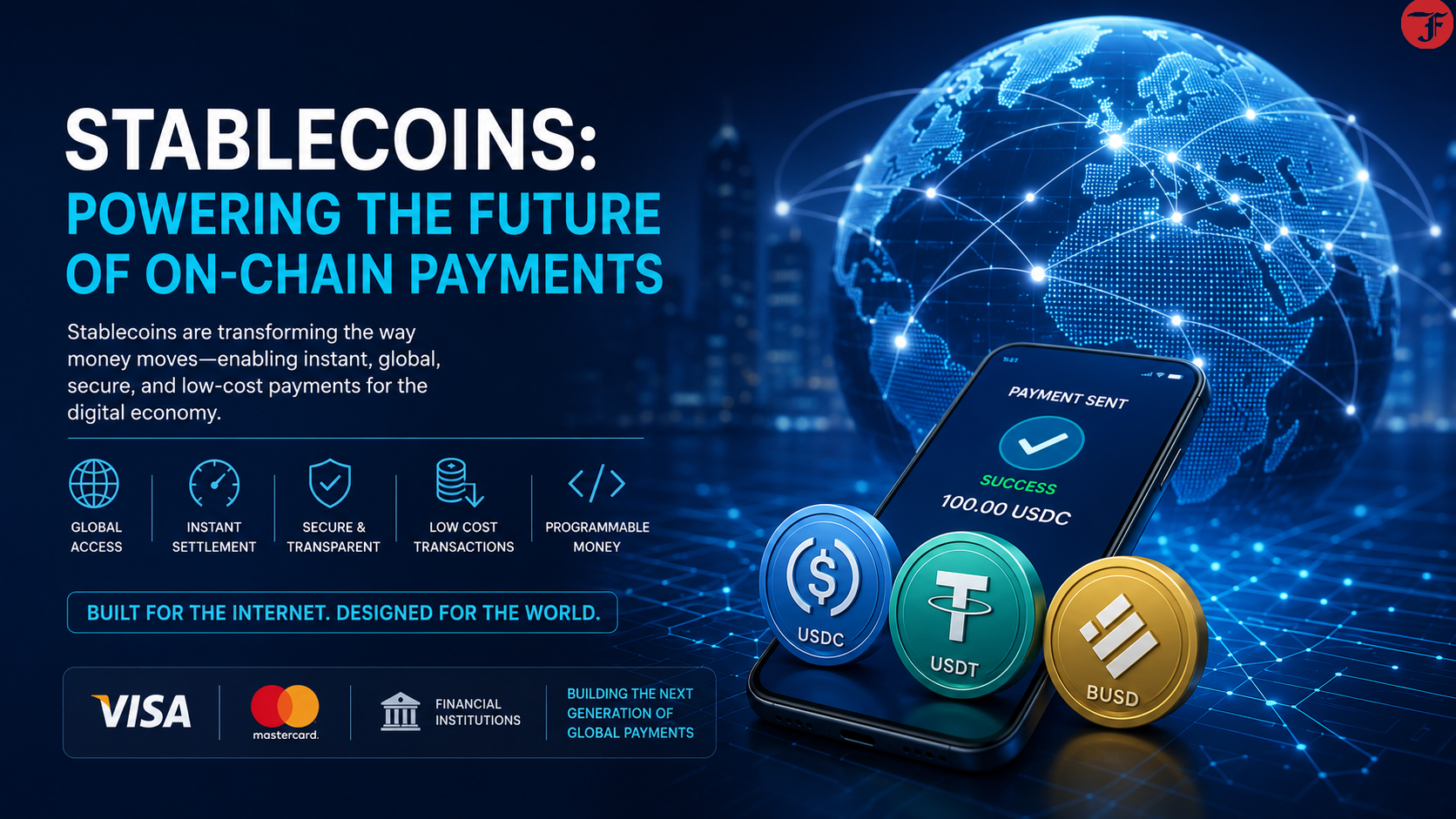
🌐 STABLECOINS ARE POWERING THE FUTURE OF ON-CHAIN PAYMENTS
The next evolution of global payments may not be a new card, bank, or payment app.
It may be programmable money moving natively on the internet.
Stablecoins are emerging as a powerful bridge between traditional finance and blockchain infrastructure—enabling faster settlement, 24/7 transactions, global accessibility, and programmable financial flows.
🔑 Why Stablecoins Matter
1️⃣ ⚡ Faster Settlement
Move value globally without relying entirely on traditional banking hours and multi-day settlement cycles.
2️⃣ 🌍 Borderless Payments
Stablecoins can simplify cross-border transactions and create new possibilities for global commerce and remittances.
3️⃣ 💰 Lower Payment Friction
For certain use cases, blockchain-based payment rails can reduce intermediaries, operational complexity, and settlement costs.
4️⃣ 🤖 Programmable Money
Smart contracts can enable payments that automatically execute based on predefined conditions—opening the door to new financial applications and autonomous transactions.
5️⃣ 🔗 Always-On Financial Infrastructure
On-chain networks operate around the clock, creating the potential for a global payment layer that is available 24/7/365.
🚀 The Bigger Opportunity
The real transformation may not be about replacing traditional finance overnight.
Instead, the future could be hybrid—where banks, fintech companies, payment networks, stablecoins, tokenized deposits, and blockchain infrastructure work together to create a more connected financial ecosystem.
The most important question is no longer:
"Will blockchain change payments?"
The better question is:
"How quickly will payments become natively on-chain?"
📌 I explored this transformation in my latest article:
👉 Stablecoins: Powering the Future of On-Chain Payments
🔗 Read the full article:
https://medium.com/@jckapadia003/stablecoins-powering-the-future-of-on-chain-payments-4975ebccba74?sharedUserId=jckapadia003
💬 What do you think?
Will stablecoins become the backbone of global payments, or will traditional payment networks simply integrate blockchain technology and evolve?
👇 Share your perspective in the comments.
#Stablecoins #OnChainPayments #Blockchain #FinTech #DigitalPayments #Web3 #Crypto #DigitalAssets #Tokenization #Payments #FinancialInnovation #FutureOfFinance #DeFi #BlockchainTechnology #FintechInnovation #DigitalEconomy #ProgrammableMoney
The next evolution of global payments may not be a new card, bank, or payment app.
It may be programmable money moving natively on the internet.
Stablecoins are emerging as a powerful bridge between traditional finance and blockchain infrastructure—enabling faster settlement, 24/7 transactions, global accessibility, and programmable financial flows.
🔑 Why Stablecoins Matter
1️⃣ ⚡ Faster Settlement
Move value globally without relying entirely on traditional banking hours and multi-day settlement cycles.
2️⃣ 🌍 Borderless Payments
Stablecoins can simplify cross-border transactions and create new possibilities for global commerce and remittances.
3️⃣ 💰 Lower Payment Friction
For certain use cases, blockchain-based payment rails can reduce intermediaries, operational complexity, and settlement costs.
4️⃣ 🤖 Programmable Money
Smart contracts can enable payments that automatically execute based on predefined conditions—opening the door to new financial applications and autonomous transactions.
5️⃣ 🔗 Always-On Financial Infrastructure
On-chain networks operate around the clock, creating the potential for a global payment layer that is available 24/7/365.
🚀 The Bigger Opportunity
The real transformation may not be about replacing traditional finance overnight.
Instead, the future could be hybrid—where banks, fintech companies, payment networks, stablecoins, tokenized deposits, and blockchain infrastructure work together to create a more connected financial ecosystem.
The most important question is no longer:
"Will blockchain change payments?"
The better question is:
"How quickly will payments become natively on-chain?"
📌 I explored this transformation in my latest article:
👉 Stablecoins: Powering the Future of On-Chain Payments
🔗 Read the full article:
https://medium.com/@jckapadia003/stablecoins-powering-the-future-of-on-chain-payments-4975ebccba74?sharedUserId=jckapadia003
💬 What do you think?
Will stablecoins become the backbone of global payments, or will traditional payment networks simply integrate blockchain technology and evolve?
👇 Share your perspective in the comments.
#Stablecoins #OnChainPayments #Blockchain #FinTech #DigitalPayments #Web3 #Crypto #DigitalAssets #Tokenization #Payments #FinancialInnovation #FutureOfFinance #DeFi #BlockchainTechnology #FintechInnovation #DigitalEconomy #ProgrammableMoney
🌐 STABLECOINS ARE POWERING THE FUTURE OF ON-CHAIN PAYMENTS
The next evolution of global payments may not be a new card, bank, or payment app.
It may be programmable money moving natively on the internet.
Stablecoins are emerging as a powerful bridge between traditional finance and blockchain infrastructure—enabling faster settlement, 24/7 transactions, global accessibility, and programmable financial flows.
🔑 Why Stablecoins Matter
1️⃣ ⚡ Faster Settlement
Move value globally without relying entirely on traditional banking hours and multi-day settlement cycles.
2️⃣ 🌍 Borderless Payments
Stablecoins can simplify cross-border transactions and create new possibilities for global commerce and remittances.
3️⃣ 💰 Lower Payment Friction
For certain use cases, blockchain-based payment rails can reduce intermediaries, operational complexity, and settlement costs.
4️⃣ 🤖 Programmable Money
Smart contracts can enable payments that automatically execute based on predefined conditions—opening the door to new financial applications and autonomous transactions.
5️⃣ 🔗 Always-On Financial Infrastructure
On-chain networks operate around the clock, creating the potential for a global payment layer that is available 24/7/365.
🚀 The Bigger Opportunity
The real transformation may not be about replacing traditional finance overnight.
Instead, the future could be hybrid—where banks, fintech companies, payment networks, stablecoins, tokenized deposits, and blockchain infrastructure work together to create a more connected financial ecosystem.
The most important question is no longer:
"Will blockchain change payments?"
The better question is:
"How quickly will payments become natively on-chain?"
📌 I explored this transformation in my latest article:
👉 Stablecoins: Powering the Future of On-Chain Payments
🔗 Read the full article:
https://medium.com/@jckapadia003/stablecoins-powering-the-future-of-on-chain-payments-4975ebccba74?sharedUserId=jckapadia003
💬 What do you think?
Will stablecoins become the backbone of global payments, or will traditional payment networks simply integrate blockchain technology and evolve?
👇 Share your perspective in the comments.
#Stablecoins #OnChainPayments #Blockchain #FinTech #DigitalPayments #Web3 #Crypto #DigitalAssets #Tokenization #Payments #FinancialInnovation #FutureOfFinance #DeFi #BlockchainTechnology #FintechInnovation #DigitalEconomy #ProgrammableMoney
·433 Views
·0 Προεπισκόπηση
