 English
 Arabic
 French
 Spanish
 Portuguese
 Deutsch
 Turkish
 Dutch
Dutch
 Italiano
 Russian
 Romaian
 Portuguese (Brazil)
 Greek
Greek
Press Release: Steel Fiber Market Statistics: Industry Analysis, Segments, Drivers and Trends Top Key Players(2024-2030) | +6.2% CAGR | Exactitude Consultancy
Other |
2024-02-21 03:36:59
 Social Networth OS
 Creator Commerce
 Launch Startup
 Global News
 Creator Award
 Talkfever App
Tout voir
Talkfever App
Tout voir

Mise à niveau vers Pro
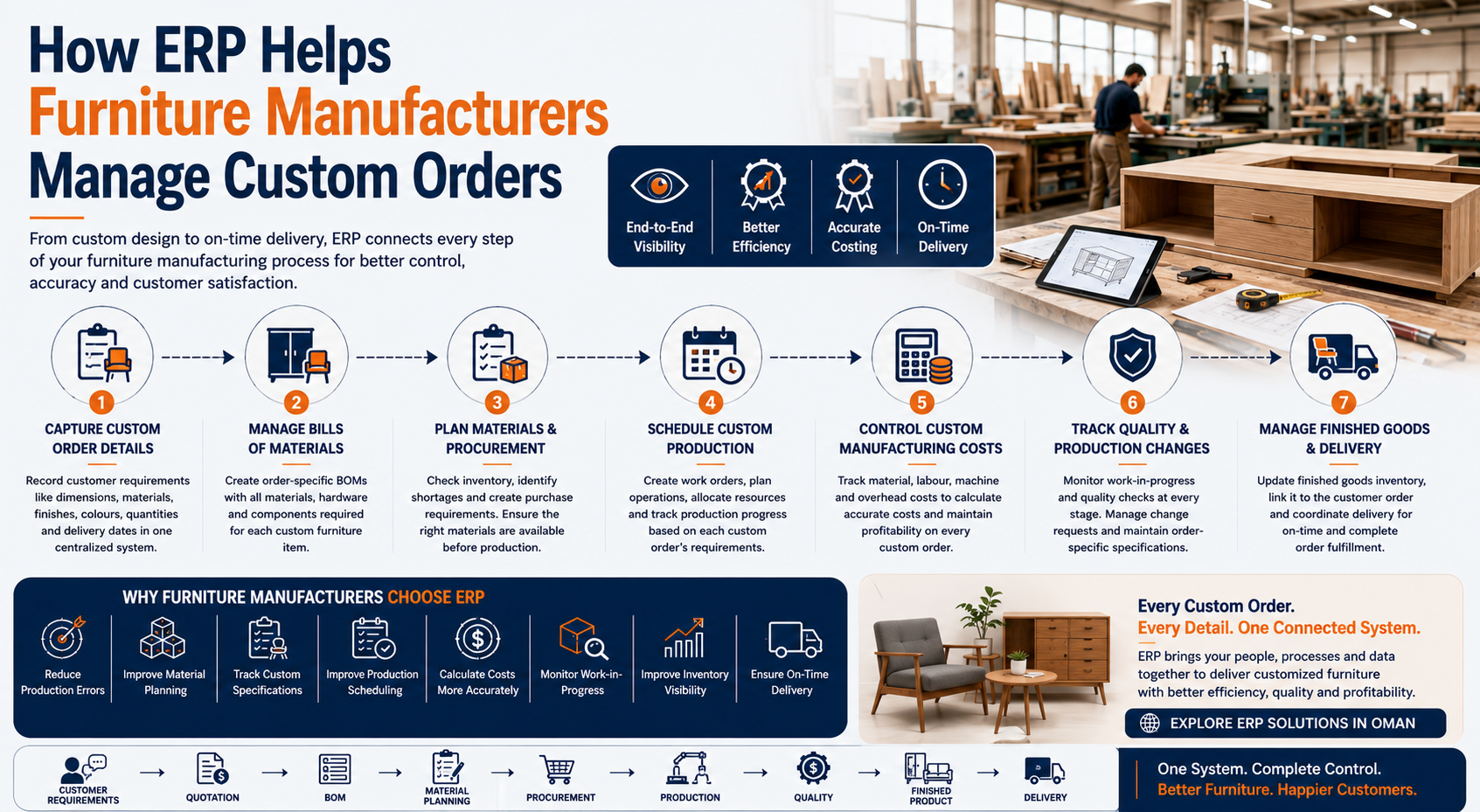
Furniture manufacturing becomes more complex when every customer order has different dimensions, materials, finishes, colours, or specifications. Managing these custom requirements through spreadsheets and disconnected systems can lead to production errors, material shortages, cost overruns, and delivery delays.
An ERP system helps furniture manufacturers connect the entire custom-order workflow in one place.
ERP allows sales teams to record customer-specific requirements such as dimensions, materials, finishes, colours, quantities, and delivery dates. This creates a centralized record that production and other departments can work from.
Every custom furniture item may require a different combination of wood, hardware, fabric, glass, foam, paint, or other components. ERP can manage product-specific Bills of Materials (BOMs), helping production teams understand exactly what is required.
Once an order is confirmed, ERP can connect the required materials with inventory and purchasing. Teams can identify shortages, create purchase requirements, and ensure materials are available before production begins.
Custom orders often need different production steps and timelines. ERP can help create work orders, plan operations, allocate resources, and track production progress from one system.
Custom products can be difficult to price accurately. ERP can bring together material, labour, machine, subcontracting, and overhead costs to provide better visibility into the actual cost of each order.
Custom furniture may go through multiple stages, such as cutting, assembly, finishing, upholstery, and inspection. ERP can track work-in-progress and quality checks while maintaining information about the specific customer order.
Once the furniture is completed, ERP can update inventory and connect the finished product with its customer order. Sales and delivery teams can track order status and coordinate dispatch more efficiently.
A connected ERP workflow can look like:
Customer Requirements → Quotation → BOM → Material Planning → Procurement → Production → Quality → Finished Product → Delivery
This gives furniture manufacturers greater visibility across each custom order while reducing manual data entry and communication gaps.
An integrated ERP can help manufacturers:
For furniture manufacturers in Oman, an ERP system can provide a centralized platform for managing customized production while helping businesses improve efficiency and scale their operations.
Explore ERP Solutions in Oman.


