 English
 Arabic
 French
 Spanish
 Portuguese
 Deutsch
 Turkish
 Dutch
Dutch
 Italiano
 Russian
 Romaian
 Portuguese (Brazil)
 Greek
Greek
The Smart Investor’s New Strategy: Guaranteed ROI Investment and Why It Is Becoming A Trend
Networking |
2025-11-17 10:21:16
 Social Networth OS
 Creator Commerce
 Launch Startup
 Global News
 Creator Award
 Talkfever App
Mostra tutti i risultati
Talkfever App
Mostra tutti i risultati

Passa a Pro
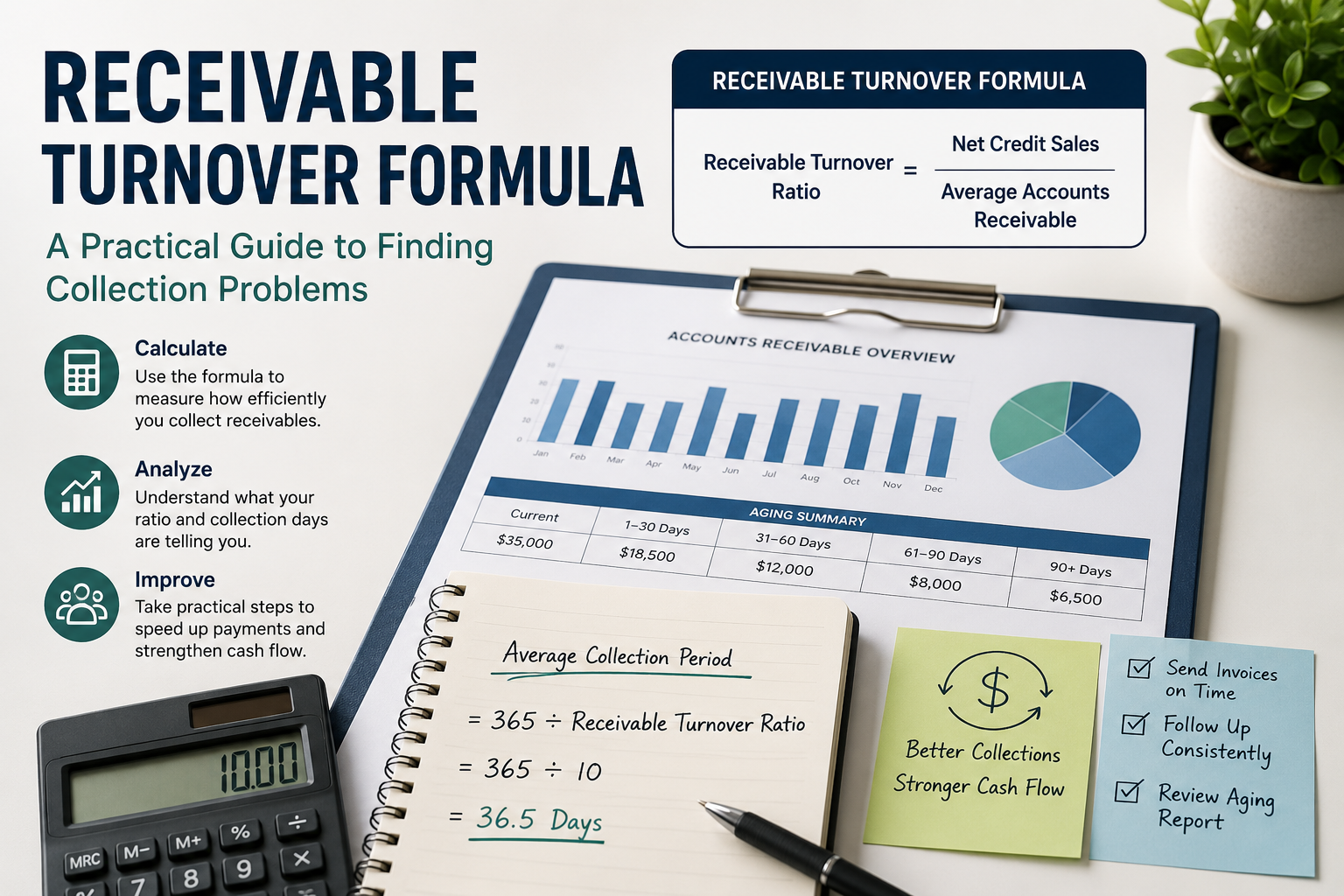
When a business sells products or services on credit, making the sale is only the beginning. The company still needs to collect the money. If customers regularly pay late, accounts receivable can grow while the business struggles to maintain enough cash for payroll, suppliers, rent, and other operating expenses.
The receivable turnover formula helps business owners evaluate how efficiently credit sales are being converted into cash collections. Instead of looking only at revenue, this financial ratio provides another perspective by showing how frequently a business turns its average accounts receivable into sales during a specific period.
Understanding this ratio can help identify slow-paying customers, weak collection procedures, or credit policies that may be putting unnecessary pressure on working capital.
The receivable turnover ratio, also known as the accounts receivable turnover ratio, measures the relationship between a company's net credit sales and its average accounts receivable.
In simple terms, it answers this question:
How many times did the business generate sales equivalent to its average receivables during the measurement period?
A higher ratio generally indicates that receivables are being collected efficiently. A lower ratio may indicate that customers are taking longer to pay or that the company needs to improve its credit and collection procedures.
The ratio is most useful when it is compared with the company's historical performance, payment terms, and industry benchmarks.
The basic formula is:
Receivable Turnover Ratio = Net Credit Sales ÷ Average Accounts Receivable
To calculate average accounts receivable, use:
Average Accounts Receivable = (Beginning Accounts Receivable + Ending Accounts Receivable) ÷ 2
For example, assume a business records $900,000 in net credit sales during the year. Its accounts receivable balance is $100,000 at the beginning of the year and $80,000 at the end.
First calculate the average receivables:
($100,000 + $80,000) ÷ 2 = $90,000
Then calculate turnover:
$900,000 ÷ $90,000 = 10
The receivable turnover ratio is 10 times.
This means the company's annual net credit sales were equivalent to approximately ten times its average accounts receivable balance.
Using net credit sales is important because the ratio is intended to evaluate credit sales and collection activity.
If a company has both cash and credit sales, simply using total revenue can distort the calculation. Cash sales do not create accounts receivable, so including them may make the ratio appear stronger than the company's actual credit collection performance.
Net credit sales may also account for sales returns and allowances, depending on the company's accounting records and calculation method.
If a business does not separately track credit sales, management should review its accounting system and reporting process to determine the most appropriate figure.
A receivable turnover ratio should not be labeled "good" or "bad" based on one universal number.
Consider a business with a ratio of 10. That might be excellent for one industry but ordinary for another. A company that normally collects customer balances within 30 days will have different expectations from a company that commonly operates with 60-day or 90-day payment terms.
The most useful approach is to compare the current ratio with previous periods.
For example:
This decline may suggest that customers are taking longer to pay.
On the other hand:
This improvement could indicate stronger collections, better credit controls, or changes in customer payment behavior.
The numbers should always be investigated in the context of the company's operations.
Many business owners find collection days easier to understand than a turnover ratio.
The average collection period can be estimated with:
Average Collection Period = 365 ÷ Receivable Turnover Ratio
Using a turnover ratio of 10:
365 ÷ 10 = 36.5 days
The company collects its average receivables in approximately 37 days.
This calculation becomes particularly useful when compared with the company's payment terms. If customers are expected to pay within 30 days but the average collection period is 37 days, management may want to investigate the difference.
A falling accounts receivable turnover ratio can be an early warning sign.
Possible causes include customers paying later, weaker credit screening, billing errors, ineffective collection follow-ups, or changes in payment terms.
For example, a business might increase sales by allowing customers more time to pay. While revenue rises, accounts receivable may increase even faster. This can create a cash flow problem despite apparently strong sales performance.
A declining ratio does not automatically mean the business is in financial trouble. However, it should encourage management to investigate why collection efficiency has changed.
Businesses often experience slow collections because of operational issues rather than customer unwillingness to pay.
Common problems include:
Fixing these process problems can sometimes improve collections without changing customer relationships or offering discounts.
Start by creating clear payment terms. Customers should know when invoices are due, how payments can be made, and what happens when an account becomes overdue.
Next, invoice customers promptly. Delayed billing automatically delays collection.
Businesses should also review their accounts receivable aging report regularly. Separate current balances from overdue invoices so that collection efforts can be prioritized.
Automated reminders can help businesses follow up consistently. A customer who receives a professional reminder shortly before or after the due date may pay faster than one who receives no communication.
It is also useful to investigate recurring late payments. If particular customers consistently pay beyond agreed terms, management may need to review credit limits or revise future payment arrangements.
Receivable turnover is closely connected to working capital management.
When customers pay promptly, the company can use collected cash to cover operating expenses, purchase inventory, repay obligations, or invest in growth. When receivables remain outstanding, cash can become tied up in unpaid invoices.
This is why profitable businesses can sometimes experience cash shortages. Accounting revenue may be recognized even though the related cash has not yet been collected.
Monitoring turnover alongside cash flow statements, accounts receivable aging, and average collection days provides a more complete view of the company's financial position.
The ratio can be reviewed monthly, quarterly, or annually depending on the size and complexity of the business.
A monthly review is particularly useful for businesses with high transaction volumes or significant credit sales. More frequent monitoring can reveal deteriorating collection performance before overdue balances become difficult to recover.
Businesses should also review the ratio after major changes to pricing, payment terms, customer credit policies, or sales strategy.
The receivable turnover formula is a simple but valuable financial management tool. By comparing net credit sales with average accounts receivable, businesses can evaluate how efficiently they are managing customer balances.
The real value comes from using the calculation to identify problems. A declining ratio, increasing collection period, or growing overdue balance may indicate that invoicing, credit policies, or collection procedures need attention.
Rather than focusing on a single target ratio, businesses should monitor trends and compare results with their payment terms and industry conditions. Regular accounts receivable reviews can improve cash flow visibility and help management make better decisions.


